
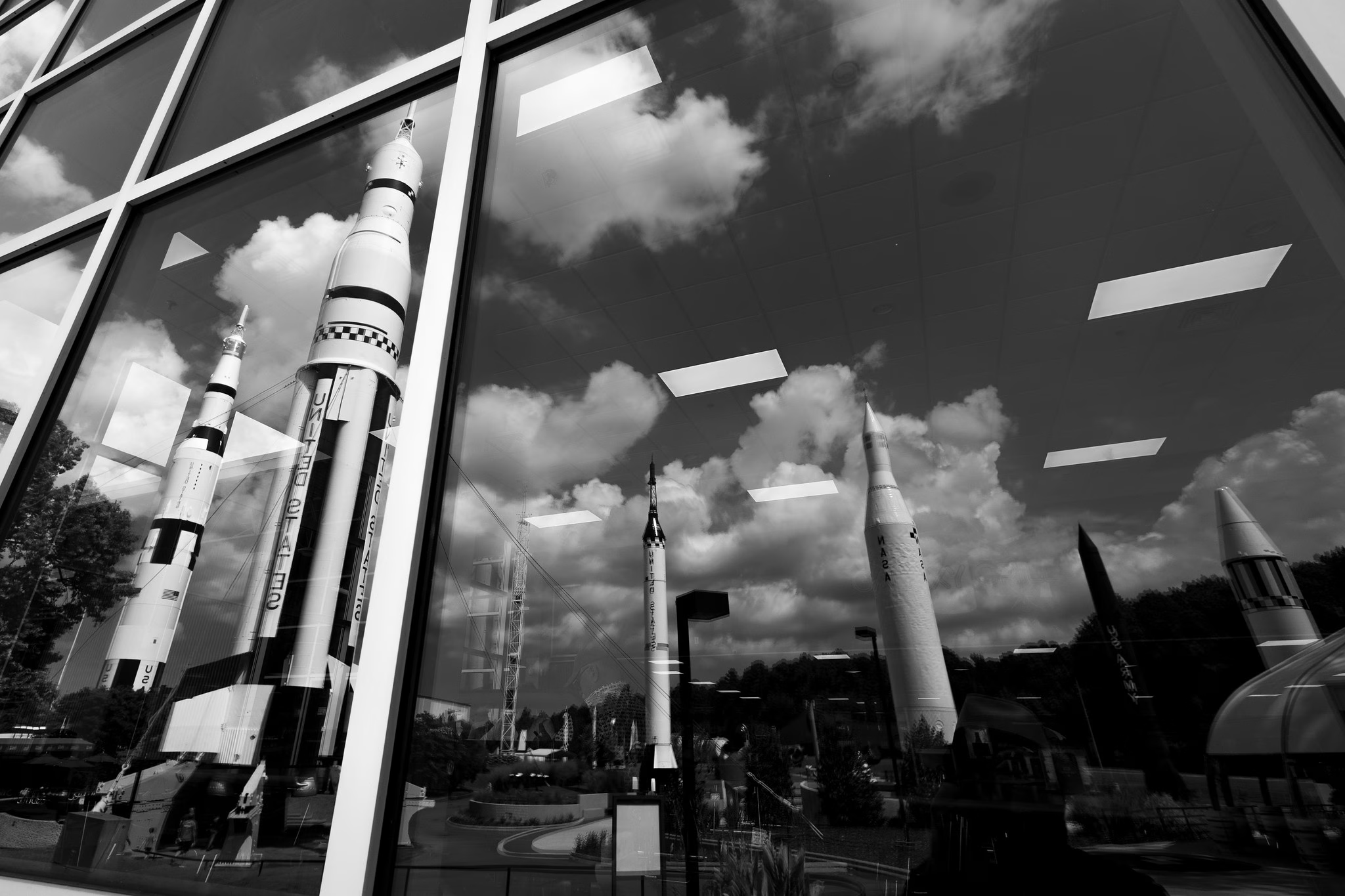

I was the kind of kid who would get up early before school in hopes of seeing a space shuttle launch live on television. My sleepy romanticism of the space program was often squashed by weather and other delays. I did a project in middle school about colonizing the moon. I was an unabashed enthusiast of manned space exploration.
And then, at some point, I grew up. Indeed, I was at the NASA Space and Rocket Center in Huntsville just over a week ago, marvelling at the size of the Saturn V on display, and chatting with a friend about the fact that while I certainly favor the scientific mission of NASA, manned space exploration seems like a poor use of resources.
And sure, my inner-middle-schooler is stirred a bit by the Artemis project, but the me-in-the-now has to wonder if the investment is at all worth it. I would much, much rather the billions going to a trip to the moon go to research grants or to using NASA for scientific, unmanned research, where the likely return on investment is higher.
And yet, we have this headline from Politico yesterday, Duffy to announce nuclear reactor on the moon.
My initial reaction was, “It often feels like we are governed by fifth graders.” I then noted that was maybe I was being too kind, giving them the acumen of 10-year-olds, as Paul Campos wondered, What if the US government were in the hands of a bunch of dull-normal eight-year-old boys?
It seems worth noting that the directive for NASA to take the US back to the moon was made by Trump in his first term. It is of a piece with his general backwards-looking understanding of America. After all, one of our most significant achievements was going to the moon. But there is also a reason we stopped going. After Apollo 11, the symbolic power of landing humans on the moon was substantially lessened with each subsequent mission. What was once “one giant leap for mankind” became a bit of a yawn. Yes, there was more to learn with each trip, but the returns were not relative to the cost and risk.
Some will counter that this is all part of a forward-looking vision for going to Mars. Again, middle school me is totally down with a mission to Mars. But adult me does not see it as worth the expense and the risk. The proverbial reason to climb a mountain is that it is there. That’s not a good enough reason to go to Mars. It is manifestly obvious that robotic probes can do more science on Mars than humans can. Robots can go farther and work longer.
I see no sustainable presence on the Moon, let alone Mars. And even if the resources could be expended to do so, what is the benefit? Sure, there is some science fiction (if not science fantasy) argument that all of this leads to long-term colonization, but even my overactive imagination has to say that such goals are wildly unrealistic.
The Politico piece makes all of this part of the “second space race.”
“It is about winning the second space race,” said a NASA senior official, granted anonymity to discuss the documents ahead of their wider release.
[…]
The first country to have a reactor could “declare a keep-out zone which would significantly inhibit the United States,” the directive states, a sign of the agency’s concern about a joint project China and Russia have launched.
[…]
The space station directive aims to replace the aging, leaky International Space Station with commercially run ones by changing how the agency awards contracts.
NASA plans to award at least two companies a contract within six months of the agency’s request for proposals. Officials hope to put a new station in space by 2030. Otherwise, only China would have a permanently crewed space station in orbit.
First, I see no reason to be worried about the Russians. Second, this is not the kind of race we saw in the ’60s. There was a real political urgency about showing which side could achieve space-based feats. There was real political power regarding who orbited the Earth first or who got to the Moon first. That is not what is going on now.
If the issue is, as it should be, one of resources, then I would rather have USAID and funding for Medicaid than a space station. And if there is a really good reason for having a space station, then let’s hear the justification beyond the kinds of reasons kids might think it is cool.
Meanwhile, via NPR: Why a NASA satellite that scientists and farmers rely on may be destroyed on purpose.
The data the two missions collect is widely used, including by scientists, oil and gas companies and farmers who need detailed information about carbon dioxide and crop health. They are the only two federal satellite missions that were designed and built specifically to monitor planet-warming greenhouse gases.
This seems kind of useful (he said, understatedly) and is relatively cheap. And yet, the administration doesn’t like reality about climate change, so adios actual data.









