
In a 5-4 ruling, the Supreme Court cleared up a 124 year-old ambiguity and ruled that the 2nd Amendment does in fact apply to state and local laws regulating gun ownership and possession:
WASHINGTON (AP) — The Supreme Court held Monday that the Constitution’s Second Amendment restrains government’s ability to significantly limit “the right to keep and bear arms,” advancing a recent trend by the John Roberts-led bench to embrace gun rights.
By a narrow, 5-4 vote, the justices signaled, however, that less severe restrictions could survive legal challenges.
Writing for the court in a case involving restrictive laws in Chicago and one of its suburbs, Justice Samuel Alito said that the Second Amendment right “applies equally to the federal government and the states.”
The court was split along familiar ideological lines, with five conservative-moderate justices in favor of gun rights and four liberals opposed. Chief Justice Roberts voted with the majority.
(…)
Monday’s decision did not explicitly strike down the Chicago area laws, ordering a federal appeals court to reconsider its ruling. But it left little doubt that they would eventually fall.
Still, Alito noted that the declaration that the Second Amendment is fully binding on states and cities “limits (but by no means eliminates) their ability to devise solutions to social problems that suit local needs and values.”
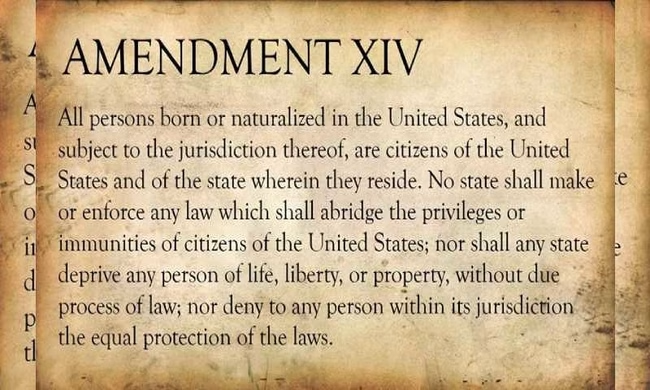
This decision essentially overturns an 1886 decision in Presser v. Illinois where the Court held that the 2nd Amendment applied only to the Federal Government. However, since this case was decided before the Court began applying other provisions of the Bill of Rights against the states through the Due Process Clause of the 14th Amendment, it was unclear how a decision that held that the 2nd Amendment was alone in not being incorporated could possibly be good law. Today, the Court affirmed that it was not and that the individual right to keep and bear arms defined in District of Columbia v. Heller applies to the states.
Beyond that, though, there’s plenty of ambiguity.
The Court did not rule today that Chicago’s gun ban was unconstitutional. Instead, it remanded the case back to the 7th Circuit Court of Appeals for a determination on that issue. Presumably, though, the Court of Appeals will now be bound to apply the Heller standards to the Chicago law, meaning that it’s highly unlikely that the law can withstand Constitutional scrutiny.
The one thing Heller made clear, though, is that there is very little agreement on the Court about what constitutes a violation of the 2nd Amendment beyond the outright bans reflected in the D.C. and Chicago laws. It will be left to other cases and others courts to decide what Heller and McDonald mean for less restrictive gun control laws, or registration schemes that exist mostly to make it difficult to own firearms. As I noted more than two years ago while wrapping up the oral argument in Heller, this is just the beginning of a whole new round of Constitutional jurisprudence.
The entire opinion, all 214 pages of it, is embedded below: