
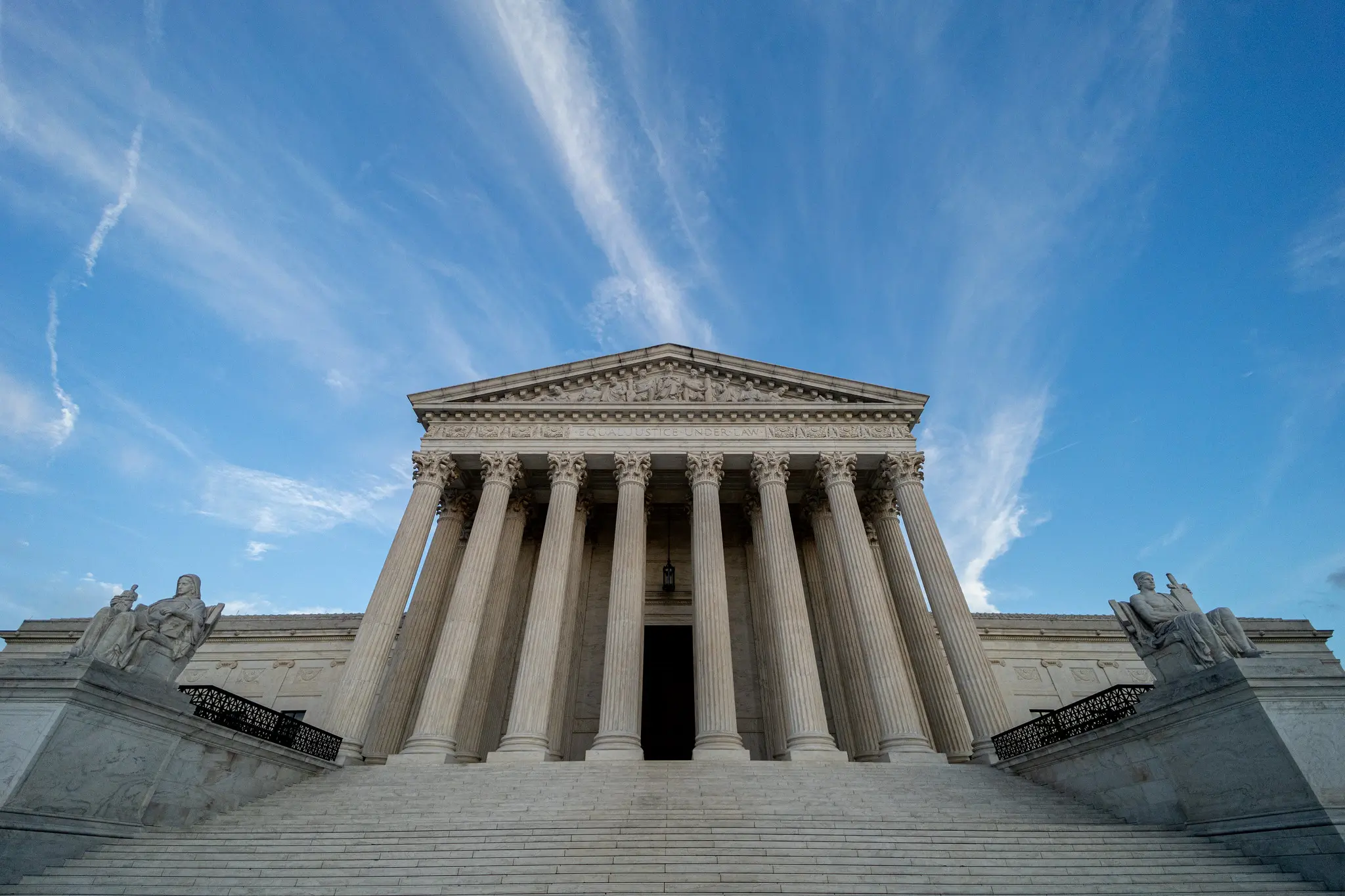

NPR’s Nina Totenberg reports, “A once-fringe theory on birthright citizenship comes to the Supreme Court.”
The Supreme Court hears historic arguments on Thursday, as the Trump administration seeks to challenge the constitutional provision that guarantees automatic citizenship to all babies born in the United States. And yet, the arguments are likely to focus primarily on a different question entirely, a legal question on nationwide injunctions that could make it much more difficult and time-consuming to bring challenges to all of Trump’s legal policies, not just this one.
[…]
Immigrant rights groups and 22 states promptly challenged the Trump order in court. Since then, three federal judges, conservative and liberal, have ruled that the Trump executive order is, as one put it, “blatantly unconstitutional.” And three separate appeals courts have refused to unblock those orders while appeals are ongoing. Meanwhile, Trump’s legal claim has few supporters. At a program put on by the conservative Federalist society, writer Robert Verbruggen, a senior fellow at the conservative Manhattan Institute, referred to birthright citizenship as “a nutty policy we’re probably stuck with.” As he observed, the only way to undo the Fourteenth Amendment’s birthright citizenship provision would be by enacting a constitutional amendment, a process that requires the House and Senate to approve by a two-thirds vote, and three-fourths of the states to do likewise — something that is unlikely in the current political climate.
Nonetheless, the Trump administration took its case to the Supreme Court on an emergency basis. But instead of asking the court to rule on the legality of Trump’s executive order, the administration focused its argument on the power of federal district court judges to do what they did here — rule against the administration on a nationwide basis.
The odd result is that on Thursday the Supreme Court may hear some arguments about birthright citizenship, but most of the debate is likely to focus on what are called “universal” or “nationwide injunctions,” like the ones in this case, that have barred the administration from enforcing its birthright policy anywhere in the country while the case proceeds through the appellate process in numerous jurisdictions.
[…]
The Trump administration is not the first to complain about nationwide injunctions, observes University of Notre Dame law professor Samuel Bray. Over the last decade, both Democratic and Republican presidents have seen their policies stymied by these injunctions, which is why Bray calls these injunctions “a bipartisan scourge.”
And yet Bray admits that there is little wiggle room in terms of a principle that would weed out unjustified nationwide injunctions, and leave in place the ones that are needed to preserve the status quo and prevent ongoing harm from continuing. “I don’t find a lot of middle-ground options here,” he concedes.
Still, he thinks nationwide injunctions, powered by overt judge shopping—in which partisans often bring cases before judges they think will agree with them—do more harm than good. And he contends that because Trump is so “flagrantly wrong” about birthright citizenship, the court could acknowledge that but use Thursday’s case to get rid of nationwide injunctions altogether.
Georgetown University law professor Stephen Vladeck vehemently disagrees.
“To me that sort of gives up the game about what’s really at stake here because you’re saying, ‘Yes, we all know that this is unlawful and we’re [still] going to let the government put it into effect anyway,’” he says.
Indeed, he adds, the birthright citizenship case is a prime example of why nationwide injunctions are sometimes needed.
The question the court needs to think about, he says, “is whether it wants the federal courts to be able to block these policies on a nationwide basis or whether its going to require these cases to go plaintiff by plaintiff and district by district when you have an administration that will see that as a green light to try to manipulate the circumstances of other cases.”
And that, he maintains will end up deluging the court with more, not fewer, emergency cases.
Professor Bray, however, thinks this case was filed at just the right time psychologically.
“You just have to imagine the justices are looking at the potential for the emergency docket consuming the entire summer when they’re supposed to be away,” he says.
The summer break is good for the justices, he observes. They get time to recharge, let tempers cool, and come back from vacation refreshed for a new term in the fall. But in laymen’s terms, given the huge number of emergency appeals about Trump administration policies, this could really screw up justices’ summer.
Fixing the problem is not so easy, though, explains William Powell, one of the lawyers representing the Asylum Seeker Advocacy Project, a group suing to block Trump’s birthright order.
“Citizenship under the Fourteenth Amendment needs to apply in a way that is uniform across the country,” he says. “We cannot have a situation in which a baby born in Massachusetts is a birthright citizen but a baby born in Tennessee isn’t.”
The 22 states that are also challenging Trump’s birthright order contend that a Supreme Court decision barring nationwide injunctions would cause chaos until each case is ultimately resolved, perhaps with a second trip to the Supreme Court. The states are particularly worried about how to ascertain citizenship when a new resident comes from another state, according to Noah Purcell, solicitor general for the state of Washington. How would the new state resident prove citizenship in order to vote or qualify for a state benefit, he asks.
“Under their theory, a child born in Philadelphia would not become a citizen, but of course, that child could easily move across the border to New Jersey or another state,” he says, adding, “And that would just be a logistical nightmare.”
This morning’s episode of The Daily, “Birthright Citizenship Reaches the Supreme Court,” is a fascinating discussion between host Michael Barbaro and NYT legal reporter Adam Liptak. Unfortunately, the transcription won’t be available until tomorrow morning.
At essence, it appears that a majority of the Justices
- agree that having district court judges issue nationwide injunctions is problematic
- see this particular case as an example where it is nonetheless the least bad option
- are frustrated that the Trump administration is using clever legal maneuvering to get a ruling on that issue while sidestepping the direct issue of birthright citizenship
I share all of those views.
It’s been nearly four decades since I studied Constitutional Law in school, but my understanding was that decisions from the numbered Courts of Appeal applied only within that circuit. (The DC Circuit may be an exception.) Given that those judges come to the bench with more elite credentials and higher levels of scrutiny at both the nomination and confirmation stages than those appointed to the district courts, it simply stands to reason that trial court decisions ought only apply to the parties involved.
Additionally, as we have become more sorted on a partisan basis, the ability to venue shop has increased exponentially. It has become commonplace for parties to file in courts where the outcome is nearly foreordained. Indeed, there are jurisdictions where a single, highly ideological judge is guaranteed to hear the case. It’s simply absurd for these individuals to be able to overturn laws passed by Congress or even executive orders issued by Presidents for months and even years as cases wind their way through the appellate process.
At the same time, as this particular case illustrates, there are absolutely situations where there is great harm in requiring every single individual whose Constitutional rights may be infringed to litigate the merits separately. In this particular case, the administration seems perfectly happy to concede losses in individual cases while avoiding having the Supreme Court issue a ruling that would, presumably, have nationwide effect.
There’s no way that I can see under our current system to square that circle. But there are certainly fixes that could be implemented.
The most de minimis solution I can see would be to empower the Courts of Appeal to hear cases where district court judges ruled that a law or executive order was unconstitutional, regardless of whether the losing party appealed. (Here, for example, the administration has lost every time the matter has been litigated but has strategically declined to appeal the core matter, given that they would almost certainly lose at the higher levels as well.) That could work through either a push or a pull. That is, either the higher court (whether in the person of the Chief Judge or a majority of some smaller body) could flag that case and bring it up or the district judge could send it up and ask for a district-wide application. That wouldn’t fully solve the problem, but it would expedite it going to the Supreme Court.
Alternatively, we could fast-track these cases to the Supreme Court for emergency review. That would take it quickly to the level where a nationwide ruling, whether on a temporary basis through an emergency order or on a permanent basis through an actual hearing. The problem with this approach, of course, is one of bandwidth. The Supremes probably lack the time to hear all such cases.
My preferred solution, offhand, would be to create a special Constitutional Court that only heard cases where plaintiffs were seeking a ruling beyond the parties directly involved in the case that implicated the constitutionality of a law or executive order. I haven’t thought through the logistics of this but, presumably, we would at least have one for every circuit to allow some geographic convenience for litigants. There would also have to be some sort of one-time compromise at the creation to avoid a single party from appointing the entire slate of judges, creating an imbalance that would last decades. Regardless, having judges that were specially selected and vetted for this type of authority given this authority rather than random district judges, who may well not be qualified for the task, would make the process much more legitimate. And I’d have all of these cases appealed to the DC Circuit rather than the regional circuits.









