
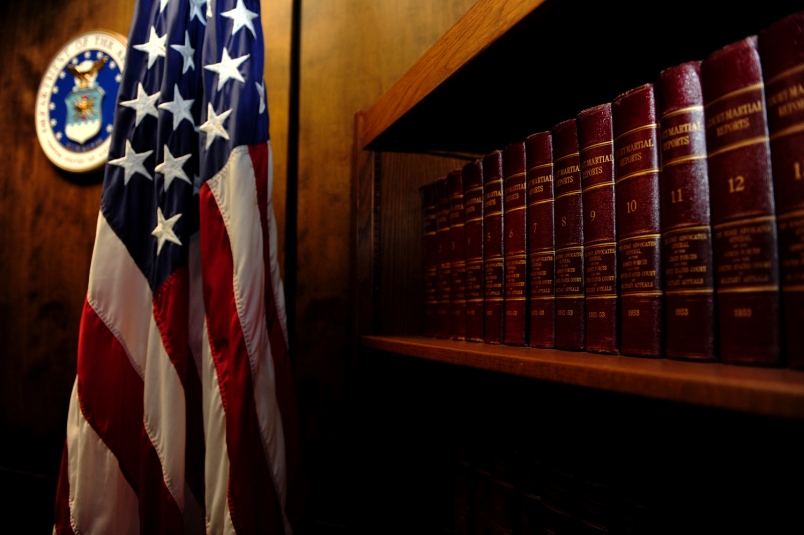

As the issue of sexual assault by military servicemen gained attention some years back, calls came to take the authority to prosecute away from commanders. I’ve opposed this policy change, arguing that the issue was one of good order and discipline within the ranks and that commanders who failed to do their job in protecting their female troops should be relieved. While my faith in the ability of commanders has not wavered, the secondary issue of “unlawful command influence” and over a year of conversations with now-retired Marine JAG James Weirick changed my mind.
We collaborated on a piece for War on The Rocks, which published it this morning as ”Sexual Assault in the Military and the Unlawful Command Influence Catch-22.” It’s well over 2000 words but the crux of it is this:
In order to address the burgeoning issue of sexual assault in the ranks and combat the perception that dealing with it was not a priority, President Obama, service secretaries, service chiefs, and commanders down to the lowest levels mounted an aggressive campaign to highlight the severity of the issue to service members. Thousands of speeches were given and extensive training was instituted. This very campaign was found to constitute “unlawful command influence” under Article 37(a) of the Uniform Code of Military Justice, which provides that “No authority convening a general, special, or summary court-martial, nor any other commanding officer, may censure, reprimand, or admonish the court or any member, military judge, or counsel thereof, with respect to the findings or sentence adjudged by the court, or with respect to any other exercises of its or his functions in the conduct of the proceedings” and that “No person subject to this chapter may attempt to coerce or, by any unauthorized means, influence the action of a court-martial or any other military tribunal or any member thereof, in reaching the findings or sentence in any case, or the action of any convening, approving, or reviewing authority with respect to his judicial acts.”
[…]
Military justice is simply different. Because military jurors are under obligation to follow the orders of those above them — and in particular the president, secretary of defense, and senior generals — the command climate and references to the wishes of senior leaders are much more difficult for military jurors to discount. Civilian jurors are simply not subject to that same pressure. Which, in turn, means military defendants need more protection than their civilian counterparts.
[…]
While it’s true that some commanders have failed to vigorously do their jobs in prosecuting sexual assault as a serious crime, that’s fixable. The real problem is that commanders have two jobs here — sending the message that sexual assault will not be tolerated and prosecuting those who break the law — that are in conflict. Because the first of those jobs is essential to the commander’s role while the second can be done by objective outside professionals, the two must be split.
The unlawful command influence restriction unnecessarily hampers senior leadership from trying to solve serious issues like the sexual-assault problem. While [then-Marine Commandant James] Amos was particularly ham-fisted in his messaging, his heart was in the right place by placing great emphasis on an issue that was impacting the welfare of the female Marines in his charge and the cohesion of his Corps.
And, of course, no one is going to stop the president of the United States or service secretaries from grandstanding when a military issue comes into the spotlight and puts pressure on them to weigh in. Commander-in-chief is only one of many hats the president wears and declining to speak out in the face of public perception that sexual assault is rampant in our armed forces would be unthinkable.
[…]
It is time to remove felony crimes from military jurisdiction. Military leaders have an obligation to address issues such as sexual assault and do all that they can to eradicate this scourge from our ranks. But as recent history had clearly demonstrated, these laudable efforts continue to result in criminal trials that courts find unfair and are forced to dismiss. The solution is to remove these cases from military jurisdiction, thus enabling commanders to continue to communicate openly with their units without impacting the fairness of criminal trials.
Much more at the link.









