


As noted in a recent post by James Joyner, President-elect Trump is talking about doing away with birthright citizenship. This is a topic I have written about before (see, On Birthright Citizenship from 2018). I would note in that previous post I wrote about Michael Anton. Anton served in the first Trump administration and has been named to be the deputy National Security Advisor in the incoming administration.
My basic views have not changed.
First, I think that the practice is firmly established in US history and its legal order.
Second, I think it is a largely unvarnished good. Even if one can conjure odd or questionable edge cases the good far, far outweighs the bad.
The text of the 14th Amendment couldn’t be clearer:
All persons born or naturalized in the United States, and subject to the jurisdiction thereof, are citizens of the United States and of the State wherein they reside.
If we are to take a plain reading of the language seriously, what else do you need to know? The question of “subject to the jurisdiction thereof” is the only place for argument, but this refers to ambassadors/ministers of foreign governments (the same reason they have diplomatic immunity), native tribes not otherwise under the jurisdiction of the federal government, or invading armies.
The debate at the time also encompassed and understood that the amendment’s language was not limited to former slaves. See Neufeld and Schneider’s 2020 piece for the Niskanen Center, Birthright Citizenship: A Core Tenet of American Liberty for some details about the contemporaneous debate.
The current interpretation of the clause was upheld by the Supreme Court in United States v. Wong Kim Ark, 169 U.S. 649 (1898). For those keeping score at home, that was a century and a quarter ago.
Moreover, what the 14th Amendment did in correcting Dred Scott was not establish a new right, but to affirm preexisting practice. See Stock’s 2010 article in the Cato Journal, Is Birthright Citizenship Good for America? In that piece, she notes that the common law practice of jus soli (law of the soil rather than of blood) dates to the founding. And, moreover notes a NY state case, Lynch v. Clarke (1844), which underscored this fact.
In other words, it was Dred Scott that was the deviation and the 14th Amendment was not the introduction of something new and novel into American jurisprudence.
If, somehow, the Trump administration can get the Supreme Court to reinterpret the 14th Amendment’s citizenship clause, then precedence will have lost all meaning, and plain text readings of the document and/or originalism will be shown to be empty husks as concepts.
I think that birthright citizenship is a policy good because it provides the surest pathway for the long-term integration of migrant communities. This is especially important in a country like the United States where almost everyone’s ancestors are from somewhere else. It may create some odd cases like the possibility that a person could start labor on one side of the border, but give birth upon crossing, thus conferring citizenship to the newborn. But so what?
If one of the alleged concerns about immigrants is that they don’t properly assimilate, taking away birthright citizenship makes that problem substantially worse, not better. I would argue, too, that citizenship based on blood leads to ethnonationalism, which never ends well. Moreover, the best way to assure allegiance to the US is for a person to be an American.
There is a lot to be said for a simple, clean way to prove you are a citizen: your birth certificate. No need to prove parental lineage or anything else.
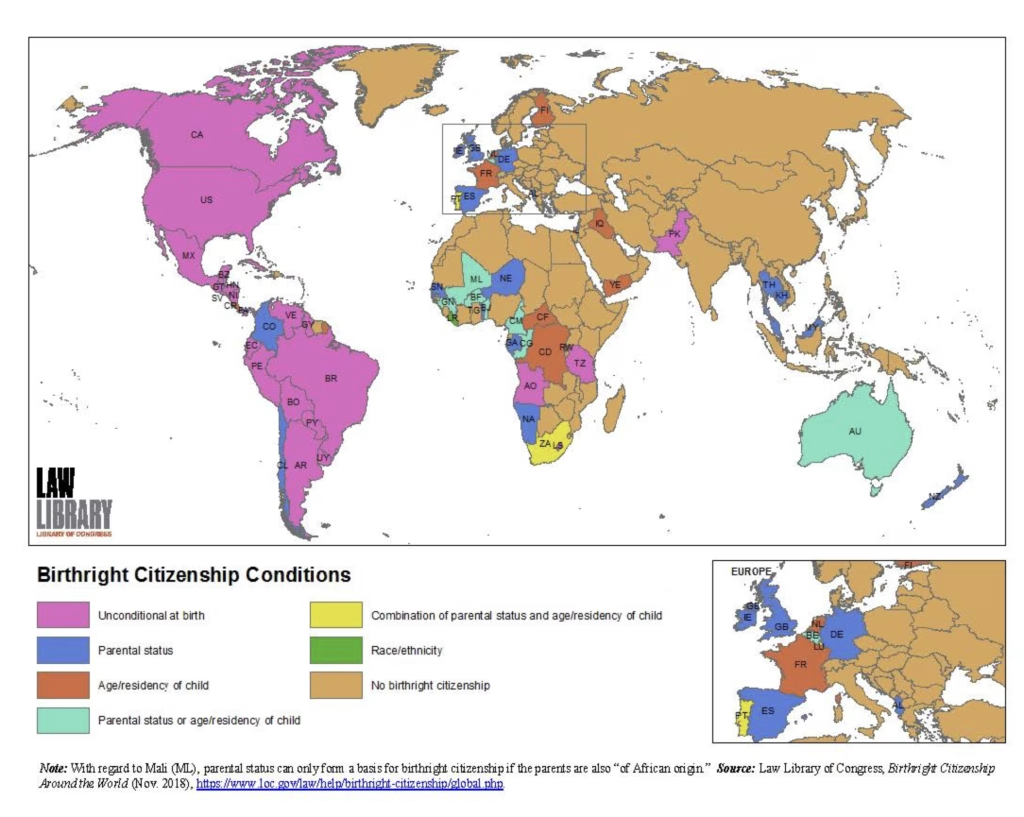
Also, note that contrary to Trump’s assertions, the US is not alone in this arena (via the LOC):
Postscript.
I have to admit, it is kind of exhausting to be writing about this yet again. While I suppose there are some nuanced arguments one could have about this subject (i.e., what the exact best way to navigate and regulate citizenship), the reality is that most people who want to revoke birthright citizenship are likely just some version of a white nationalist who thinks that “American” mostly means “Anglo.”










