
The Economics President, Continued
Nothing like a war of choice to send indicators in the wrong direction.

Three headlines on the NYT home page at the moment.
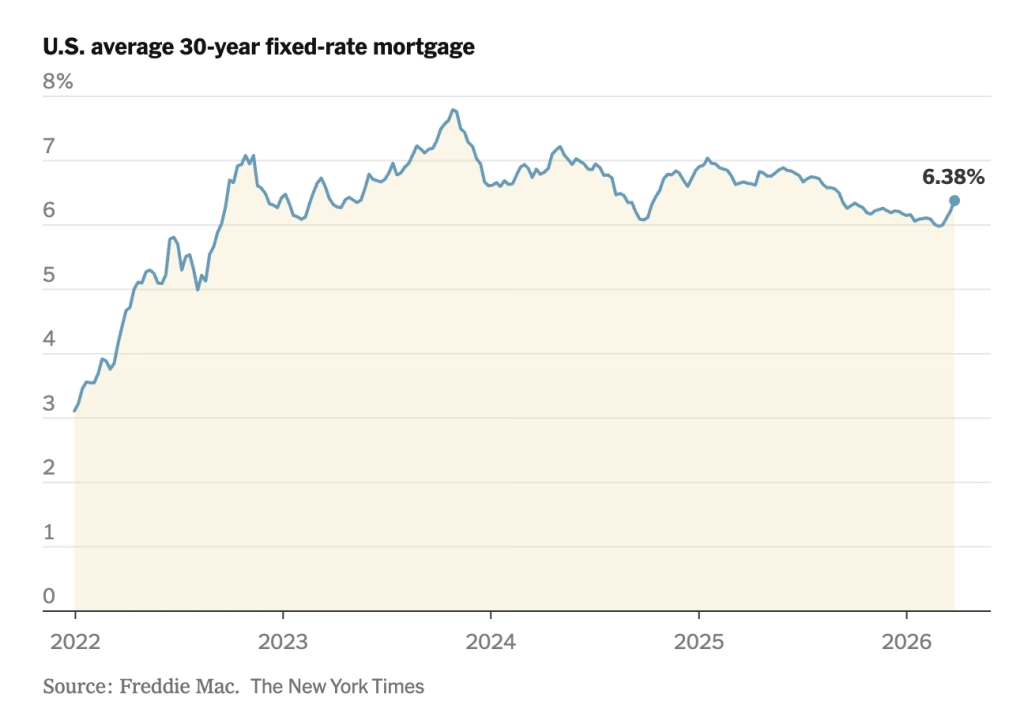
1) Mortgage Rates Jump Again as Iran War Effects Ripple Through Housing Market.
The average rate on a 30-year mortgage in the United States hit 6.38 percent, the fourth increase since the war began.
2. The war will push U.S. inflation above 4 percent this year, according to a new forecast..
The war in Iran will lead to a surge in inflation this year, as the closure of the Strait of Hormuz pushes up prices for oil, gas and other commodities, the Organization for Economic Cooperation and Development said on Thursday.
The inflation rate in the United States will average 4.2 percent this year, more than one percentage point higher than the group’s previous forecast, made late last year, the Paris-based organization said. Across the Group of 20 nations, inflation is forecast to average 4 percent this year, 1.2 percentage points higher than previously expected.
3. Oil Prices Go Higher and Global Stocks Fall.
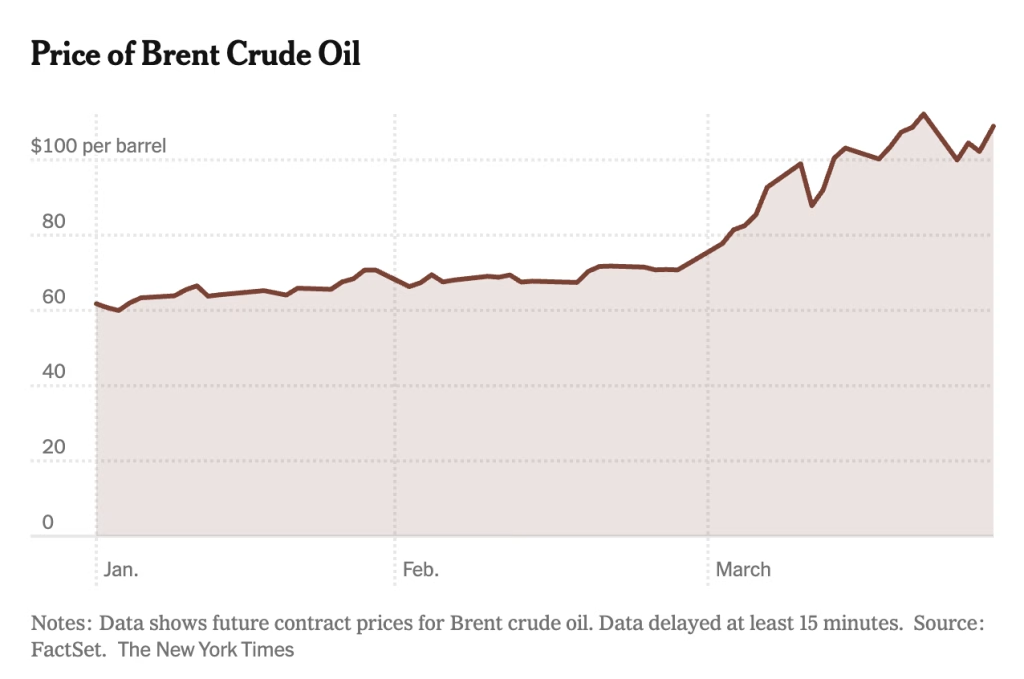
- U.S. gas prices ticked down less than a penny on Thursday to remain around a national average of $3.98 a gallon, according to the AAA motor club. It was the first day the price did not increase since the war began, leaving the cost for drivers up 34 percent in that period.
- Diesel prices have increased even more quickly, rising to $5.38, up 43 percent since the start of the war.
All of this is because Trump launched a war of choice without any notion of what strategic success would look like.
Inflation? Fake news.
Seriously…the only thing Fatso could brag about was the stock market…which really has NOTHING to do with the economy!!
How can there be inflation if the war is won and it’s not even a war but an excursion and it’s all NATO’s fault for not helping and Iran has given us a great gift and SQUIRREL!!1
Real world. Gas at the corner was $3.09 on Feb 2, 2025. I have photos.
It was $3.85 this past Tuesday. I have photos.
That’s about $13.00 per tank for my Outback. Who knows for one of these bigass trucks?
And while most presidents don’t affect gas prices, this is DIRECTLY ATTRIBUTABLE to Fatso.
@Daryl:
I’m certainly not an economist, but it’s always seemed to me that if we continue to shift money into the upper income brackets and manage to avoid a Depression, the stock market will always go up.
And this is just the start.
In the following one to four weeks the last ships to leave the Gulf before February 28 will arrive at their destinations and offload.
Then the real fun begins.
Unless the war has ended, or at minimum the US has secured the Straits of Hormuz.
In addition to global crude and LNG prices going north fast, gasoline aka petrol and diesel will also.
And the other things the Gulf now produces: unlike the 1980’s its no longer just a hydrocarbons exporter.
Nitrate fertilisers, ammonia, urea, sulphur, etylene, aluminium, helium.
The consequences being a massive hit to GCC states economies.
In turn to dollar revenues that get recycled, and thus US Treasury bond demand (though probably offset for a time by “safe haven” effect).
Global inflation to the point of growing “demand destruction” and in due course recession.
@Daryl:
@reid:
This will likely,at least short term, benefit from global money looking for a safe haven, and a bit dubious about US Treasury bonds.
Once energy cost increases start to hit US demand, and the impact of global demand destruction begins to afflict US exports and US overseas financial trading and investments, there is a serious threat of a major “market correction”.
The US may be a little shielded by increased activity in hydrocarbons production and export, and possibly food exports as fetliser shortages hit other countries.
But this will also be linked to US domestic price rises.
With a possible side effect of MAGA demands for US economic autarky, despite that likely being a medium term disaster for the US.
@JohnSF:
Not disagreeing at all but you forgot about the AI bubbble.
Idle question:
Knowing that closure of Hormuz had like a 101.2% probability of happening if Iran were attacked, wouldn’t professional war planners have developed means to deal, or to at least attempt to deal, with such an eventuality?
I admit I can’t see what that would be. In my own not even amateur way, the one thing that comes to mind is seizing Kharg Island right at the start. Of course, this wouldn’t prevent Iran from closing the strait, but their own oil would be cut off as well. I assume they’d still keep traffic from moving out of the Gulf, but then they’d have had to contend with a massive loss of revenue.
Past that, I’ve no clue how the calculus plays out. Whether Iran rides it out for weeks, or months, or caves within a couple of days.
Plainly a war of choice against Iran was always a bad idea. But a necessary war might take place just the same, like one did against Iraq in 1990-91.
BTW, back in 2006 or so, I recall musings that the US had troops and lots of gear and bases on both sides of Iran’s border (Afghanistan and Iraq), and that therefore America should widen the war and take out the Mad Mullah Regime. This was seen as easy to accomplish as taking down Saddam was. The justification was that Iran was working on a nuke.
20 years later, they still don’t have any.
@Daryl:
I’m unsure about how badly an energy price spike will hit that.
Given a lot of (over optimistic) forecasts about AI date centres building out their own energy supply. And how it will interact with the “money haven” effect.
Also the possible effects on NVIDIA and other major input supply chains: ie hit to Taiwan of LNG price increases, helium shortages, price increases of refined silicon, etc etc.
If the bubble does pop in the next few months, things will get really spicy.
@Kathy:
The problem being there is no easy way to deal with Iran shutting Hormuz, unless Iran can be forced to capitulate by other means. (Whatever they might be imagined to be.)
The only alternative seems to be a major land operation along much of the northern shore of the Persian Gulf. Which looks like a nightmare of having to secure in depth into the mountains further inland.
Kharg is rather pointless: if the US wants to interdict Iranian oil, it can do so just by grabbing the ships in the Arabian Sea, or at the straits, if it controls the straits.
The straits are the key, and that means land war on the scale of Iraq 1991 or 2003.
The alternative of supressing drones and such by air strikes alone looks very iffy indeed.
I have little doubt CENTCOM pointed this out, but simply got overruled.
IMHO, as I’ve said before, I suspect Iran’s plan was never a nuke, but to use “near-nuke and hold” as a negotiating lever and cover: indirect deterrence, as it were.
For the simple reason that if Iran ever did get to the point of weapons grade and metallization, the probability of an Israeli nuclear pre-emptive strike goes to unity.
Forecasting what happens next is almost impossible.
Iran collpses? Iran folds? Trump folds? US escalates?
Because the clock is ticking to GCC economic collapse, which means either securing the straits, or somehow (?) replacing the Iranian regime, or some sort of deal.
And the last has a range from Iran concedes through “cold peace” to US concedes.
One problem now is that Iran is also now pushing for demands almost impossible to accept: security gurantees for Iran itself, acceptance of Iranian nuclear activity, protection for Iranian proxies, compensation payments, and recognition of Iranian control over the Straits of Hormuz.
Even if the US accepted them there are now other players at the table, with vital interests engaged.
One such being the Saudi-Pakistan alliance.
Once you open the Gates of War, closing them can be difficult.
A reality Trump was far too stupid to appreciate.
@JohnSF:
As noted, I’m not even an amateur.
That said, I’m not surprised it’s a hard, bloody, costly task, best not undertaken except in a more dire emergency. pretty much the only plausible cause would be if Iran unilaterally, without provocation, had closed off Hormuz.
Irony must love this so-called administration…
Now, when Iran says it wants recognition of sovereignty over the strait, which goes counter to international law and common sense, I take it to mean they reserve the right to collect tolls and deny passage at their discretion. That alone should be reason to go to war with Iran, which of course wouldn’t be the case had the US and Israel not gone to war with Iran first.
I’m half hoping and half dreading it’s a bargaining position. Hoping because it could be “given” away in return for something else. Dreading because El Taco might grant it in exchange for a made up prize the Iranians can cook up with ChatGPT.
@Kathy: I will agree with JohnSF. The military plans for nearly everything. In this case it’s just hard to stop especially as you need all your resources at the start of the war to be doing other stuff. However, I also strongly suspect this is a lot like the Iraq war where Bush and Cheney were told by Shinseki that we would need over 300,000 troops and Bush and co decided the military was wrong and we could manage just fine with half that number.
Steve





