

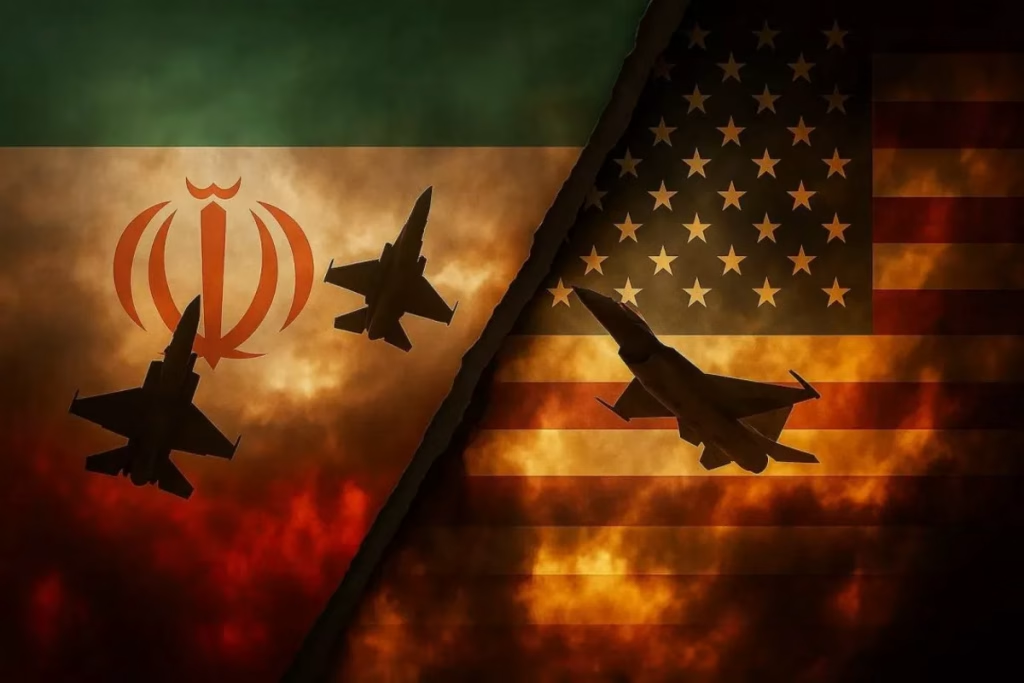
The Trump administration keeps signaling that a deal to end the three-month-old war with Iran is nearing.
POLITICO (“Rubio says US-Iran peace deal could take ‘a few more days’“):
U.S. Secretary of State Marco Rubio said Tuesday that the United States and Iran may require “a few more days” to reach an agreement to end the war between the two countries, dampening hopes for a quick resolution to the military conflict that began three months ago.
“The president’s expressed his desire to make [a deal] — he’s either going to make a good deal or no deal,” Rubio told journalists as he concluded a four-day visit to India, during which he discussed the war’s impact on global energy prices with Prime Minister Narendra Modi. “But that may take a little while, I mean, a few more days.”
AP (“What we know and don’t know about the emerging deal to end the Iran war“):
The United States and Iran appear to be closing in on a deal to end the war and open the Strait of Hormuz. U.S. President Donald Trump said Monday that negotiations are “proceeding nicely,” while reiterating his warning that fighting would resume if no deal is reached.
It is not clear when or how the deal might be finalized and when its various parts will take effect. Details come from two regional officials and a U.S. official who spoke on condition of anonymity to discuss the sensitive negotiations.
An Iranian delegation led by parliament speaker Mohammad Bagher Qalibaf traveled to Qatar on Monday as part of talks, though it wasn’t immediately clear what would be discussed. Qalibaf led historic face-to-face talks with Vice President JD Vance in Pakistan last month.
Iran’s Foreign Ministry spokesman, Esmail Baghaei, said that while understandings have been reached on “a large portion of the issues,” there was still work to be done. “To say that this means an agreement is on the verge of being signed is not something anyone can claim,” he told reporters.
The sticking points throughout (whether Israel can continue its war against Hezbollah in Lebanon, whether Iran will continue supporting its proxies throughout the region, under what conditions the Strait of Hormuz reopens, and the fate of Iran’s nuclear program) continue to be the sticking points.
Meanwhile, both sides maintain that a ceasefire remains in place despite the fact that firing has not ceased.
NYT (“U.S. Carries Out Renewed Strikes in Southern Iran“):
American military forces conducted what U.S. Central Command said were “self-defense strikes” in southern Iran on Monday “to protect our troops from threats posed by Iranian forces.”
The targets included missile launch sites and Iranian boats trying to place mines, Capt. Tim Hawkins, a Central Command spokesman, said in a statement.
“U.S. Central Command continues to defend our forces while using restraint during the ongoing cease-fire,” said Captain Hawkins, who declined to say which ships came under fire, where they were located or precisely where the other U.S. strikes took place.
A senior U.S. military official said Iranian surface-to-air missiles threatened some of the dozens of American warplanes and nearly two dozen Navy warships — including two aircraft carriers and their escort vessels — that are in or around the Gulf of Oman and Arabian Sea enforcing a blockade against vessels trying to enter or leave Iranian ports. The official added that the U.S. strikes hit near Bandar Abbas, a major port and Iranian navy base.
American and Iranian forces have had other skirmishes since a cease-fire took effect about six weeks ago. But the strikes on Monday came as Iranian negotiators arrived in Qatar for talks on ending the war, and they threatened to upend a fragile potential agreement that President Trump has said could reopen the Strait of Hormuz and relieve the greatest energy disruption in modern times.
That Iranian missile batteries were reportedly zeroing in on U.S. Navy ships came as no surprise, despite repeated assertions from Mr. Trump, Defense Secretary Pete Hegseth and other military leaders that the 38-day American-Israeli military campaign had vastly degraded or destroyed much of Iran’s combat power.
U.S. intelligence agencies have told policymakers in confidential assessments from early this month that Iran has regained access to most of its missile sites, launchers and underground facilities. While the United States has sunk most of Iran’s conventional navy, Iran’s Islamic Revolutionary Guards Corps still retains hundreds of small speedboats that can be used to lay mines in the strait.
Most alarming to some senior officials is evidence that Iran has restored operational access to 30 of the 33 missile sites it maintains along the Strait of Hormuz, which could threaten American warships and oil tankers transiting the narrow waterway.
Which underscores a point I have been making since it began: the so-called ceasefire disproportionately benefits Iran. It has given them weeks to re-arm and regroup. Conversely, the readiness of American sailors and Marines aboard ship are considerably degraded through a combination of boredom, atrophy, and rustiness.








