
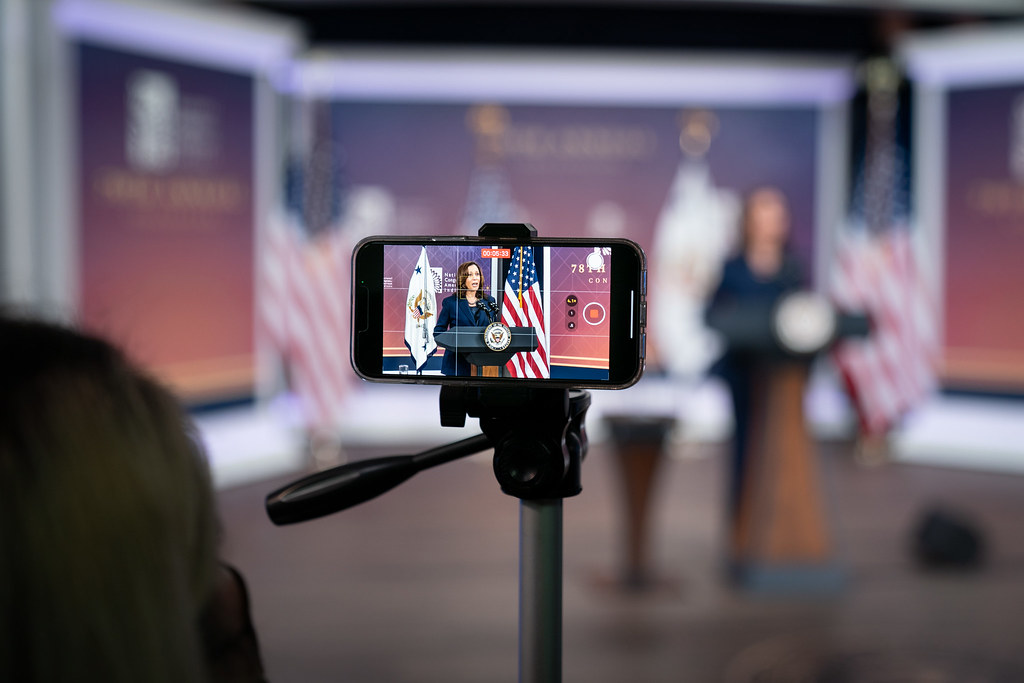

One of the ongoing attacks on Vice President Kamala Harris from former President Trump and his supporters is that she’s not a good politician. For example, yesterday OTB commenter Jack wrote: “Kamala Harris was a drag on the ticket because, well, she is an idiot with the political instincts of snail.” This idea of Harris being (a) not smart and (b) a bad politician is echoed in this run-on sentence from a recent Donald post on Truth Social (strap in for this epic run-on sentence):
I’m doing really well in the Presidential Race, leading in almost all of the REAL Polls, and this despite the Democrats unprecedentedly changing their Primary Winning Candidate, Sleepy Joe Biden, midstream, with a Candidate, Kamala Harris, who failed to get even a single Primary Vote, and was the first out of 15 Democrat Candidates to quit the race.
Setting aside the usual Trump lying and puffery (i.e. he’s not doing “really well” in any polls at the moment), there’s a particular portion of that quote that I want to zoom in on: “a Candidate, Kamala Harris, who failed to get even a single Primary Vote, and was the first out of 15 Democrat Candidates to quit the race.” Beyond implying that Harris is undeserving of her position because of her race and gender (i.e. being the DEI pick), most Right Wing attacks on Harris as a person ultimately hinge on her poor performance in the 2020 Democratic Primary.
Harris announced that she was considering running for the Democratic Nomination in December 2018. On MLK Day, 2019, she formally announced her campaign to seek the nomination. At the time, she was the sixth major Democrat to enter the race, almost two and a half months before Biden entered the race. She would remain in the race until December of that year. Here is some of the reporting from a CNN post-mortem of Harris’s campaign’s ups and downs:
Harris’ abrupt decision on Tuesday makes the senator the most high-profile candidate to date to drop out of the race to challenge President Donald Trump, and is the culmination of months of disjointed messaging, contentious infighting among top aides and severe money issues that plagued the campaign.
A host of issues sunk Harris’ campaign, but the final straw, according to a number of Harris aides and advisers, was the California senator could see no path toward the nomination given her inability to gain any traction in the race or raise money to get her message out, leading her to make what she called “one of the hardest decisions of my life” and end her presidential bid.
Harris was the lone black woman to launch a bid in 2020 and aimed to coalesce a diverse coalition of voters that mirrored that of President Barack Obama. But Harris failed to cut into former Vice President Joe Biden’s commanding lead with black voters, particularly in the early voting state of South Carolina, and struggled to break into the top tier of contenders in Iowa, despite polls showing voters viewed her favorably.
The CNN article and a more indepth one from the New York Time (free to read link) published just before she dropped out of the race dive into the campaign’s major challenges. Both call out issues with her campaign and fundraising staff and structure (including the decision to bifurcate the leadership of her campaign team). She also struggled to define her positions in a race that included Joe Biden running as a centrist (to her right) and Elizabeth Warren running as an extreme progressive (to her left). That led to her messaging was all over the place. All of that also led to a drop in fundraising that ultimately buried the campaign before any vote was cast.
However, both articles from 2019, also point out some useful context for understanding what has been happening in 2024. From the Times:
Harris’ central reason for dropping out now was to preserve her political future, multiple people close to the senator told CNN. At 55 years old, Harris did not want to assume debt – financial or political – and she believes she will be better positioned to be considered as a running mate or to run for re-election in 2022 if she accepted reality and ended her candidacy now.
So we see a Harris who understood that she was failing and made the choice to end the campaign early to preserve her political future. Personally, that doesn’t strike me as someone with the political instincts of “a snail.” Likewise, the Times article points out that there were highlights within her 2019 campaign. For example:
On a conference call with donors after the last debate in mid-November, Jim Margolis, a senior campaign adviser, pointed to her improved performance as a case study in letting “Kamala be Kamala,” according to one person who participated in the call — a reference to Ms. Harris’s strengths when she is listening to her competitors’ comments and reacting freely.
It was her abundant political skills — strong on the stump, a warm manner with voters and ferocity with the opposition that seemed to spell trouble for Mr. Trump — that convinced many Democrats of Ms. Harris’s potential.
That second paragraph, in particular, reflects much of what we are currently seeing on the campaign trail. What’s particularly striking to me is how often both articles contain phrases like “Harris realized the problem, but wasn’t sure at the time how to fix it.” This brings us to the topic of failure.
For some people, failure is seen as toxic. There’s a certain mindset where only losers fail. Not to mince words Kamala Harris failed in the 2020 Democratic primary in a pretty major fashion. Hence the criticism from Donald Trump and his followers. However, what they miss (or choose not to acknowledge) is that failure isn’t necessary the end of a bigger process.
I have a friend and martial arts mentor who shared a great phrase with me: “FAIL is just an acronym for (F)irst (A)ttempt (I)n (L)earning.” I love this phrase as it spoke to something I had been struggling to externalize. Failure is a necessary part of learning. In fact, learning often involves many failures. Over the years, I’ve expanded on the phrase, saying: “The F in F.A.I.L. can also mean (F)ifth, (F)ortieth, or (F)ive-hundreth attempt in learning.”
After failing in 2019, Harris had four years as Vice President to learn from that failure and practice her skills. We’re seeing the results of that process at the moment. The rollout of her campaign has been measured and methodical. She appears to have intentionally resisted doing press until she gets everything in place (including her VP, staff, and messaging). While she’s inherited a campaign team from President Biden, we’ve yet to hear about the same types of internal battles that plagued her 2019 from the start. All and all, it really appears that she’s learned from her failure.
This can be contrasted with the current reporting on the challenges facing the current Trump campaign, namely Trump himself. Most of the reports, see today’s Axios article and the recent one from the New York Times (free link) focus on his inability to change his behavior, beginning with publicly acknowledging the loss of the 2020 election. From Axios:
What we’re hearing: Republican sources close to Trump tell us he realizes he needs to bring new focus to a message that can be meandering and self-indulgent. But it’s Trump. So a new script is often fictional wishfulness.
- Trump “is struggling to get past his anger,” a top Republican source tells us.
- Trump’s aides know he won’t change. So they’re focusing “not on the need for him to change but on the need to adapt his message to win,” the source said. “But he has to convince himself to leave the other garbage behind.”
Trump failed to win reelection in 2020. But rather than face that failure and engage in any sort of reflection, Trump denied losing the election. And if we look at his approach to campaigning 2024, it is essentially the same as what he did in 2016 and 2020 (just with far fewer campaign rallys). Granted, that strategy worked once (in 2016) and failed once (in 2020). And it did appear to be working for most of this cycle. Trump was the presumptive Republican nominee out of the gate and acted out of that position of power (choosing not to participate in any of the Republican Primary Debates). The problem is that life can come at you fast, and now Trump (and his supporters) find themselves in a very different position. From the Times:
As Ms. Harris — long ridiculed and underestimated — has transformed the contest, campaigning energetically and drawing roughly even with Mr. Trump in many polls, Mr. Trump has responded with one unforced error after another while struggling to land on an effective and consistent argument against her.
He has found the change disorienting, those who interact with him say. Mr. Trump had grown comfortable campaigning against an 81-year-old incumbent who struggled to navigate stairs, thoughts and sentences. Suddenly, he finds himself in a race against a Black woman nearly 20 years younger, one who has already made history and who is drawing large and excited crowds.
The people around Mr. Trump see a candidate knocked off his bearings, nothing like the man who reclined serenely on July 15 as he watched as thousands of delegates cheered him on the first night of the Republican National Convention.
Imagine, just for a moment, if Trump had accepted and tried to learn from his failure. Or, at the very least, accept that, even if that isn’t possible for him, it’s something that other people can do. This isn’t a guarantee that Harris will continue to perform well. But as long as she continues to demonstrate she learned from 2019 and has taken steps to improve, Trump and his followers are going to struggle with a reality that they can’t believe is happening. If only there were word for that experience.
Three quick follow up thoughts:
First, what we are seeing with Harris isn’t a new phenomenon or one that is restricted to politics. For example, one need look no further than sports. Since we are about to enter football season, here’s a recent article from NFL.com that lists what they consider to be the 10 greatest one-season turnarounds in football. If Harris continues to perform well, perhaps she’ll end up in a similar article for political careers.
Second, in addition to clearly underestimating Harris’s ability to learn from failure, Trump and his supporters like Jack have made the mistake of using a single political race to define Harris. In part, this is most likely because she is a California politician, and an assumption that any Democrat with a pulse can win office in California. While there is some truth to the political lean of the state, this fails to acknowledge that Harris still had to successfully win Democratic party primaries (at the local and state level) and navigate state-wide races. While it’s true that San Francisco leans Democrat, she still had to win two elections in a field that featured three Democrats. So again, characterizing someone who had won multiple elections over the course of her political career as having the political instincts of “a snail” probably has more to do with one’s personal biases than any interest in the actual facts at hand.
Third, as I wrote about yesterday, I think one of the challenges that the Trump campaign has faced is that they are currently handing over all of their media and messaging to a VP who only won a single election (in a State that is becoming a Republican equivalent of California) and has so far demonstrated worse political instincts (at least when it comes to the press) than Harris. Which is… wait for it… weird.









