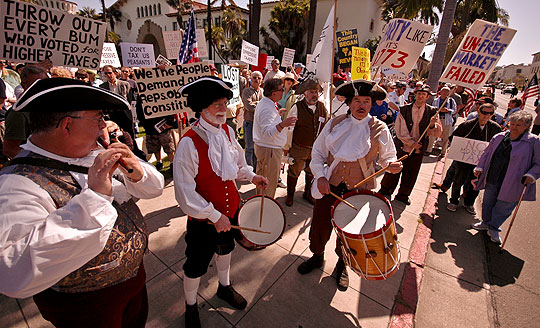

According to a new poll, the Tea Party movement, while a substantial force inside the Republican Party, is not representative of the American people as a whole:
According to an Associated Press-GfK Poll this month, 84 percent who call themselves tea party supporters don’t like how President Barack Obama is handling his job – a view shared by just 35 percent of all other adults. Tea partiers are about four times likelier than others to back repealing Obama’s health care overhaul and twice as likely to favor renewing tax cuts for the highest-earning Americans.
Exit polls of voters in this month’s congressional elections reveal similar gulfs. Most tea party supporters – 86 percent – want less government intrusion on people and businesses, but only 35 percent of other voters said so. Tea party backers were about five times likelier to blame Obama for the country’s economic ills, three times likelier to say Obama’s policies will be harmful and twice as apt to see the country on the wrong track.
These aren’t subtle shadings between tea party backers and the majority of Americans, who don’t support the movement; they’re Grand Canyon-size chasms.
With Republicans running the House next year, the findings highlight the delicate dance facing leaders who will have to address tea party concerns without alienating moderate voters who will be crucial in 2012, when the GOP hopes to win the White House and boost its strength on Capitol Hill.
One certainty: There are too many tea party supporters for politicians to ignore, especially for Republicans. About 3 in 10 adults in the AP-GfK Poll call themselves tea party backers, including 60 percent of Republicans. In the exit poll in this month’s election, which saw high conservative turnout, 4 in 10 voiced tea party support, and 2 of every 3 GOP votes came from them.
(…)
The poll also shows sharp differences between the tea party and the 7 in 10 independents who don’t support the tea party, a group both parties will target in 2012. Tea party backers take a far more negative view of Obama and his agenda than those independents do and are far likelier to think favorably of the GOP and unfavorably of Democrats.
Tea partiers are likelier to be white, male, older and more affluent than everyone else, the polls show – groups that tend to be more conservative. Yet even compared with the 47 percent of conservatives who don’t back the tea party, the views of conservatives who do support the movement stand out.
Among conservatives who are tea party backers, 74 percent are glad Republicans will run the House next year while Democrats retain control of the Senate and White House. Just 36 percent of conservatives who don’t back the tea party agree that divided government will be good for the country, likely because of concern over gridlock. Tea party backers are also far likelier than other conservatives to like Palin, the former Alaska governor.
All of this poses a bit of a problem for the Republican Party, and is likely to require somewhat of a delicate balancing act for whoever ends up being the nominee in 2012 if they want to succeed. It seems fairly clear at this point that no candidate is going to make it through the GOP primaries without appealing to the Tea Party movement. While they aren’t necessarily a majority of GOP voters, they are a sizable and, more importantly, politically active minority to the point where it’s hard to see how any candidate that “the movement” finds unacceptable can win the nomination at all. For all intents and purposes, the GOP is the Tea Party, at least for the foreseeable future.
In appealing to the Tea Party base, though, any Republican candidate is going to have the same problem that any other nominee would have after a grueling primary process that required them to run to the right. The General Election campaign will require them to move to the center, and that means the GOP needs to steer clear of controversy:
GOP pollster Steve Lombardo says it will be a challenge for Republican leaders to find policies that will deliver “a two-fer for independents and more extreme elements” of the party. He and other Republicans say the answer is to focus on areas of broad agreement like curbing federal spending, taxes and deficits.
Based on the exit polls, it seems the GOP would do better to concentrate on what actually drove voters to the polls earlier this month, the economy:
The problem with this part of Ponnuru’s hypothesis is that it isn’t supported by the exit polls:
The results underscored the economic distress defining the 2010 election. Eighty-nine percent of voters said the national economy’s in bad shape — nearly as many as the record 92 percent who said so two years ago. What changed is the direction of their ire: In 2008, 54 percent of such voters favored Barack Obama. This year, 55 percent backed Republicans for the House.
Health care came back as the second most important issue at 19%. All other issues were in the single digits.
Additionally, at least one post-election poll suggests that the budget deficit and debt aren’t as big an issue for the general public as some in the GOP might think:
For all the recent frenzy over reducing the deficit, a new poll by CBS News shows that only 4% of Americans consider it the biggest problem faced by the country.
Respondents were asked: “Of all the problems facing this country today, which one do you most want the new Congress to concentrate on first when it begins in January?”
56% of respondents said Congress should focus on the economy and jobs 14% said health care, while only 4% said the budget deficit and national debt. Immigration, education, wars in Iraq or Afghanistan, and taxes each got 2%, while 9% said other.
Federal spending and the debt are important issues, but it seems fairly clear that they are far more important to the Tea Party movement than they are to the public as a whole. The idea that there’s some kind of broad political consensus on those issues isn’t supported by the available evidence. That’s not saying that Republicans shouldn’t attack debt and spending issues over the next two years, of course, but the danger they face this time around is similar to the one they faced in 1994. By concentrating on issues that are important to their base, they are in danger of ignoring what’s important to the public as a whole. Much like 2008, this election was primarily about one thing, the economy. If Republicans forget that, they’ll suffer the same fate Democrats did three weeks ago.
In its efforts to placate the Tea Party, the GOP may find itself losing touch with the voters it needs two years from now.