Some brilliant sleight-of-hand from Kevin Drum here:
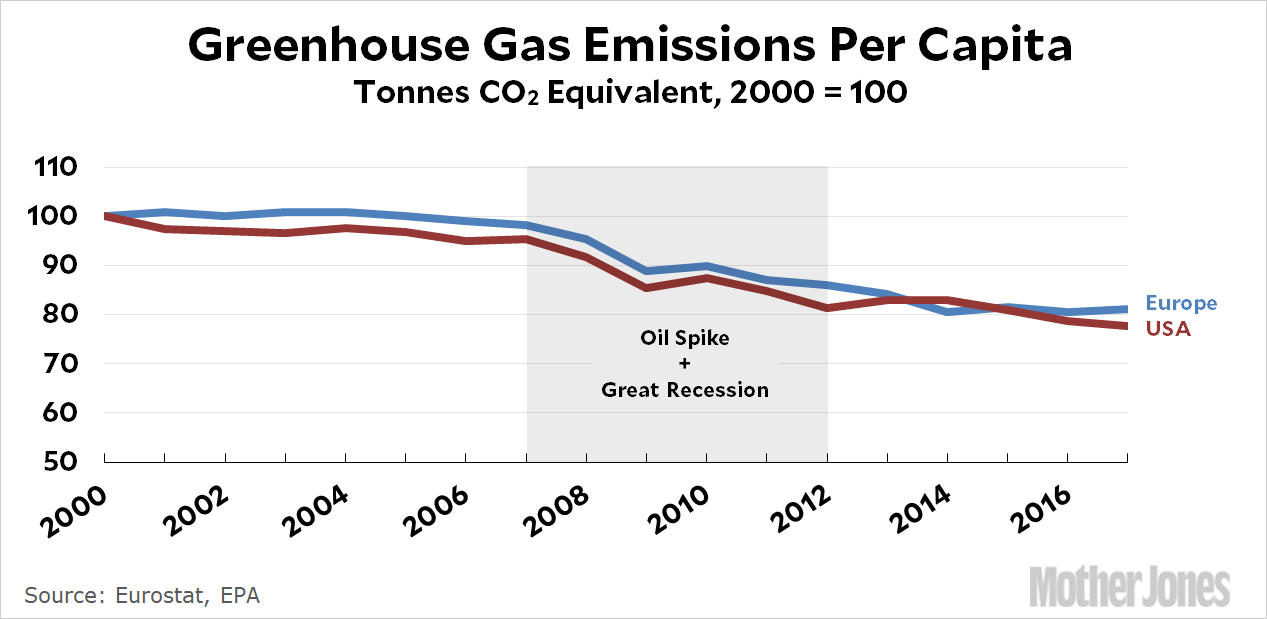
I want to acknowledge that for all the infighting in liberal circles, the real problem is that full-scale climate denialism has taken over the Republican Party. This is what’s keeping us from making serious inroads into carbon emissions. In Europe, by contrast, there is no equivalent to the Republican Party. Nobody denies that climate change is real, and there’s no monolithic political opposition to doing something about it. As a result, over the past two decades Europe has been far more successful at reducing carbon emissions than the United States:

My initial thought was that Kevin had made a mistake in graphing because it doesn’t show what he’s us up to expect. But that was the point:
Wait. What’s going on here? In fact, the United States has reduced per-capita carbon emissions slightly more than Europe, and neither one has managed much reduction at all except when they’re forced to.¹ Nearly all of the reduction since 2000 came during the five-year period when oil prices spiked and the Great Recession killed off economic activity.
In other words, it doesn’t seem as if either the Republican Party or America’s dysfunctional politics is really the problem. So what is? It must be something common to both Europe and the US, and the obvious answer is that we all live in democracies. Roughly speaking, our governments do what the public wants, and the public doesn’t have much interest in reducing carbon emissions. Oh, we say we do, and we’ll support minor things like ETS or CAFE that have a barely noticeable effect on us. We’ll support solar power—if it produces electricity nearly as cheaply as coal. We’ll all buy electric cars—but only when the price comes down and the batteries get better. We’ll check out the energy star rating the next time we buy a new refrigerator. And that’s about it.
As for the rest of the world, I won’t even show you the chart. It’s too depressing. Outside of Europe and the US, carbon emissions are just going steadily up, up, up. Even the Great Recession barely made a dent. For the world as a whole, carbon emissions have increased more than 20 percent in the past two decades as poor countries try to catch up to the living standards of the West.
After a bit more discussion, he circles back to a seemingly obvious yet somehow controversial point:
Outside of war, I can’t think of an example in all of human history where a large polity—let alone the entire world—willingly made significant sacrifices in service of a fuzzy, uncertain hazard that’s decades away. We are overclocked hairless apes who are simply not designed to think that way. Why would anyone deny this?
I’d note that it’s been a few decades since we made any significant sacrifices even during wartime; we just put it on the national credit card.
So, what then? Just give up?
This, then, circles back to what I was saying a couple of days ago: A climate plan that requires significant sacrifice might work on planet Vulcan, but not on planet Earth. Assuming otherwise is nonserious. We need a plan that will work with only homo sapiens to carry it out, and that means a plan that takes into account human selfishness and shortsightedness. It means a plan that will appeal to China and India and Brazil and the rest of the world. It means a plan that will somehow reduce atmospheric carbon a lot even while most of us sit around fat, dumb, and happy.
The only such plan I can think of is one that increases global R&D spending on climate mitigation by, oh, 10x or so. Maybe 20x if it’s feasible. This money would be spent on developing new sources of clean energy and energy storage; reducing the price of current sources of clean energy; figuring out ways to remove carbon from the atmosphere; and pretty much anything else that seems remotely useful. The fruits of this research would be turned over to the private sector for free, and they would then compete to sell it all over the globe. This would harness human selfishness instead of fighting it. It’s not guaranteed to work, but unlike the GND and similar manifestos, at least it’s not guaranteed to fail.
That seems reasonable. He adds, in a Postscript, that he personally would prefer something more aggressive; he just doesn’t think it’s politically feasible for reasons already explained.