

I have been paying attention to the border for most of my career. While immigration policy is not my area of academic expertise, it is also true that Latin American politics is (even if I don’t write about it much here at OTB and, moreover, that my academic writings have been far more in the general are of democracy). It is impossible to study and teach about US-Latin American relations and not have to deal with the border.
- It is a complicated topic.
- This is ultimately about human beings.
- Another key is the profound economic force of supply and demand.
- People frequently don’t understand two dynamics.
- First, the difference between legal and illegal crossings (specifically the sheer volume of legal crossings).
- Second, the fact that a lot of people and contraband don’t enter via walking across the border.
I dove into the OTB archives and noted that we were collectively talking about a border “crisis” even during the Obama administration and there was the ongoing attempt to deploy the military to “fix” the problem. I suspect we will be having similar discussions a decade from now (if anything because we, as a country, are unwilling to address the issue realistically.
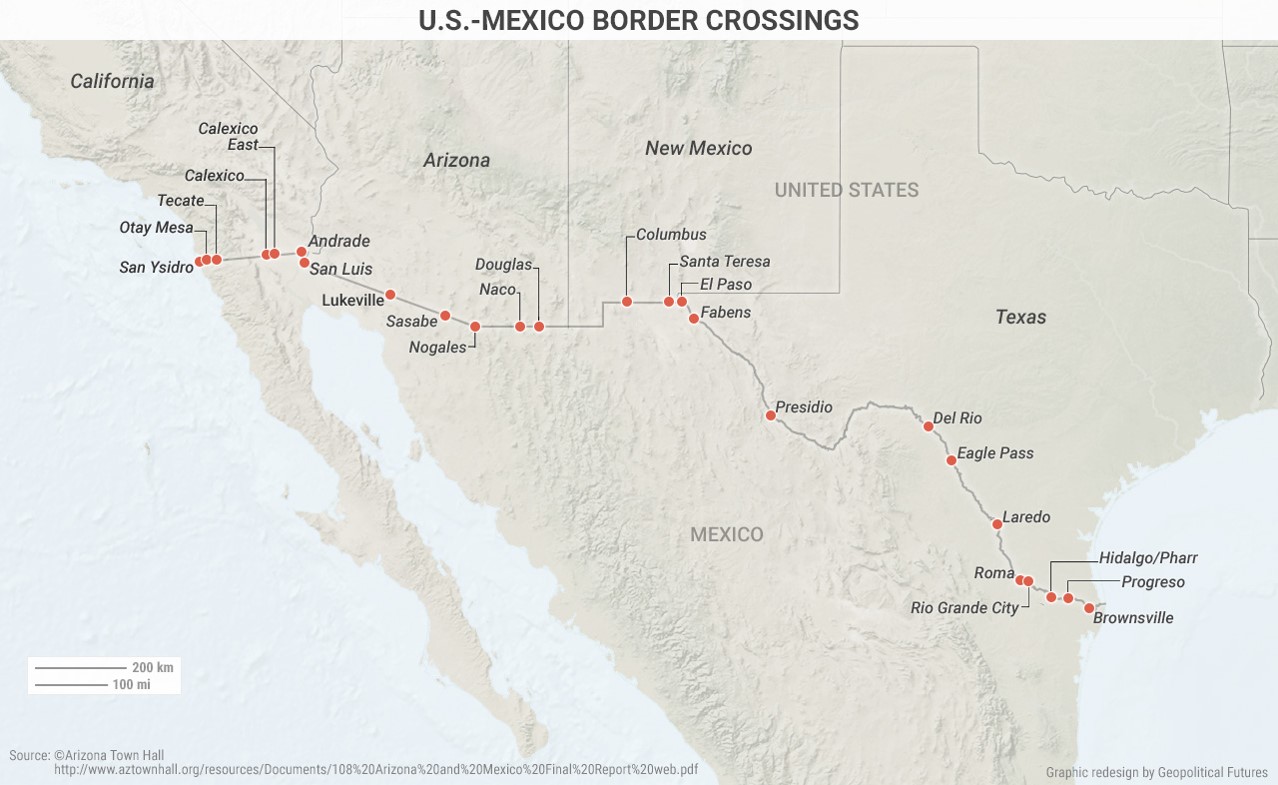
First, if the goal is to halt illegal entry into the United States, and to stop all smuggling, this is simply impossible for a host of reasons. One is simply scale. The US-Mexican border is very, very long and the frontier in question is vast. The motivations for crossing are impossible to quell and resourcing necessary to do so are beyond vast.
The issues involved include but are not limited to, trade/basic economics, family and social ties across borders, long-term history, crime, and humans trying to improve their lives. There is also the broader context of things like the drug trade, which we have demonstrated over decades and billions spent that it cannot be stopped.
Second, all of this is about human beings. Some of it is about human greed as linked to the vast amounts of money that the drug trade and other illegal activities can generate. A lot of it is motivated by a human need to improve their living conditions. And any solutions to this problem will affect human beings and poorly executed policy can result in humanitarian crises.
Moreover, we need to recognize that what drives migration are poor conditions in home countries. The long-term goal, therefore, needs to be helping the source countries. This includes weighing policy options, such as whether sanctions on Venezuela are really serving US national security needs. On the one hand, I have no objection to putting pressure on the Maduro regime. On the other, making the economy in Venezuela even worse is a major contributor to the migrant crisis on the US border.
I have argued for years that until policymakers are willing to confront the real human drives involved, no policy will make the difference claimed.
I would recommend people read this piece from last August in the Atlantic: Seventy Miles in Hell about migrants willing to traverse the Darién Gap between Colombia and Panama. People willing to undertake that journey are not going to be deterred by a border wall or much of anything, to be honest.
Americans who pontificate about these issues (or who make proclamations from rally stages) are ignoring that these are people who essentially walk to the US from places like Venezuela so that they can get jobs cleaning toilets framing houses, or doing grueling agricultural work.
Third, the power of supply and demand is real. Walls won’t stop it. Indeed, nothing will fully stop it. It is constantly a source of amazement that people who claim the market is profoundly important will not stop and see that whether we are talking about drugs or labor, that the border issue is fundamentally one of market forces and that any solution to the overall issue has to take this fact into account.
I wrote about Border Policy and the Laws of Supply and Demand back in 2010!
Fourth, the border isn’t just a place where illegal crossing take place. As I noted back in 2019:
There are almost one million legal crossings (by foot, by car, by bus, by truck, etc,) a day between the US and Mexico. There are massive amounts of economic activity across that border daily. And it isn’t just Mexicans who make money off those crossings. Mexico is the US’ largest trading partner in the world. And, of course, these border communities are symbiotically tied together–people live on one side of the border, and work on the other. Families live on both sides.
Two quick thoughts on this. One is that a lot of contraband, such as fentanyl, is smuggling in via daily legal crossings at ports of entry. Another is that many of the undocumented in the United States came in legally, but then overstayed their visas (the estimates are around 40% of all undocumented are via over-stayers). As such, a forcefield across the US-Mexican border that made entry by foot impossible would not solve the problems that “sealing” the border purports to fix.
To be clear: I am not advocating for an open border. Although, yes, I am advocating for a more open border than we currently have insofar as I do think that the net benefit of immigration outweighs the negative. The US needs labor. And, moreover, more laborers mean more taxpayers and consumers. Fully exploring that, however, is its own discussion.
What I am saying, without any doubt, is that our current policies don’t work, and Trump’s approach won’t make things better–but it will cost a lot, both in dollars and humanity.
Part of what motivated this post was this piece from Texas Monthly: The Border Crisis Won’t Be Solved at the Border. In some ways, the subhead of the piece is all you need to read:
If Texas officials wanted to stop the arrival of undocumented immigrants, they could try to make it impossible for them to work here. But that would devastate the state’s economy. So instead politicians engage in border theater.
Indeed. As many have noted, if the real goal is stopping migration, we have to make it impossible for migrants to work in the US. That means attacking the problem on the employer side. It also means coming to terms with the significant and important impact that migrants have on the US economy.
The piece illustrates, as most such pieces do, what migrants are willing to face to come to the US and why. And, also, it notes basic facts like the following, which intersect with my run-down above.
As the train crossed into Kinney County, Marco gazed at the rolling hills. He felt a mix of emotions. He had left his aging mother behind in Honduras and didn’t know when, or if, he’d see her again. In the U.S., however, he expected to earn enough to send her the money she needed for health care and other bills. Driving a bus in San Pedro Sula, Marco made 8,000 lempiras—about $325—a month. Working just a week on a construction site in the States, he could make $1,120. He could change his mother’s life.
Keep in mind that Marco is from Honduras. Marco was willing to travel almost 1,700 miles by whatever means necessary so he could send money back to help his mother, whom he might never see again.
This is the power that motivates migration and it is what policy has to take into consideration.
US border policy is frequently analogous to a town frequently flooded by a river. Instead of figuring out how to harness the power of the flowing water and use engineering to mitigate the force of nature, the mayor thinks all that is needed is a big wall and a bucket brigade.
Simplistic solutions won’t solve a thing.
At any rate, to my point above about the economic benefits of migrants, the piece notes:
Many industries have slowly recovered from the COVID-era labor crisis. Economists generally agree that the surge in immigration played a huge role in that recovery. But across the country, employers still say they can’t fill vacancies, even as some have increased wages to varying degrees. “America is facing a worker shortage crisis: There are too many open jobs without people to fill them,” the U.S. Chamber of Commerce warned in September. According to the chamber, Texas has just eighty workers for every hundred open jobs.
The deficit in construction is historic, by some measures. Associated Builders and Contractors, a trade association, reported that in 2022 the industry averaged more job openings per month than it had ever recorded. Texas building executives are speaking in apocalyptic terms about the labor shortage they’re still facing. Behind closed doors, they bluntly acknowledge that countless new projects won’t get off the ground unless they hire workers who are in the country illegally. In a survey conducted this September by another trade group, 77 percent of construction firms with job openings, and 74 percent of those in Texas, reported that they were struggling to fill them.
The construction issue is especially noteworthy. We all agree that we need more housing supply in the US. Building houses requires people. Many construction workers are migrants.
For two decades, the number of U.S.-born workers entering the construction trade has nosedived. Even if tomorrow all companies raised wages high enough to lure Texans away from their laptop jobs, it could take years of training to condition these newcomers to the rigors of building.
Cutting off the supply of undocumented workers, then, would be like cutting off the supply of concrete and lumber. Far fewer homes and businesses would be built in the next few decades. It would push up the prices paid by those who buy homes and office buildings. So an inviolable relationship has developed between new construction and migrants: If you build, they will come.
[…]
Today, Texas is home to some 1.6 million undocumented immigrants, according to a Pew Research Center study of 2022 census data. No industry in the state employs a greater number of unauthorized workers than construction, the nonpartisan Migration Policy Institute found. Since 2000, Texas’s population has grown by around 10 million, with many new arrivals chasing the “Texas Miracle”—a fast-growing economy that’s the envy of other states. Construction workers lacking legal status have laid the foundations for this miracle. They erected the work camps housing pipe fitters and roughnecks out in the oil fields. They rebuilt Houston after Hurricane Harvey. And they built thousands of apartment complexes and homes, helping Texas avoid the worst of the affordable-housing shortage that is crippling other states.
I would recommend the entire piece, but will note this before I move on:
Contract labor is far less regulated than full-time employment. While companies are prohibited from hiring independent contractors they know to be unauthorized, they are not required to verify that those contractors are legally eligible to work. And even if a business asks prospective employees for their documents, those are easy to fudge. In some Texas cities, migrants can buy cards bearing fraudulent Social Security numbers at flea markets for $250 or less. Others try an even simpler fix: They give their employers a random string of nine numbers and hope no one checks their validity.
This means that undocumented immigrants are paying billions in taxes to Social Security and Medicare/Medicaid without qualifying for any of the benefits. The Institute on Taxation and Economic Policy, a liberal think tank in Washington, D.C., estimates that in 2022, undocumented workers in Texas alone paid $4.9 billion in taxes—a sum that would increase to $5.3 billion if these workers were granted legal status.
It’s not just contractors skimming profits from undocumented immigrants’ labor. All U.S. citizens are getting a cut.
This speaks to a number of issues. One, it does demonstrate that employers are the choke point, so to speak, if the goal is actually fewer migrants in the US. Two, it utterly undercuts the notion that migrants are sponges. We have known for a very long time that this is quite the opposite: undocumented workers are helping fund Social Security and Medicare/Medicaid.
To transition to the question of mass deportation, I will provide one more quote from the TM piece:
Anyone who pays taxes would foot the bill for mass deportations. The average removal costs around $10,000, according to estimates.
So, let’s note that mass deportations would disrupt key sectors of the economy (such as construction), would deprive the federal government of tax dollars, and would cost lots of money.
Oh, and it would result in massive human rights violations.
Along those lines I recommend Janelle Bouie’s column from earlier this month: The One Thing Not Named Trump That Trump Cares About. That “thing” is mass deportations. Bouie describes the way in which mass deportation is Trump’s tonic to cure all ills. He then gets into the cost.
A little less obvious is the extent to which mass deportation would plunge the United States into economic darkness. According to a new report from the nonpartisan American Immigration Council, a mass deportation plan designed to expel 13.3 million undocumented immigrants over about 10 years would crash the economy, immiserate millions of Americans and siphon nearly $1 trillion from the federal government.
During Tuesday’s debate, Vance said the Trump deportation plan would start with about one million alleged criminal offenders. To deport one million immigrants per year, the report says, “would incur an annual cost of $88 billion, with the majority of that cost going toward building detention camps.” Even assuming some measure of “self-deportation,” the federal government would have to build “hundreds to thousands of new detention facilities to arrest, detain, process and remove” all targeted immigrants, at an estimated cost of $66 billion per year.
On top of that, the government would need to spend $7 billion per year to conduct the arrests, $12.6 billion per year to carry out legal processing for arrestees and an average of $2.1 billion to remove these immigrants from the country. None of this includes the cost of personnel, which could raise the overall price tag quite a bit. “Even carrying out one million at-large arrests per year,” the report says, “would require ICE to hire over 30,000 new law enforcement agents and staff, instantly making it the largest law enforcement agency in the federal government.” Assuming an average annual inflation rate of 2.5 percent, this deportation program would cost at least $967.9 billion over 10 years.
On the construction industry:
But the cost of mass deportation almost pales in comparison to the direct economic cost of removing millions of people from the economy. Mass deportation, the report contends, would hurt key industries that rely on undocumented labor: “The construction and agriculture industries would lose at least one in eight workers, while in hospitality, about one in 14 workers would be deported due to their undocumented status.”
I recommend the entire piece. One thing is for certain: if seriously pursued, this would be a devastatingly bad policy choice.
As Bouie concludes.
American cynicism, political or otherwise, is so ingrained that it’s only too easy to believe that neither Trump nor Vance is serious. Mass deportation might sound cruel and inhumane, but in this view it’s just a performance. If they win, this argument goes, they’ll set it aside in favor of something less dangerous and inflammatory.
This is wishful thinking. The mass deportation of tens of millions of Americans has been the centerpiece of Trump’s campaign for most of the past year. His running mate believes in it. His advisers, like Stephen Miller, have every intention of seeing as much of it through as possible.
The former president is running on a promise to commit a moral crime of world-historical proportions. Knowing what we know about his first term in office, what makes anyone think that he won’t try to do it?
Those are some serious dice a lot of Americans are willing toss on Election Day.









