
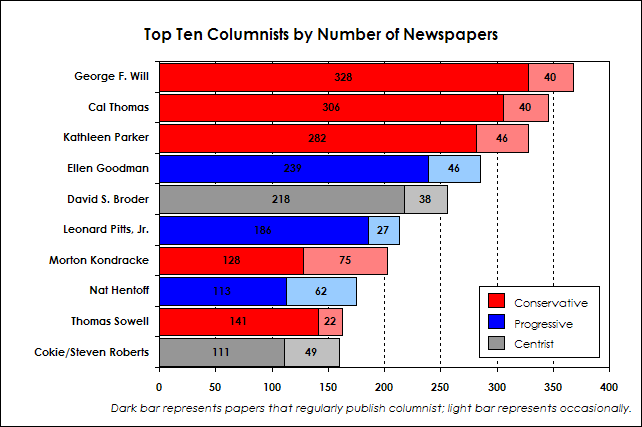
A Media Matters study showing that conservative columnists outpace their progressive counterparts in both number and circulation is getting quite a bit of buzz on the leeward side of the blogosphere. The study’s top findings:
- Sixty percent of the nation’s daily newspapers print more conservative syndicated columnists every week than progressive syndicated columnists. Only 20 percent run more progressives than conservatives, while the remaining 20 percent are evenly balanced.
- In a given week, nationally syndicated progressive columnists are published in newspapers with a combined total circulation of 125 million. Conservative columnists, on the other hand, are published in newspapers with a combined total circulation of more than 152 million.
One obvious concern in a study like this being conducted by an organization whose very mission is to expose conservative bias in the press is that the coding will be skewed. They looked at 100 columnists, many of whom I’m unfamiliar with, so I can’t provide detailed feedback on that score. Looking at the major columnists, though, raises a couple of red flags:

Personally, I would score Broder and the Roberts family as progressive; still, while they’re clearly left-of-center, they’re hardly fire breathing liberal activists. But, surely, Mort Kondracke isn’t a conservative now? Yes, he’s on FOX News and the Weekly Standard‘s masthead. He’s always been a left-of-center guy, though; he just happens to be a hawk. Similiarly, on the top columnists by circulation list, they code Thomas Friedman and, quite curiously, Ron Brownstein as centrists.
Presumably, there are several cases among the lesser-known columnists where conservatives would question the coding. Just changing Kondracke and Brownstein, frankly, would have a big impact on the numbers.
My sense is that the coding decisions were honest but made from the perspective of rather hard core progressives who see very moderate liberals as “centrists” and generally left-of-center people who are security hawks as “conservatives.” That’s a perfectly natural bias. (Indeed, I did much the same thing with my Friendly Forces and Loyal Opposition feed lists, putting centrist libertarians who were staunch war opponents on the second list.) Still, if the purpose is to create a starting point for discussion across the aisle, the coding decisions should have been made by a more neutral committee.
There are other questions, too. King Banian suggests that papers are using syndicated columnists to balance out their own editorial slant and that, because reporters tend to be left-of-center and columnists tend to come from the ranks of reporters, the natural slant of the in-house columnists will be to the left. It would be next to impossible to put together an empirical study of this hypothesis, given the sheer number of papers and the difficulty in coding for all those local columnists, but it’s not implausible.
Duncan “Atrios” Black (a Media Matters fellow) suggests that publishers feel a lot of pressure to publish conservative columnists because of the longstanding “liberal bias” meme.
Matt Yglesias figures economics is the key. That’s always a good starting point in figuring out why the media does anything.
Ezra Klein provides another incredibly plausible explanation.
[H]ow “interesting” an opinion is largely depends on how much it diverges from yours. So a liberal op-ed editor may be quite hard on other liberals, who don’t sound, to him, like they’re saying anything new. Conversely, he could be quite easy on conservatives, because even their basic arguments are, to him, analytically fresh and innovative.
Maybe so. There is, after all, a contrarian bias in the punditry game. Heck, Slate has built a whole publication around it.
UPDATE: Even Andrew Sullivan doesn’t think Kondracke is a progressive, although he’d characterize him as a centrist.
My introduction to Kondracke was during his McLaughlin Group days when I was in high school or college. He was always cast as a liberal in those days. My guess is that both his views and mine have evolved considerably since.









