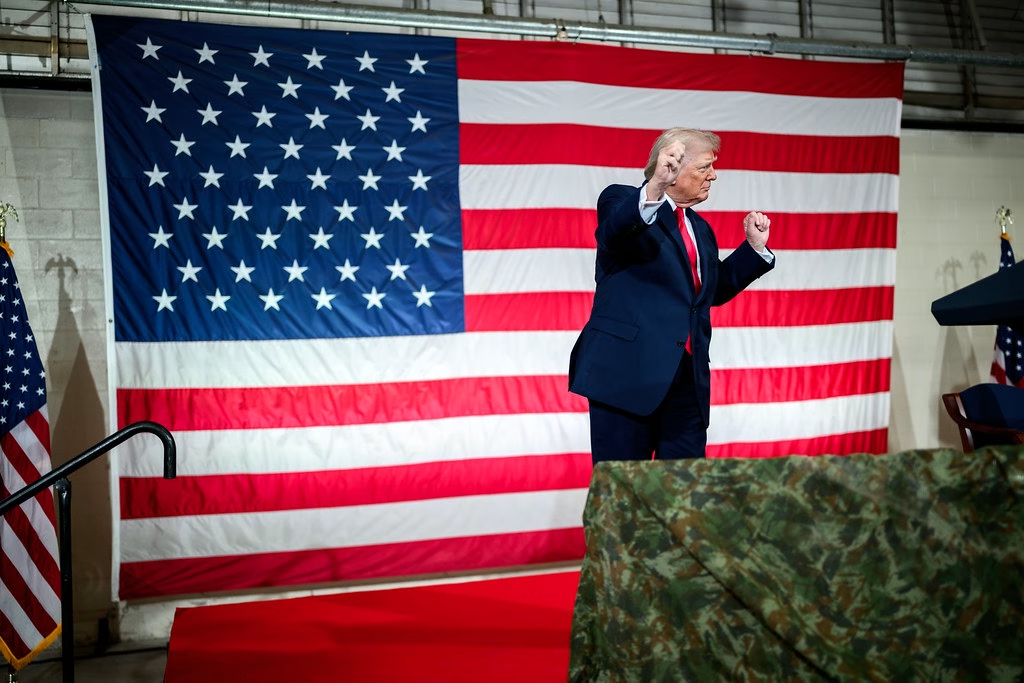

As expected, President Trump announced this afternoon that he was declining to certify Iranian compliance with the Joint Comprehensive Plan Of Action (JCPOA), the deal reached in 2015 after years of sanctions and negotiations that reduced some sanctions against Iran in exchange for the Iranians taking concrete steps to pull back from their nuclear weapons research program:
WASHINGTON — President Trump on Friday made good on a long-running threat to disavow the Iran nuclear deal that was negotiated by his predecessor, Barack Obama. But he stopped short of unraveling the accord or even rewriting it, as the deal’s defenders had once feared.
In a speech that mixed searing criticism of Iran with more measured action, Mr. Trump declared his intention not to certify Iran’s compliance with the agreement. Doing so essentially kicks to Congress a decision about whether to reimpose sanctions on Iran, which would blow up the agreement.
“We will not continue down a path whose inevitable result is more violence, more chaos and Iran’s nuclear breakout,” Mr. Trump declared at the White House, as he laid out a broader strategy for confronting Iran.
The president derided the deal as “one of the worst and most one-sided transaction the United States has ever entered into.” But he added, “What’s done is done, and that’s why we are where we are.”
Mr. Trump said he would ask Congress to establish “trigger points,” which could prompt the United States to reimpose sanctions on Iran if it crosses thresholds set by Congress.
Just to be clear, this move does not mean that Trump is walking away from the deal entirely, although it does put the deal in peril and could potentially end up
“In the event we are not able to reach a solution working with Congress and our allies, then the agreement will be terminated,” Mr. Trump said.
Those could include continued ballistic missile launches by Iran, a refusal to extend the duration of constraints on its nuclear fuel production, or a conclusion by the United States’ intelligence agencies that Iran could produce a nuclear weapon in less than a year.
Mr. Trump delivered a fire-breathing denunciation of the Iranian government, saying it financed terrorist groups, imprisoned Americans, plotted attacks on troops, and fomented civil wars in Iraq, Yemen and Syria. “Given the regime’s murderous past and present,” he said, “we should not take lightly its sinister vision for the future.”
Enacting new legislation on the agreement would require 60 votes in the Senate, meaning Republicans would need to pick up some Democratic support.
Mr. Trump argues his strategy is far tougher on Iran than the Obama administration was. The policy “focuses on neutralizing the government of Iran’s destabilizing influence and constraining its aggression, particularly its support for terrorism and militants,” the White House said in a summary issued Thursday evening.
The nuclear deal is the latest international agreement that Mr. Trump has tried to exit, amend or water down, including the Paris climate accord and the Trans-Pacific Partnership. The closest analogy to this deal may be Nafta, the trade agreement that Mr. Trump once threatened to rip up and is now undergoing a painstaking renegotiation.
In this case, however, Iran has said that it will not take part in any renegotiation of an accord it also hammered out with three European countries, as well as with Russia and China. Persuading the Europeans — Britain, France and Germany — to reopen the negotiations could prove almost as difficult.
Even getting Congress, which is deeply divided on the Iran deal, to agree on additional legislation could prove difficult. While some Republicans are eager to undermine the deal, Democrats are equally determined to preserve what they view as another legacy of the Obama administration that Mr. Trump is trying to dismantle.
On Thursday evening, Senator Bob Corker, Republican of Tennessee and the chairman of the Foreign Relations Committee, released a potential blueprint toward imposing an automatic return of sanctions if Iran was believed able of producing a nuclear weapon within a year, or if it violated other restrictions.
Mr. Corker worked on the proposal with administration officials and Senator Tom Cotton, the Arkansas Republican who is a hard-liner on Iran policy, and predicted it could earn bipartisan support. It suggests that Mr. Corker’s bitter personal feud with Mr. Trump will not obstruct their cooperation on this issue.
Mr. Trump’s decision came after a fierce debate inside the administration, according to a senior official familiar with the discussions and who agreed to describe them on condition of anonymity.
In addition to Secretary of State Rex W. Tillerson, Defense Secretary Jim Mattis argued that it was in the national security interests of the United States to keep the deal’s constraints on Iran. The two men succeeded, over time, in persuading Mr. Trump not to immediately scrap an accord that he had said during last year’s presidential campaign was a “disaster” and the “worst deal ever.”
In this case, however, Iran has said that it will not take part in any renegotiation of an accord it also hammered out with three European countries, as well as with Russia and China. Persuading the Europeans — Britain, France and Germany — to reopen the negotiations could prove almost as difficult.
Even getting Congress, which is deeply divided on the Iran deal, to agree on additional legislation could prove difficult. While some Republicans are eager to undermine the deal, Democrats are equally determined to preserve what they view as another legacy of the Obama administration that Mr. Trump is trying to dismantle.
On Thursday evening, Senator Bob Corker, Republican of Tennessee and the chairman of the Foreign Relations Committee, released a potential blueprint toward imposing an automatic return of sanctions if Iran was believed able of producing a nuclear weapon within a year, or if it violated other restrictions.
Mr. Corker worked on the proposal with administration officials and Senator Tom Cotton, the Arkansas Republican who is a hard-liner on Iran policy, and predicted it could earn bipartisan support. It suggests that Mr. Corker’s bitter personal feud with Mr. Trump will not obstruct their cooperation on this issue.
Mr. Trump’s decision came after a fierce debate inside the administration, according to a senior official familiar with the discussions and who agreed to describe them on condition of anonymity.
In addition to Secretary of State Rex W. Tillerson, Defense Secretary Jim Mattis argued that it was in the national security interests of the United States to keep the deal’s constraints on Iran. The two men succeeded, over time, in persuading Mr. Trump not to immediately scrap an accord that he had said during last year’s presidential campaign was a “disaster” and the “worst deal ever.”
For its part, Iran has rejected both reopening the existing agreement and negotiating a successor agreement that would extend the restrictions on producing nuclear fuel beyond the 15 years in the original accord.
Asked last month about the possibility of new negotiations to extend the duration of restrictions on Iran, Iran’s foreign minister, Mohammad Javad Zarif, said in an interview, “Are you prepared to return to us 10 tons of enriched uranium?”
That relinquished stockpile — one of Iran’s biggest concessions — was about 98 percent of the nuclear fuel holdings in the country’s possession and was the key assurance that Tehran could not rapidly produce a nuclear weapon.
Mr. Tillerson said new legislation could address what the administration views as one of the major weaknesses of the agreement: its “sunset” provisions, under which the restrictions on Iran’s nuclear activities expire in stages, starting in less than a decade. “We have a countdown clock to when Iran can a resume its nuclear program,” Mr. Tillerson said.
But it is a clock that will tick for quite a while. The most critical restriction in the deal — one limiting how much nuclear fuel Iran can produce — expires in 2031, years after Mr. Trump leaves office. And after that, Iran would still be prohibited from producing a nuclear weapon, and would be subject to highly intrusive inspections.
It’s worth noting that Trump’s announcement stops short of withdrawing the United States completely from the deal, which is what he had been threatening to do throughout the campaign for President. Instead, it essentially throws the issue over to Congress which now has sixty days within which it could decide to either impose new sanctions against Iran, taking steps to get the U.S. out of the deal, or taking no action at all. After that period expires, the next step would be within the President’s discretion and the options available to him include essentially doing nothing, meaning that the deal would continue forward or he could formally withdraw from the deal and call for renegotiation of the agreement notwithstanding the fact that both Iran and the other nations that were involved in the negotiations, including U.S. allies such as France, Germany, and the United Kingdom, that they would not agree with such a step and that there would be no additional or expanded negotiations. In other words, while Trump’s announcement today doesn’t mean the immediate end of the deal, it does place the deal in jeopardy and calls into question just how much the Trump Administration can or will be trusted when it comes to making international agreements of any kind.
Trump’s announcement is notable in several respects, not the least of them being that he cited absolutely no evidence that Iran had violated the deal, a revelation that might arguably justify a decision to withdraw from it in the future. In fact, members of Trump’s own foreign policy team, including most notably Secretary of Defense James Mattis and Secretary of State Rex Tillerson have both gone on the record as saying that Iran is in compliance with the agreement and that staying in the JCPOA is in the national interest of the United States. Additionally, the International Atomic Energy Agency (IAEA), the agency charged with running the inspections called for under the agreement has said that Iran is complying with the agreement in its most recent report on the agreement. Instead, Trump said that Iran is violating the “spirit” of the agreement without specifying what that means and went on to cite things that were not even covered by the terms of the agreement, such as Iran’s missile program, the foreign policy positions it has taken that are often adverse to those of the United States, and actions that took place in the past such as terrorist that took place as long as twenty years or more in the past.
Even though Trump hasn’t thrown the entire JCPOA in the trash can, at least not yet, it’s arguably the case that he has done serious damage to American credibility around the world and made it much more difficult for Secretary Tillerson and other diplomats to do their job both with respect to America’s allies and its adversaries. As I noted when I wrote about the prospect of decertification earlier this month, the JCPOA was more than just an agreement between the United States and Iran, it was the result of years of coordinated effort on sanctions by the United States, several of its most important allies, and well as adverse powers such as China and Russia to force Iran to the negotiating table with regard to its nuclear weapons research program. That process led to sanctions that ultimately brought Iran to the table in Switzerland and set in motion the process that eventually resulted in the JCPOA. In the wake of Trump’s entry into the White House, all of these parties have made it clear that they would not participate in efforts to reopen the negotiations and, absent evidence of noncompliance, would not go along with a decision to back out of the deal and reimpose sanctions. This leaves the prospect of the United States essentially standing alone in the world.
Backing out of the deal now even though everyone is in agreement that Iran is actually in compliance with the agreement has the potential to do real damage to American credibility in other parts of the world, as I noted in my post last week:
Most ominously, of course, a move like this would impact the international efforts to deal with the North Korean nuclear program and Pyongyang’s aggressive rhetoric against the United States, South Korea, Japan, and other nations in the region. For both the North Koreans and the Chinese, as well as our allies in South Korea, Japan and elsewhere in the region. As it is the North Koreans are clearly paranoid when it comes to the United States and the west. A move like this would likely lead them to wonder, with some justification, whether the United States can or should be trusted to live up to its agreements. These conclusions would be even more justified if Congress ends up reimposing sanctions even though there doesn’t appear to be a legitimate basis to do so. The consequences of this unwise, ill-advised move cannot be understated.
Where we go from here depends on what happens next. If Congress tries to reimpose sanctions, then it’s likely that the entire deal could fall apart and that, prompted by the urging of hardliners in Tehran who will point to this as evidence that they were right all along, Iran will seek to restart its nuclear weapons development program. Even if that doesn’t happen, though, the damage done to American credibility when comes to other agreements will have been done and the consequences of that could be quite dangerous indeed.