NYT (“Trump and Netanyahu Tell Hamas to Accept Their Peace Plan, or Else“):
President Trump on Monday cast his plan for a cease-fire in Gaza as a landmark deal to bring peace after two years of catastrophic violence. But in reality, it was more like an ultimatum to Hamas.
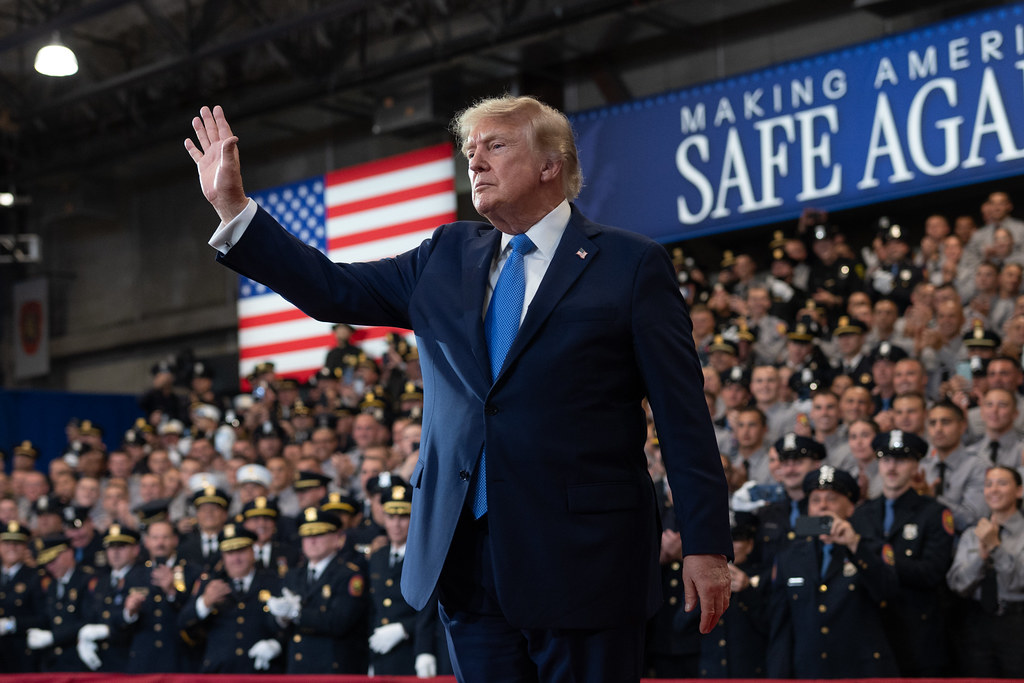
Standing alongside Prime Minister Benjamin Netanyahu of Israel, Mr. Trump unveiled a proposal to which both men had agreed. If Hamas refuses to do the same, Mr. Trump said, the United States will let Israel “do what you would have to do.”
“Israel would have my full backing to finish the job of destroying the threat of Hamas,” said Mr. Trump, who under the plan would become the temporary chairman of a board in charge of the redevelopment of Gaza.
The joint appearance by Mr. Trump and Mr. Netanyahu at the White House was a clear display of unity at a moment when Mr. Trump has shown signs of frustration with the Israeli prime minister, and when much of the world has grown horrified at Israel’s prosecution of the war against Hamas in Gaza, which has killed tens of thousands of Palestinians.
But it was far from assured that Hamas would agree to their demands.
The U.S. plan contains provisions that Hamas has said publicly it will not accept, such as its removal from power and disarmament, leaving the proposal’s future uncertain and increasing the possibility that Israel will intensify its military campaign in the enclave, with the full support of the United States.
“When it comes to this plan, no one contacted us, nor were we part of the negotiations around it,” Taher al-Nounou, a senior Hamas official, said in a televised interview.
The proposal calls for an immediate cease-fire, after which Hamas would have 72 hours to return all Israel hostages, both dead and alive. In return, Israel would release 250 prisoners sentenced to life, plus 1,700 Gazans who were detained after the Oct. 7, 2023, massacre.
Once all hostages are returned, Hamas members who decommission their weapons would be given amnesty.
Notably, the proposal says nothing concrete about a pathway to Palestinian statehood. While it recognizes statehood “as the aspiration of the Palestinian people,” it says only that while Gaza is rebuilt and when an overhaul program by the authority “is faithfully carried out, the conditions may finally be in place for a credible pathway” to statehood.
Hamas would have to agree to play no role in governing Gaza in the future. And while Israel would pull back its forces by degrees within the Gaza Strip, it would maintain a sizable buffer zone inside Gaza’s borders “for the foreseeable future,” Mr. Netanyahu said.
Considering that the alternative is to continue suffering destruction at the hands of the Israeli military, this is a reasonable deal. And, indeed, early indications are that they will swallow this bitter pill.
CBS News (“Hamas leaning toward accepting Trump’s Gaza ceasefire plan quickly, source tells CBS News“):
Hamas and other Palestinian factions are leaning toward accepting President Trump’s plan to end the war in Gaza, and they will present the group’s response to Egyptian and Qatari mediators on Wednesday, a source close to the process told CBS News on Tuesday.
The plan, which Mr. Trump presented alongside Israeli Prime Minister Benjamin Netanyahu at the White House on Monday, is a 20-point proposal which, if agreed to, would see a swift ceasefire in Gaza, the release of all the remaining hostages and a number of Palestinian prisoners in Israel, an increased flow of humanitarian aid and the eventual transfer of control over the territory to an interim administration of Palestinian technocrats overseen by an international “Board of Peace” chaired by Mr. Trump.
[…]
Former British Prime Minister Tony Blair would also be on the “Board of Peace,” and, according to the plan, Israel would maintain security control around the perimeter of Gaza. Speaking Monday after his appearance with Mr. Trump, Netanyahu indicated that Israeli forces would remain “in most parts of the Strip” at least until all of the hostages were returned.
A diplomatic source with knowledge of the talks told CBS News that an Egyptian official and the Qatari prime minister had provided Hamas representatives with a copy of the proposal.
Indeed, the international community, including much of the Arab world, seems to be jumping on board.
The Palestinian Authority, which partially administers areas of the Israeli-occupied West Bank, issued a statement supporting the plan, which was published by the PA-linked WAFA news agency.
In its statement, the PA stressed “the importance of the partnership with the United States in achieving peace in the region,” and reaffirmed its commitments to certain reforms, including “holding Presidential and Parliamentary elections within one year after the end of the war.”
“We have affirmed that we desire a modern, democratic, non-militarized Palestinian state that is committed to pluralism and the peaceful transfer of power,” the statement said.
Mr. Trump’s proposal does not include any immediate role for the PA in administering post-war Gaza, but it says the organization could eventually “securely and effectively take back control of Gaza” once it has implemented a series of reforms.
The leaders of a number of Muslim majority nations, including key states in the Middle East, quickly signalled support for the plan. Jordan, the United Arab Emirates, Indonesia, Pakistan, Turkey, Saudi Arabia and Qatar issued a joint statement welcoming Mr. Trump’s “sincere efforts to end the war in Gaza” and asserting their “confidence in his ability to find a path to peace.”
“They emphasize the importance of the partnership with the United States in securing peace in the region. Along these lines, the ministers welcome the announcement by President Trump regarding his proposal to end the war, rebuild Gaza, prevent the displacement of the Palestinian people and advance a comprehensive peace, as well as his announcement that he will not allow the annexation of the West Bank,” the joint statement said.
The president of the European Council, Antonio Costa, said he was “encouraged by Prime Minister Netanyahu’s positive response” to the U.S. proposal, and that “all parties must seize this moment to give peace a genuine chance,” CBS News partner network BBC News reported.
The U.N. High Commissioner for Human Rights, Volker Turk, told CBS News that “anything that brings us to a ceasefire, to the release of hostages, to an end to the carnage that we see, and an end to the incredible suffering, and a pathway for peace is welcome.”
While Israel’s standing in the international community is quite possibly at an all-time low, Hamas and the people of Gaza have paid dearly for the October 7 massacre. Despite the growing international recognition, including from many of our closest allies, of a Palestinian state, this does not appear to get us any closer to that eventuality. If anything, they’re further away than they have been in years.