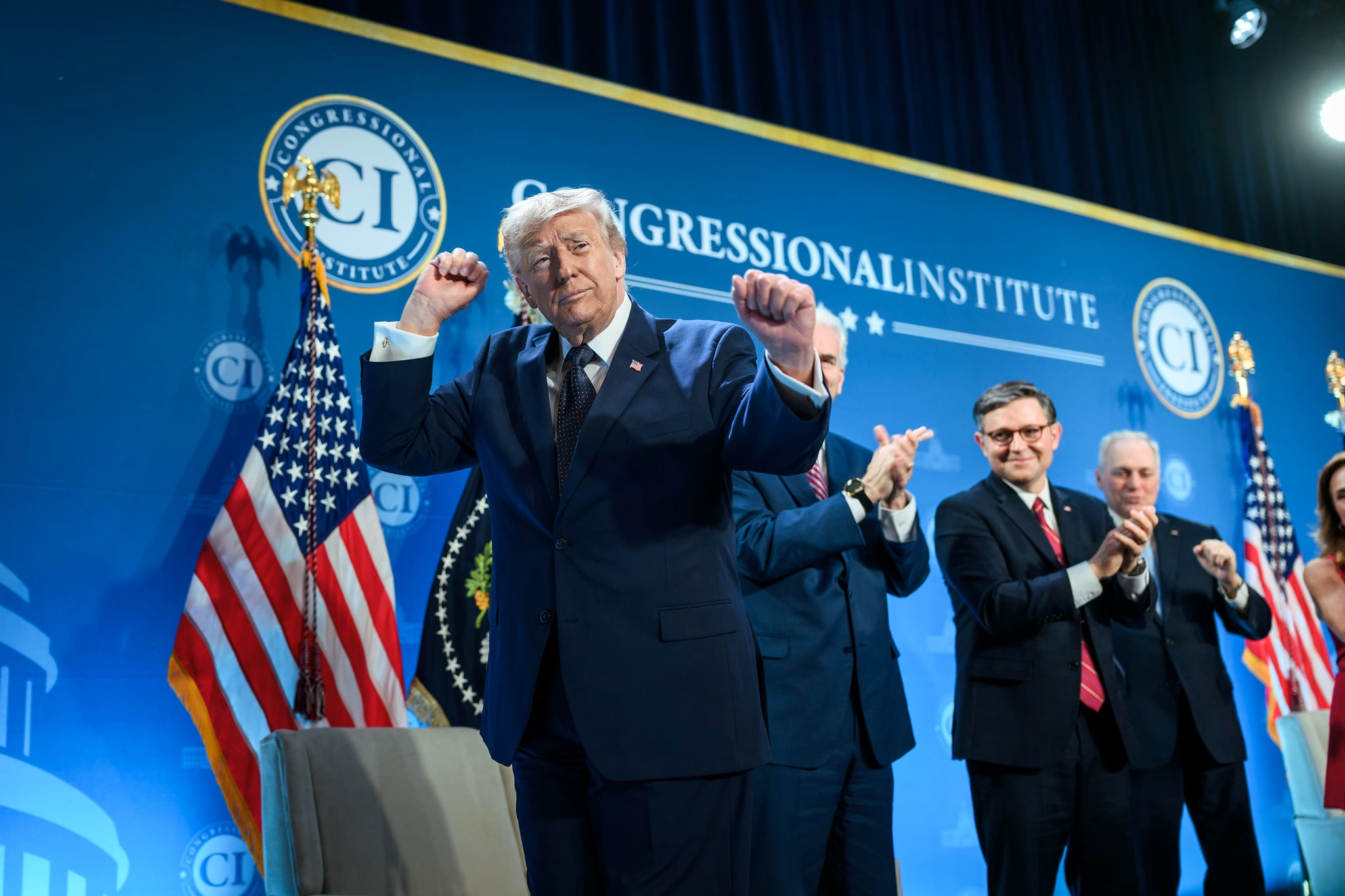
The President has canceled the White House’s subscriptions to the New York Times and Washington Post—and is apparently going to order all federal agencies to follow suit.
The Wall Street Journal, which hasn’t been banned—yet—reports:
The White House is planning to instruct federal agencies to not renew their subscriptions to the New York Times and the Washington Post, administration officials said, escalating President Trump’s attacks on the media outlets.
“Not renewing subscriptions across all federal agencies will be a significant cost saving—hundreds of thousands of taxpayer dollars will be saved,” White House press secretary Stephanie Grisham said in an email Thursday.
Ms. Grisham declined to provide further details, and it wasn’t immediately clear how the White House intended to compel agencies to cancel the subscriptions or how soon the order would take effect. The White House was still working on implementing the directive as of Thursday morning, an administration official said.
[…]
The president has repeatedly railed against and sought to discredit the newspapers’ coverage of his administration, including its dealings with Ukraine and the resulting impeachment inquiry in the House. On Twitter and during campaign rallies, Mr. Trump has attacked the news media, calling it the “enemy of the people” and dismissing some of the country’s most venerable journalism outlets as “fake news.”
In June, Mr. Trump wrote on Twitter that a Times story represented a “virtual act of Treason.” The publisher of the New York Times, A.G. Sulzberger, responded with an opinion article in The Wall Street Journal, saying the “new attack crosses a dangerous line in the president’s campaign against a free and independent press.”
Aside from the childishness of the act and outrageousness of using his office to go after the freedom of the press, it’s not obvious he has the authority to do this. I haven’t the foggiest idea how agencies go about getting the authorization to subscribe to periodicals—we don’t get any non-DoD publications in my institution—but would presume there’s a process involved to prevent fraud, waste, and abuse.
In the age of Internet news, it’s not obvious why most Federal offices would need or could justify paying for a subscription to any newspaper. There’s more news available for “free” than anyone could possibly read. While the NYT and WaPo are, along with the WSJ, arguably the three most important papers in the country, there are few stories of any significance that one couldn’t get elsewhere.
The NYT used to offer free subscriptions to those with a .gov or .mil email address but stopped some time back. WaPo still does. So, government employees who need access to do their jobs will be able to get one of the two papers at no cost regardless of whether the order goes into effect.
The NYT report on the story has an amusing anecdote:
There is some precedent for a presidential cancellation.
In 1962, John F. Kennedy, apparently fed up with the coverage of The New York Herald Tribune, decreed that copies of that newspaper would no longer be delivered to the White House. His press secretary, Pierre Salinger, after initially ignoring the president’s repeated requests to cancel the paper, eventually acquiesced and announced that Kennedy would instead read The St. Louis Post-Dispatch.
The move was met with mockery. A New Jersey lawmaker ordered a year’s gift subscription to The Herald Tribune sent to Kennedy. On the floor of Congress, Representative Steven Derounian, Republican of New York, called the decision “childlike.”
“If all members of Congress followed the president’s lead, we would find that we were reading no newspapers at all,” Mr. Derounian said, according to an account in The Congressional Record. “It might be well to remind President Kennedy that on Jan. 20, 1961, he was inaugurated as president, not coronated as king.”
Kennedy, it turned out, could not get along without his daily copy of The Herald Tribune. In his memoir, Mr. Salinger wrote that the staff was forced to “bootleg” copies of the paper to the president until it was formally allowed back in the White House.
Interestingly, the Herald-Tribune went out of business in 1966, although a deal was struck with the NYT and WaPo to keep its Paris affiliate alive as the International Herald Tribune. It remained in existence until its rebranding as the NYT International Edition in 2013.