
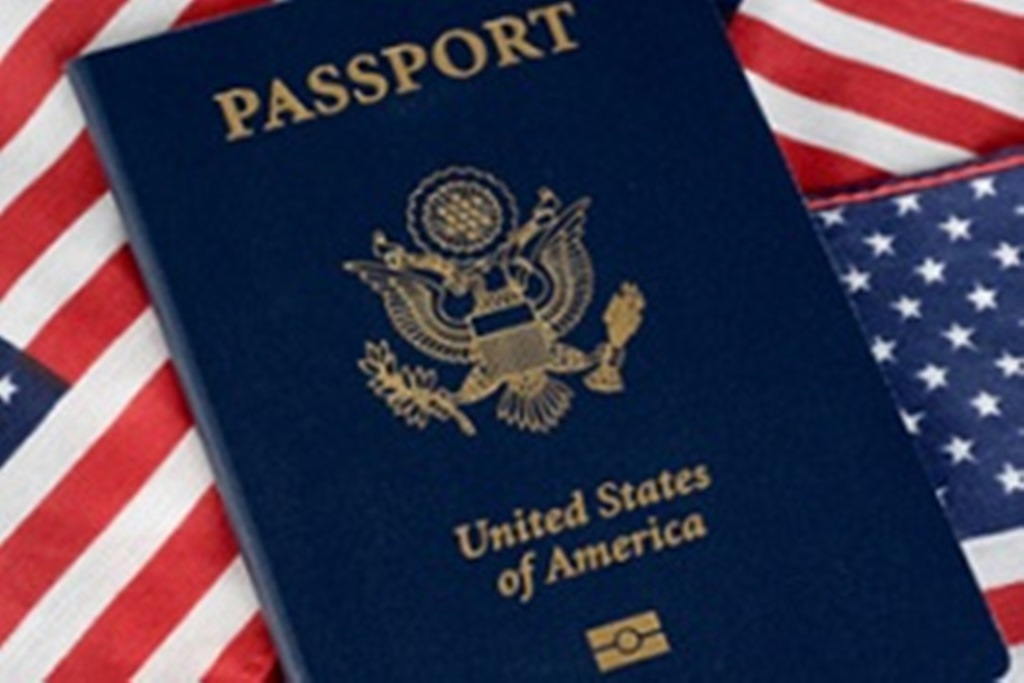

WaPo (“Trump signs executive order requiring proof of citizenship in federal elections“):
President Donald Trump signed an executive order Tuesday requiring people to provide documents proving they are citizens when they register to vote, a mandate that experts said could prevent millions of Americans from voting.
The order reflects Trump’s long-standing fixation on election administration as well as his baseless claims following the 2016 and 2020 presidential races that both were riddled with fraud, particularly illegal voting by noncitizens. There is no evidence that widespread corruption, by noncitizens or others, tainted either contest.
Republicans in dozens of states have sought for decades to require voters to present identification to cast ballots, but Trump has taken that effort to a new level with an executive order establishing a federal mandate to provide proof of citizenship to register to vote.
The U.S. Constitution designates the power to regulate the “time, place and manner” of elections to the states, with the proviso that Congress can step in and override those laws. It gives no specific power to the president to do so. Election experts said that Trump was claiming power he does not have and that lawsuits over the measure were all but guaranteed.
“This executive order is unlawful,” said Wendy Weiser, vice president for democracy at the Brennan Center for Justice at New York University’s School of Law. “The president does not have the authority to require this. The president cannot override a statute passed by Congress that says what is required to register to vote on the federal voter registration form.”
Others suggested that the order reflects Trump’s desire to expand executive power — and for the Supreme Court to allow it. His order directs the Election Assistance Commission — an agency governed by statute enacted by Congress — to change the federal voter registration form to require government-issued documentary proof of citizenship.
“The Court is well on the way to establishing that all federal agencies must be conceived as within the executive branch, no matter how Congress denominates or structures them,” Richard Pildes, a constitutional law professor at New York University, wrote on a widely read election law blog.
Less clear is whether states would be required to adopt the federal form. States typically produce their own voter registration forms, and voters are free to use either to register in federal elections.
Only citizens can vote in federal elections, but most states do not require voters to provide proof of citizenship. Instead, voters must sign statements swearing they are citizens. Noncitizens who sign such statements can be charged with crimes and deported.
The order allows voters to use passports or certain driver’s licenses to prove citizenship, but not birth certificates. Separately, it also attempts to bar states from counting mail ballots that officials receive after Election Day. Last year, 18 states allowed mail ballots that arrived later so long as they were postmarked by Election Day.
Trump specified that he would withhold federal election funding from states that do not comply with theraft of directives included in his order.
AP (“Trump signs order seeking to overhaul US elections, including requiring proof of citizenship“) adds:
Voting rights groups have expressed concerns that the requirement could disenfranchise people. An estimated 9% of U.S. citizens of voting age, or 21.3 million people, do not have proof of citizenship readily available, according to a 2023 report by the Brennan Center for Justice and other groups.
There are also concerns that married women who have changed their names will encounter trouble when trying to register because their birth certificates list their maiden names. Such hiccups happened in recent town elections in New Hampshire, which has a new state law requiring proof of citizenship to register to vote.
[…]
Colorado’s Democratic secretary of state, Jena Griswold, called the order an “unlawful” weaponization of the federal government and said Trump is “trying to make it harder for voters to fight back at the ballot box.”
Democratic Rep. Joe Morelle of New York, the ranking member of the House committee that oversees elections, said the executive order “is not just misguided — it is immoral and illegal.”
At least one Democratic attorney on Tuesday threatened legal action. Marc Elias, who has been the subject of Trump’s ire, said in a social media post: “This will not stand. We will sue.”
The executive branch does have some authority over elections, said Justin Levitt, a constitutional law expert and former White House senior policy adviser during the Biden administration. He said some federal agencies provide election support, including the U.S. Election Assistance Commission, which distributes federal grant money to states and runs a voluntary certification program for voting systems. The U.S. Cybersecurity and Infrastructure Security Agency helps election officials protect their systems.
Former President Biden issued an executive order in 2021 directing federal agencies to take steps to boost voter registration, which drew complaints from Republicans who called it federal overreach. Trump has rescinded that order.
Let’s leave aside for now whether the President has the legal authority to order this. I’m skeptical, but the courts will adjudicate that soon enough. And, rather clearly, the administration is working overtime to create a series of test cases to force a ruling on the Unitary Executive Theory that they have championed and to which at least a couple of Supreme Court Justices have shown sympathy.
As a matter of public policy, I have no theoretical objection to requiring people to prove their identity and citizenship to vote. We require photo ID for rather mundane things, including getting into R-rated movies. The other day, I had to present my driver’s license for scanning in order to buy a bottle of bitters! And, to the extent we wish to restrict voting to citizens rather than all those who have to abide by our laws, it seems prudent to take measures to prevent non-citizen voting.
And the forms of ID that are acceptable are reasonable enough:
A) a United States passport;
(B) an identification document compliant with the requirements of the REAL ID Act of 2005 (Public Law 109-13, Div. B) that indicates the applicant is a citizen of the United States;
(C) an official military identification card that indicates the applicant is a citizen of the United States; or
(D) a valid Federal or State government-issued photo identification if such identification indicates that the applicant is a United States citizen or if such identification is otherwise accompanied by proof of United States citizenship.
Alas, in reality, it’s more complicated. For one thing, neither driver’s licenses nor military ID cards have citizenship information on them. I’ve had a REAL ID-compliant Virginia driver’s license for a very long time now; it doesn’t state that I’m a citizen. Ditto my DOD ID card.
That could, of course, be sorted out, although certainly not in time to go into effect for the 2026 election cycle. Hell, the Real ID Act is twenty years old, and states are still dragging their feet.
The bigger issue, of course, is that studies have long shown that even ordinary voter ID laws disproportionately impact the poor, racial minorities, and the elderly. They’re less likely to own a car, and thus to have driver’s licenses. And, even if states provided free photo ID, it’s harder for them to get to issuing facilities and wait in line.
Interestingly, while the longstanding conventional wisdom is that these rules harm the electoral chances of Democrats—which explains why most of the push comes from Republicans—I’m not sure that remains true. Given the fact that the top predictor of party alignment has become educational attainment, it may well be that Democratic voters are more likely to have the ability to easily prove citizenship. Certainly, they’re much more likely to have a passport.
An interesting coda to all of this is the first paragraph of the order:
Despite pioneering self-government, the United States now fails to enforce basic and necessary election protections employed by modern, developed nations, as well as those still developing. India and Brazil, for example, are tying voter identification to a biometric database, while the United States largely relies on self-attestation for citizenship. In tabulating votes, Germany and Canada require use of paper ballots, counted in public by local officials, which substantially reduces the number of disputes as compared to the American patchwork of voting methods that can lead to basic chain-of-custody problems. Further, while countries like Denmark and Sweden sensibly limit mail-in voting to those unable to vote in person and do not count late-arriving votes regardless of the date of postmark, many American elections now feature mass voting by mail, with many officials accepting ballots without postmarks or those received well after Election Day.
It’s an interesting twist to see a Republican administration relying on international precedent to justify policy changes. That’s usually a Democratic move. Then again, once Canada becomes the 51st state, we’ll have a leg up on implementation since they’re already ahead on this.









