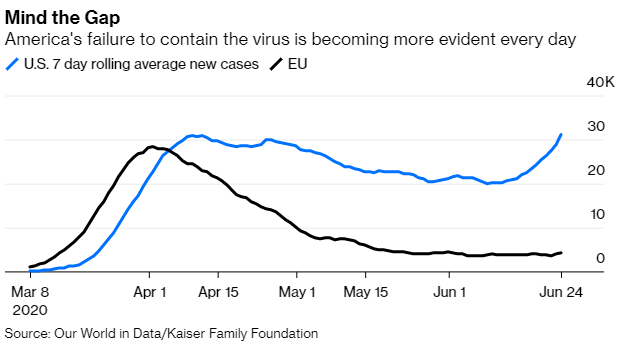
The radically different approaches to the novel coronavirus by the European Union and the United States are, predictably, yielding wildy different outcomes.
Max Nissen, writing for Bloomberg (“A Horrifying U.S. Covid Curve Has a Simple Explanation“):
The alarming chart below has been making the rounds. It illustrates the poor job the U.S. has done in containing Covid-19 compared to the European Union, a bigger region of independent countries that suffered an earlier outbreak. Why the big difference? What is America doing wrong?

There are a lot of possible answers to those questions. A sluggish initial response and failure to ramp up testing let the virus spread far and wide in the U.S. And instead of coordinating a coherent and aggressive national response, President Donald Trump has consistently downplayed the threat of the infection and left decisions to insufficiently supported states. As a result, decisions over lockdowns and reopenings have been chaotic and have ignored the guidelines put forth by federal public health officials.
Amid all of this, one particular difference stands out between the American and European approaches. Many states were happy to reopen after simply “bending the curve” — that is, slowing upward growth and ensuring spare hospital capacity. These states went on to expand economic activity at an elevated plateau with lots of ongoing transmissions. In contrast, European countries mostly waited to reopen until they crushed the curve or reached its far slope, with substantially lower incidence or dramatic reductions in the viral spread. It’s not the only explanation for a growing gap, but it’s a compelling one.

Italy is something of an exception, having opened with a comparatively high case count. However, the country was recovering from a particularly large and concentrated outbreak, and its incidence was on a steep downward trajectory. Its average daily count was below 20 cases per million within a week of its initial limited opening, a metric none of the most troubled states have managed since early April.
So why is low incidence so crucial to successful reopening? It’s simple math. More virus circulating in a community means more opportunities for it to spread. It makes every precaution individuals and officials take a bit less effective, and every activity riskier. This doesn’t necessarily translate to immediate outbreaks, as people came out of lockdown quite cautiously. But as activity expands to include things such as indoor service at bars, a high base level of infection becomes increasingly likely to cause problems.
Persistently high case levels amid a substantial reopening also make it far more challenging to identify and isolate a high percentage of infected individuals — again, a numbers problem. At a certain point, there are too many cases and contacts to have a hope of tracing them
That the number of cases was going to rise as we started re-opening was inevitable. And it would have been unreasonable to expect everyone to remain in lockdown indefinitely until a vaccine is found and distributed.
But full lockdown and reckless reopening weren’t the only alternatives. And, indeed, many states, including my own, have gradually phased out restrictions—while also mandating wearing of masks in public spaces—without seeing a spike in the disease.