
The Trump Administration announced this morning that the government was ordering the expulsion of 60 Russian diplomats and the closing of the Russian consulate in Seattle in retaliation for the attempted assassination via poisoning of former Russian Spy Sergei Skripal and his daughter in Great Britain earlier this month:
President Trump ordered the expulsion of 60 Russians from the United States on Monday, adding to a growing cascade of similar actions taken by western allies in response to Russia’s alleged poisoning of a former Russian spy in Britain.
Poland, Italy, Denmark, France and Germany were among 14 European Union member nations announcing plans to expel Russians from their countries in solidarity with Britain, which previously expelled 23 Russian diplomats after the poisoning. Canada also said it would expel four.
The American expulsion order, announced by administration officials, includes 12 people identified as Russian intelligence officers who have been stationed at the United Nations in New York, and also closes the Russian consulate in Seattle. The Russians and their families have seven days to leave the United States, according to officials.
The expulsions are the toughest action taken against the Kremlin by President Trump, who has been criticized for not being firm enough with President Vladimir V. Putin of Russia. The officials said the action was a coordinated effort with other allies. Poland announced it will expel the Russian ambassador and several other diplomats in response to the poisoning. And Germany announced plans to expel four Russian diplomats within the next week.
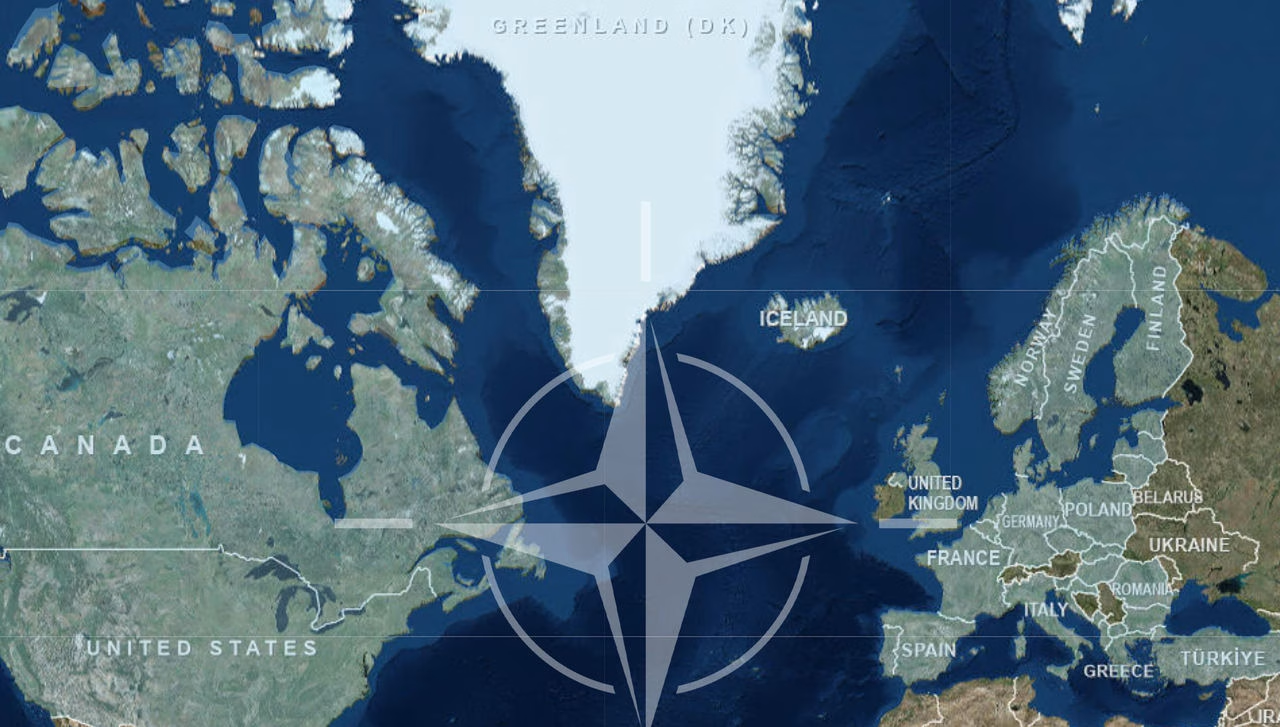
In a call with reporters, senior White House officials said that the move was to root out Russians actively engaging in intelligence operations against the country, and to show that the United States would stand with NATO allies. The officials said that the closure of the consulate in Seattle was ordered because of its proximity to a U.S. naval base.
“Today’s actions make the United States safer by reducing Russia’s ability to spy on Americans and to conduct covert operations that threaten America’s national security,” the White House said in a statement.
The Kremlin has maintained that it had nothing to do with the poisoning.
(…)
Those sanctions came as the United States joined Britain, France and Germany in denouncing Russia for its apparent role in a nerve-gas attack on a former Russian spy and his daughter on British soil, calling it a “clear violation” of international law.
White House officials called the nerve agent used against the Skripals “military grade,” but declined to elaborate on the substance used.
American officials estimate there are currently more than 100 Russian intelligence officers in the United States.
Mr. Trump has said that, despite its denials, Russia was likely behind it. “It looks like it,” he told reporters in the Oval Office on March 15, adding that he had spoken with Prime Minister Theresa May of Britain.
“We are in deep discussions,” Mr. Trump continued. “A very sad situation. It certainly looks like the Russians were behind it. Something that should never, ever happen. And we’re taking it very seriously, as I think are many others.”
Mr. Trump has been slower to act than leaders in Britain, France and Germany over the attack, in which Sergei V. Skripal, 66, a former spy, and his daughter, Yulia Skripal, 33, were attacked with a nerve agent.
The senior administration officials who described the expulsion order said the three weeks that lapsed between the attack and White House action was due to close coordination among about a dozen American allies.
Poland has positioned itself to take a lead role in coordinating a response from the Eastern European nations traditionally most wary of their giant neighbor to the east.
The Russian ambassador to Poland, Sergei Andreyev, was summoned to the foreign ministry on Monday morning and informed of imminent diplomatic action against his country. The Polish foreign minister was expected to make an announcement later this afternoon.
The Polish foreign minister, Jacek Czaputowicz called the tragic incident in Britain an “unprecedented attack on civilians with the use of chemical weapon,” that had not been seen since World War II.
Mr. Czaputowicz said the Russian ambassador and three other diplomats were now considered “persona non grata,” giving them until April 3 to leave the country.
Russia’s overall goal, Mr. Czaputowicz said, is to “disrupt international order and create a sense of danger.”
Any expulsion of Russian diplomats would be an unprecedented move on Warsaw’s part, the first time they took diplomatic action against their neighbor due to Russian behavior outside of Poland.
All of this grows, of course, out of the attempted murder of Skirpal and his daughter earlier this month via what British authorities quickly determined to be a deadly nerve agent known to have originated from Russia itself, leading to the inevitable conclusion that only Russia could have behind the attack. Soon after the attack, British Prime Minister Theresa May accused Russia of having poisoned Skripal and his daughter and called them out for staging an attempted assassination on British soil. British Foreign Secretary Boris Johnson also stated openly that it was “likely” that the attack against Skripal was directly ordered by Russian President Vladimir Putin himself. Within days after that, May announced retaliatory measures by kicking 23 Russians living in the United Kingdom under diplomatic passports out of the country, hinting that this may not be the only step that the United Kingdom takes. Several days later, Russia announced the expulsion of an equal number of British diplomats, repeating a tit-for-tat pattern that we’ve seen in situations such as this in the past and which we will also likely see from Russia in response to the expulsions announced by the Trump Administration today.
In addition to the announcement by the United States, a number of European nations announced that they were expelling Russian diplomats from their own nations. This includes France and Germany, which each announced that they expelling four Russian diplomats in their respective nations. Additionally, twelve other European nations have made similar announcements today. In total, more than 100 Russian diplomats are being expelled from 18 different countries, British Prime Minister Theresa May announced earlier today. All of these will no doubt result in similar tit-for-tat expulsions on the part of Russia. The closure of the Seattle consulate is of particular interest since it will cut down the total number of Russian consulates to four locations, including one in San Francisco, Houston, New York City, and, of course, the embassy in Washington, D.C. By contrast, the United States has consulates in St. Petersburg, Vladivostok, and Yekaterinburg in addition to the Embassy in Moscow. Whether the Russians will order the closure of one of these locations is one of the questions that the future will have to answer.
This action ranks among the strongest actions the Trump Administration has taken against Russia to date and comes less than a week after the President had called Russian President Putin and, against the advice of his top national security advisers, congratulated Russian President Vladimir Putin for winning an election whose legitimacy was heavily disputed by Russian dissident groups and international authorities. Earlier this month, the Administration announced sanctions against the Russian individuals and entities that had been previously indicted by Special Counsel Robert Mueller in connection with attempted interference in the 2016 election. Prior to that, though, Trump had failed to implement and has still failed to implement sanctions mandated by Congress in legislation that he himself signed into law. In any case, given that the Russian connection to an attempted murder on the soil of our closest and most important ally, these sanctions seem to be entirely appropriate. The only question is what comes next.