
AP (“US, British militaries launch massive retaliatory strike against Iranian-backed Houthis in Yemen“):
The U.S. and British militaries bombed more than a dozen sites used by the Iranian-backed Houthis in Yemen on Thursday, in a massive retaliatory strike using warship- and submarine-launched Tomahawk missiles and fighter jets, U.S. officials said.
The U.S. Air Force’s Mideast command said it struck over 60 targets at 16 sites in Yemen, including “command-and-control nodes, munitions depots, launching systems, production facilities and air defense radar systems.”
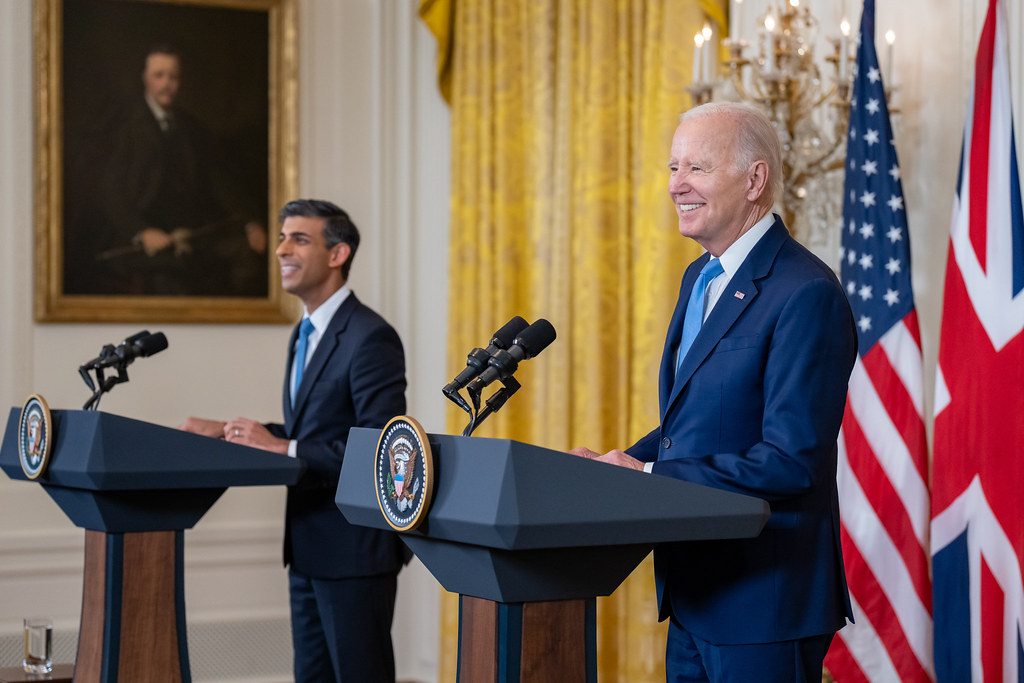
President Joe Biden said the strikes were meant to demonstrate that the U.S. and its allies “will not tolerate” the militant group’s ceaseless attacks on the Red Sea. And he said they only made the move after attempts at diplomatic negotiations and careful deliberation.
“These strikes are in direct response to unprecedented Houthi attacks against international maritime vessels in the Red Sea — including the use of anti-ship ballistic missiles for the first time in history,” Biden said in a statement. He noted the attacks endangered U.S. personnel and civilian mariners and jeopardized trade, and he added, “I will not hesitate to direct further measures to protect our people and the free flow of international commerce as necessary.”
[…]
The strikes marked the first U.S. military response to what has been a persistent campaign of drone and missile attacks on commercial ships since the start of the Israel-Hamas war. And the coordinated military assault comes just a week after the White House and a host of partner nations issued a final warning to the Houthis to cease the attacks or face potential military action. The officials described the strikes on condition of anonymity to discuss military operations. Members of Congress were briefed earlier Thursday on the strike plans.
The warning appeared to have had at least some short-lived impact, as attacks stopped for several days. On Tuesday, however, the Houthi rebels fired their largest-ever barrage of drones and missiles targeting shipping in the Red Sea, with U.S. and British ships and American fighter jets responding by shooting down 18 drones, two cruise missiles and an anti-ship missile. And on Thursday, the Houthis fired an anti-ship ballistic missile into the Gulf of Aden, which was seen by a commercial ship but did not hit the ship.
In a call with reporters, senior administration and military officials said that after the Tuesday attacks, Biden convened his national security team and was presented with military options for a response. He then directed Defense Secretary Lloyd Austin, who remains hospitalized with complications from prostate cancer surgery, to carry out the retaliatory strikes.
In a separate statement, U.K. Prime Minister Rishi Sunak said the Royal Air Force carried out targeted strikes against military facilities used by the Houthis. The Defense Ministry said four fighter jets based in Cyprus took part in the strikes.
Noting the militants have carried out a series of dangerous attacks on shipping, he added, “This cannot stand.” He said the U.K. took “limited, necessary and proportionate action in self-defense, alongside the United States with non-operational support from the Netherlands, Canada and Bahrain against targets tied to these attacks, to degrade Houthi military capabilities and protect global shipping.”
The governments of Australia, Bahrain, Canada, Denmark, Germany, Netherlands, New Zealand and South Korea joined the U.S. and U.K. in issuing a statement saying that while the aim is to de-escalate tensions and restore stability in the Red Sea, the allies won’t hesitate to defend lives and protect commerce in the critical waterway.
Reuters (“US and Britain strike Yemen in retaliation for Houthi attacks on shipping“) adds:
A U.S. official said the targets were not just symbolic but intended to weaken the Houthis’ ability to attack: “We were going after very specific capability in very specific locations with precision munitions.”
In a country only just emerging from nearly a decade of war that brought millions of people to the brink of famine, morning brought long queues at petrol stations from people fearing an extended new conflict with the West.
[…]
U.S. Defense Secretary Lloyd Austin, who is in hospital due to complications from surgery, said in a statement that the strikes had targeted Houthi drones, ballistic and cruise missiles, coastal radar and air surveillance.
Houthi attacks on commercial ships have forced shipping lines to send vessels on a longer, costlier route around Africa, creating fears that a new bout of inflation and supply chain disruption could derail the global economic recovery.
Carmaker Tesla said delays to parts supplies from Asia due to Red Sea unrest had forced it to shut its factory in Germany for two weeks, the first big manufacturer to make such an announcement.
But Washington has had to weigh its determination to keep the shipping lane open against the risk of spreading war in the region. The strikes were the first by the United States on Yemeni territory since 2016, and the first time it has attacked the Iran-backed Houthis at such scale.
“The concern is that this could escalate,” said Andreas Krieg at King’s College in London.
Saudi Arabia called for restraint and “avoiding escalation”. The Saudis have for nearly a decade backed the opposing side in a war against the Houthis, which has lately been in a delicate state of U.N.-backed peace negotiations.
The United States also accused Iran of being involved operationally in the Houthi attacks, providing the military capabilities and intelligence to carry them out.
“We believe that they have been certainly involved in every phase of this,” a senior U.S. official told reporters.
Violence has also escalated in Lebanon, the Israeli-occupied West Bank, Syria and Iraq in the three months since Israel mounted a military assault on Gaza.
NYT (“U.S.-Led Strikes Spark Outrage in Middle East“):
Many in the Middle East, including some U.S. allies, condemned the American-led airstrikes against Houthi targets in Yemen on Friday and warned that they risked causing a broader conflict in the region.
The strikes came after a series of Houthi attacks against ships in the Red Sea. The Houthis have said they are targeting Israeli ships and vessels headed to Israel in an effort to support Palestinians in Gaza, who have been under relentless Israeli bombardment for nearly 100 days, although some Houthi targets have had no clear connection to Israel.
[…]
Even close U.S. ally Oman, which often mediates between the Houthis and international parties, expressed concern, a reflection of the fear that the American-led action would not deter the Houthis but would only inflame regional conflict.
“It is impossible not to denounce that an allied country resorted to this military action, while meanwhile, Israel is continuing to exceed all bounds in its bombardment, brutal war and siege on Gaza without any consequence,” Oman’s Foreign Ministry said in a statement.
In Bahrain, another U.S. ally, people took to the streets on Friday to protest their country’s involvement in the military coalition, according to Bahraini activists who shared pictures of the demonstrations. Amid popular anger over its participation in the coalition, the Bahraini government has not independently acknowledged its role, but was named in the joint statement announcing the strikes.
The Biden administration has signaled that these strikes would be forthcoming absent change in Houthi behavior for days now, so they’re hardly a shock. The United States has been the primary enforcer of the law of the sea, including freedom of navigation, for generations now and, certainly, wasn’t going to allow a nonstate actor to get away with attacking commercial shipping.
Whether this leads to wider escalation remains to be seen. Iran has certainly enabled the Houthi attacks, as well as Hezbollah attacks into Israel. While destabilization hardly seems in their interest, adding to Israel’s challenges is.
The oil markets went up 4% overnight, the NYT reports:
Oil prices rose sharply on Friday as the Middle East conflict looks to be spreading. Brent crude, the international benchmark, rose by about 4 percent to just over $80 a barrel.
“It’s obviously an escalation,” said Richard Bronze, head of geopolitics at Energy Aspects, a London-based research firm. Brent crude last breached $80 a barrel briefly in late December.
Mr. Bronze said that it was unlikely that the United States-led airstrikes on Houthi positions in Yemen would stop attacks on shipping by the Iran-backed force.
“In many ways the group has been trying to provoke exactly this kind of response,” he said.
So far, though, the impact on energy prices from the attacks on ships in the Red Sea has been limited because oil and natural gas tankers have not been impeded as much container vessels.
In addition, traders view the market as having plenty of oil. In an indication of this situation, Saudi Aramco, the Saudi national oil company, recently cut its prices for crude oil to Asian refiners for February by $2 a barrel.
That sounds alarming until one looks at the accompanying graph:

Unless I’m missing something, this is hardly an unusual fluctuation and, indeed, prices are way down since the war in Gaza started.