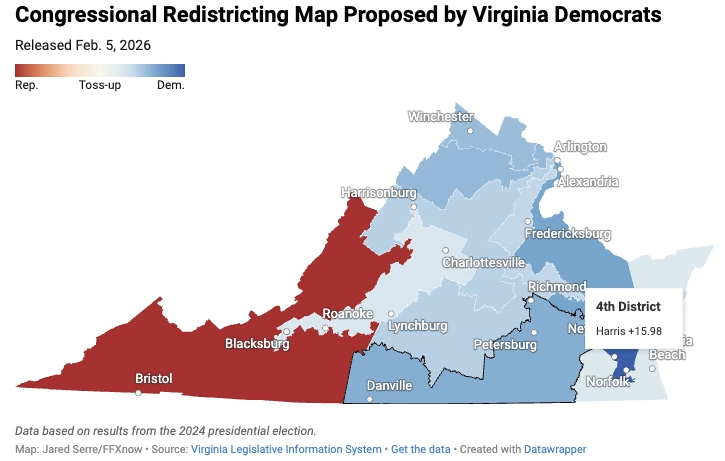
Virginia Passes Radical Gerrymander

Fighting autocracy with autocracy.

Map: Jared Serre/FFXnow

NYT (“Virginia Passes Gerrymandered House Map, Lifting Democrats’ Midterm Chances“):

Democrats maintained their electoral momentum on Tuesday by securing the passage of an aggressively gerrymandered House map in Virginia, which could deliver the party up to four extra seats as it tries to win back control of Congress.

National party leaders had been heavily invested in the outcome, with Representative Hakeem Jeffries of New York, the minority leader, helping orchestrate the statewide Virginia referendum with Democratic state legislators. Speaker Mike Johnson, hanging on to a slim majority, tried to rally the state’s Republicans.

Democrats sought to focus the campaign on President Trump, who instigated the nationwide redistricting fight last summer in Texas to help House Republicans in the midterms. A vote for a gerrymandered House map, Democrats argued, was a vote to help their party stop Mr. Trump’s agenda. The president stayed out of the contest until the final hours before Election Day, when he urged Virginians to block the map.

“Donald Trump tried to rig the midterm elections by gerrymandering the national congressional map,” Mr. Jeffries said in an interview on Tuesday night. “He has failed.”

[…]

The vote in Virginia erased the small structural advantage that Republicans had built in the country’s redistricting battle.

Republicans could still seize back their edge, however, with the prospect of a new map in Florida. And the Supreme Court may well set off a political earthquake with a ruling that upends a key provision of the Voting Rights Act, which could lead to more Republican gains.

But for now, Democrats have averted their fears from the start of the gerrymandering fight that Republicans could gain an overwhelming cartographic advantage. And with the political environment shifting in their favor, they are increasingly optimistic about winning back the House.

Mr. Jeffries, in the interview, made clear that he expected Democrats to claim nearly all of Virginia’s 11 House districts.

“In November, we’re going to win 10 congressional seats in Virginia and take back control of the House of Representatives,” he said.

WaPo (“Takeaways from Virginia’s vote to boost Democrats in national redistricting war“) notes:

The Supreme Court is slated in the coming weeks to deliver a Voting Rights Act decision that could allow Republicans to draw new lines for a swath of additional seats.

Such a ruling would be a boon to Republicans, but it may come too late to have much effect on this year’s midterm elections. Some states have already held their primaries, and others will do so soon, which will prevent them from establishing new districts for this fall. But they could take advantage of the expected decision for the 2028 elections.

The specifics of the ruling will determine whether Republicans can draw more districts in their favor and, if so, how many. If the Supreme Court strikes down a key provision of the Voting Rights Act, Republicans could redraw a dozen or more seats in their favor.

An analysis by the liberal groups Fair Fight Action and Black Voters Matter put the number of districts that could be redrawn as high as 19.

The practicality of this is unclear, given many states have already held their primary elections for the 2026 race.

Regardless, the whole thing is simply outrageous. Virginia is a purple state, with a slight Democratic lean at the presidential level, owing mostly to the rapid growth in recent years of the DC suburbs and exurbs of Northern Virginia. It was very much a red state when I moved here in 2002. The existing districts, which give the state 6 Democrats and 5 Republicans in Congress, is quite representative. The new one, which gives Democrats an advantage in 10 of 11 districts, is simply a disenfranchisement of nearly half the population.

But, of course, Virginia voters weren’t operating in a vacuum. President Trump demanded that red states work to steal seats in a likely-to-fail effort to maintain control of the House in the midterms. While many resisted, some complied. So, California and Virginia actually overturned provisions in their own constitutions requiring nonpartisan districting to fight back.

The result, though, is a furthering of the trend to turn Americans into partisans rather than citizens. So, for example, the new map splits Fairfax County, where I live, across five Congressional Districts. Which effectively means there will be no Member representing the county. Fairfax residents voted to do so by a 39-point margin.

Presuming Florida joins in, as expected, and the courts allow all of these efforts to go through, the net effect on the midterm outcome will likely be negligible. The efforts will largely cancel each other out. But American democracy, such as it is, has been further eroded. And, despite claims from the likes of Gavin Newsom and Abigail Spanberger that these are temporary, emergency measures, I’m skeptical that this won’t be the new normal.

FILED UNDER: Congress, Democracy, US Politics, , , , , , , , , , , , , , , , , , ,
James Joyner
About James Joyner
James Joyner is a Professor of Security Studies. He's a former Army officer and Desert Storm veteran. Views expressed here are his own. Follow James on Twitter @DrJJoyner.

Comments

  1. Jen says:

    This was all so avoidable. Gov. Abbott has a LOT to answer for, I believe.

    None of this had to happen, but the blame for this all needs to be laid squarely at the feet of the President and the Republicans.

    The new one, which gives Democrats an advantage in 10 of 11 districts, is simply a disenfranchisement of nearly half the population.

    This is similar to the lines in Wisconsin, which hugely favors Republicans despite leaning Democratic. I despise gerrymandering, and feel that it distorts and disenfranchises a LOT of voters. Districts should strive to be compact, contiguous, and competitive.

    ReplyReply
    7
  2. the whole thing is simply outrageous.

    Taken as an isolated event, sure. Taken as part of the broader whole, far less so.

    The real outrage, to get on one of my hobby horses, is that we are using an electoral mechanism invented in the 1700s, and there are ways to easily construct a system wherein parties would get roughly the same percentage of seats as the percentage of the vote they receive.

    Maybe, just maybe, if enough people grasp that the districting wars can be mutually damaging, some sort of reforms will be explored.

    But American democracy, such as it is, has been further eroded.

    Competitiveness in elections has been further eroded, as has accountability of elected officials ot voters. This is a massive problem.

    Democracy may have been enhanced, in a national sense, if the result of all this back-and-forth means that the rough national partisan preferences are reflected in the House.

    Also, it counters the party actively attacking democracy.

    ReplyReply
    6
  3. And to be clear: I don’t like having to do this, as I noted in the CA case.

    ReplyReply
    2
  4. @Jen:

    Districts should strive to be compact, contiguous, and competitive.

    BTW, I agree in the abstract, but setting aside the districting wars, it behooves me to note that it would be impossible to adequately draw all 435 districts to fit those criteria, and proportional representation really is the only answer.

    ReplyReply
    2
  5. Modulo Myself says:

    I remember before the 2000 election there was talk that Bush might win the popular vote but lose the EC. There was some Republican on television saying if that happens then the system will have to be fixed. I’m guessing it would have been fixed. Bush would have ended up being President and probably an archaic political system would have been dragged forward into modernity.

    The opposite took place, and the Republican myth that they were the silent majority was turned upside down. Everything partisan since then has revolved around the need to make things more archaic and unfair in order to ignore reality, because one party can’t handle it.

    ReplyReply
    5
  6. wr says:

    Let us not forget where the ultimate blame for this resides: On John Roberts and the corrupt, politicized Supreme Court, which took out a little time from ruling that corruption could never be prosecuted to insist that there’s nothing wrong with political gerrymandering.

    Up next — their ruling that there’s nothing wrong with racial gerrymandering, because we’re past all that race stuff now.

    ReplyReply
    10
  7. DK says:

    Regardless, the whole thing is simply outrageous.

    Depends on what “the whole thing” means.

    If said whole includes…

    – a Senate which by structure and procedure routinely disenfranchises both the national majority and the most populous states
    – an Electoral College system which disenfranchised the democratic majority in 2016, handing the presidency to an incompetent, unqualified, unfit pederast who received 3+ million fewer votes than Hillary Clinton
    – a dishonest, radical, rightwing Supreme Court majority, formed in undemocratic disenfranchisment, ruling corruptly to gut voting rights, flood elections with dark money, supercharge gerrymandering, and protect presidential criminality
    – that same protected president (who should’ve been constitutionally blocked from office after attempting a coup and inciting a terror attack on Congress) returning to power and initiating mid-decade gerrymandering

    …then, yes, the whole thing is outrageous.

    If “the whole thing” references this VA redistricting alone, then no it’s not outrageous. Because it is an inevitable and welcome corrective to all that outrageousness upstream.

    Belatedly-outraged conservatives, including those on SCOTUS, are welcome to admit they were wrong and to then join decades-old liberal efforts in a) requiring Electors ratify the national popular vote, b) making it easier to vote not harder, c) outlawing gerrymandering nationwide, and d) making the Senate more democratic by ending the automatic 60-vote procedural filibuster.

    Failing that, Dems in VA and elsewhere declining to unilaterally disarm is righteous and justified.

    ReplyReply
    7
  8. gVOR10 says:

    @Modulo Myself:

    Everything partisan since then has revolved around the need to make things more archaic and unfair in order to ignore reality, because one party can’t handle it.

    As Jane Mayer documented in Dark Money, back in the 80s the Koch Bros realized their brand of libertarianism couldn’t attract a majority, so they and their circle set out to rule without a majority. Their most successful effort has been buying the Supreme Court. The bought Court , as @wr: notes, has legalized bribery and blessed political gerrymanders. They’ve also granted Trump criminal immunity and removed almost all barriers to money in politics.

    ReplyReply
    2
  9. Jen says:

    @Modulo Myself: I’m not sure what you’re saying here:

    I remember before the 2000 election there was talk that Bush might win the popular vote but lose the EC. There was some Republican on television saying if that happens then the system will have to be fixed. I’m guessing it would have been fixed. Bush would have ended up being President and probably an archaic political system would have been dragged forward into modernity.

    Did you mean to type “wouldn’t have ended up being President”? If he’d lost the EC, he would not have been elected.

    ReplyReply
  10. Jen says:

    @Steven L. Taylor: Agreed–the word “strive” is doing some heavy lifting in my comment.

    ReplyReply
    1

Speak Your Mind

*






