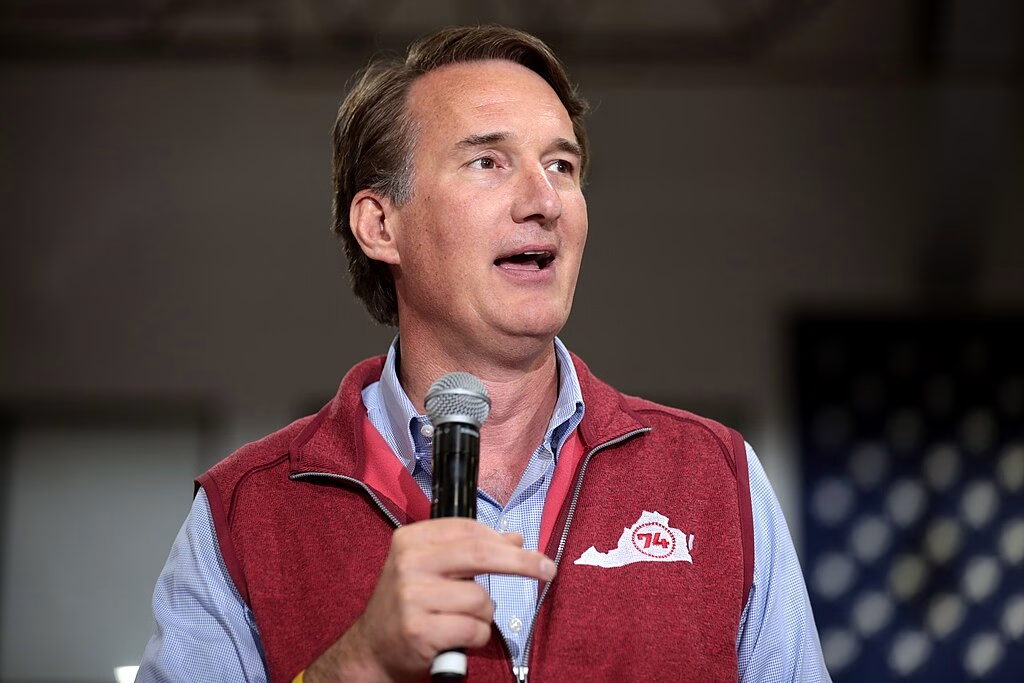
Less than six weeks into his term as governor, Republican Glenn Youngkin has more Virginia voters who approve than disapprove. WaPo:
Virginia voters disagree with Gov. Glenn Youngkin (R) on several major issues and are slightly more negative than positive about his performance after a month in office, according to a poll from the Wason Center for Civic Leadership at Christopher Newport University.
Forty-one percent of voters say they approve of the job Youngkin is doing compared with 43 percent who disapprove, with 16 percent saying they don’t know how they feel, the poll found. While the numbers are heavily partisan — Republicans are almost universally positive and Democrats sharply negative — Youngkin’s overall approval “is certainly lower than those of recent governors in Wason Center polling early in their term,” center academic director Quentin Kidd said in a news release.
In fairness, 41 percent approval and 43 percent disapproval in a poll with a margin of error of 4.2 percent amounts to a tie. And I don’t truly consider a politician “underwater” unless their disapproval is above 50 percent. Still, he’s aggressively pursuing conservative policies more closely aligned with Florida or Alabama than with a state that has voted Democratic the last four elections.
The CNU poll finds that Virginia voters seem to be to the left of Youngkin on many of his most high-profile issues, including taxes.
With the state running huge budget surpluses, 59 percent of voters want to use the money on “underfunded government services, such as education, public safety and social services,” while 38 percent favor tax cuts or rebates, according to the poll.
At least one tax cut is popular, though, with nearly three-quarters of voters favoring some form of relief from the state’s 2.5 percent tax on groceries — 47 percent preferring a total repeal of the tax, as Youngkin is seeking, and 25 percent favoring a grocery tax credit for low-income Virginians.
The poll finds that Virginia voters are not on board with Youngkin’s crusade against critical race theory, which is an academic framework for studying systemic racism that is not on the state’s K-12 curriculum. Slightly more than a third of voters (35 percent) support a ban on teaching critical race theory in public schools, while 57 percent oppose such a ban.
Similarly, nearly two-thirds of voters (63 percent) support teaching “how racism continues to impact American society” while one-third (33 percent) oppose such teaching, according to the poll.
The poll’s findings also undercut the law that makes masks optional in public schools, finding that 56 percent of voters think a decision about masks in schools should be based on health data and experts, while 41 percent think it should be left up to parents.
A majority of voters also support requiring coronavirus vaccination for people in jail or prison, first responders, members of the military, teachers and medical providers, the poll found. Respondents were almost evenly split on whether to require vaccination for college students or state government employees, with 50 percent saying yes and 48 percent no for both.
There was less support for requiring coronavirus vaccination in public schools. Voters were evenly split (49-49) on whether to require shots for high school students, but slightly opposed to requiring vaccination for middle-schoolers (51 percent no, 47 percent yes) and very opposed to requiring them for children in elementary school (55 percent no, 42 percent yes).
Virginia voters also favor remaining in the Regional Greenhouse Gas Initiative, a multistate compact aimed at reducing carbon pollution that Youngkin has vowed to exit because he thinks it drives up consumer energy bills. More than two-thirds of voters (67 percent) say they favor remaining in the initiative, with 26 percent calling for an exit.
I’d be surprised if most Virginians had given more than a moment’s thought to the Regional Greenhouse Gas Initiative, much less had a strong opinion about it. But otherwise Youngkin is running the Republican playbook in a Democratic state.
Which brings me to the reason I’m writing about local politics at a site where relatively few readers live, as I do, in Virginia: the strangeness of our politics.
As I’ve noted more than once, the Commonwealth elects its statewide offices (governor, lieutenant governor, and attorney general—all of whom run independently of one another) in off-off years—odd-numbered years that fall between Presidential and Congressional cycles.* Not only does this just about guarantee low turnout but it has the odd impact of almost always going in the opposite direction of the state’s vote in the Presidential election the year prior. Thus, a state that voted Republican in every Presidential election from 1976 through 2004 elected five Democrats as governor during that span. And, despite having voted Democrat for President in the last four elections, it has elected two Republican governors in the year after.
In a high-turnout election, Virginians would almost certainly have elected the Democrat, Terry McAuliffe, rather than Youngkin. But Republicans have a natural advantage in low-turnout contests because their key constituency groups, the elderly and wealthy, are more likely to vote. And, ten months into President Biden’s term, Democrats are simply less likely to be energized, both because they’re not angry at a sitting Republican President and because they’re deflated that Biden wasn’t able to enact all of the policies he ran on.
Compound that with the fact that Virginia is the sole remaining state where a governor can’t serve a serve a second, consecutive term, and our representative democracy is neither representative nor democratic. Youngkin really has no incentive to moderate his policy positions to please the majority of Virginia residents. His next step is either to retire from politics and go back into business or, most likely, a run for President. In either case, pleasing Republican primary voters is where his incentives lie.
Indeed, the main constraint on Youngkin is the other undemocratic weirdness of Virginia’s system: the fact that the legislature is elected in a different off-off year election than the executive. Democrats still have a narrow margin in both houses based on their wins in the 2019 election. They’re up again in November 2023, when most voters are paying more attention to the 2024 Presidential primaries than to state politics.