
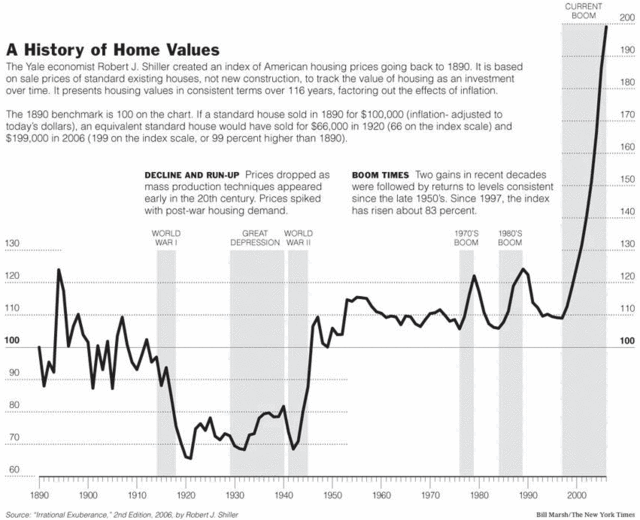
Alex Tabarrok has generated quite a buzz over his suggestion that the “housing bubble” might be a myth. He begins with this graph of housing prices from Robert Shiller published in the NYT:

The clear implication of the chart is that normal prices are around an index value of 110, the value that reigned for nearly fifty years (circa 1950-1997). So if the massive run-up in house prices since 1997 was a bubble and if the bubble has now been popped we should see a massive drop in prices.
But what has actually happened? House prices have certainly stopped increasing and they have dropped but they have not dropped to anywhere near the historic average.
He goes further and posits that prices are unlikely to ever drop anywhere near the 110 level which means we’re not only not in a housing bubble but have established a much higher equilibrium.
Paul Krugman terms this analysis “strange,” noting that past bubbles took around six years to fully deflate and that the housing futures market is expecting a continued decline for the foreseeable future.
Megan McArdle agrees that there’s a new equilibrium but is baffled as to why it should be.
Fester figures the combination of cheap, easy credit and rampant speculation in the housing market constitutes a bubble no matter how you slice it.
Our own Dave Schuler, moonlighting at his own site, lists seven reasons why the whole thing is unlikely to “blow over” any time soon.
Kevin Drum finds Tabarrok’s argument “odd,” noting that “I too don’t expect to see home prices go down to their historical levels, but if the housing index goes from 110 to 200 and then crashes back to 160, what would you call that? I’d call it both a new equilibrium and a bubble.”
So would I.
At the individual level, it all depends on timing. If you bought a house in the Washington, D.C. area twenty years ago for $150,000 and can now sell it for $900,000 and retire to Florida in luxury, you’re in great shape. It really doesn’t matter that you’ve “lost” $200,000 compared to what you could have sold the same house for eighteen months ago. On the other hand, if you bought the house three years ago for $1.1 million and can’t keep up with the new rates now that your ARM has kicked into gear and can’t sell it and pay off the mortgage, the fact that the house still has historically high value isn’t of much consolation.
At the macro level, though, it’s hard to argue that it’s not a bubble. One can argue, as I have, that it was a self-fulfilling prophecy largely created by years of “housing bubble is coming” prophecy and a Fed trying to cure irrational exuberance by jacking up interest rates. But that doesn’t make it not a bubble, just a bubble that didn’t have to burst.









