

The OU Daily reports: OU puts graduate instructor on leave after student claims discrimination on Bible-based essay grade.
OU placed a graduate student instructor on leave after a student publicly contested a grade and filed an illegal discrimination claim after she received a failing grade on an essay that cited the Bible.
[…]
“The University of Oklahoma takes seriously concerns involving First Amendment rights, certainly including religious freedoms. Upon receiving notice from the student on the grading of an assignment, the University immediately began a full review of the situation and has acted swiftly to address the matter,” the statement read.
Like the case at Texas A&M that I wrote about earlier this year, the issue in controversy is linked to gender, although in this situation, it is in a psychology course.
According to the statement, university leaders contacted Samantha Fulnecky, a psychology junior, the day she submitted her complaint, and a formal grade appeals process was conducted. Steps were taken to ensure there was no academic harm to the student, the statement reads.
OU also placed a graduate student instructor on administrative leave and placed a different full-time professor to teach the class for the remainder of the semester after the student reported filing a claim of illegal discrimination based on religious beliefs.
“OU has a clear process for reviewing such claims and it has been activated, …” the statement reads. “OU remains firmly committed to fairness, respect and protecting every student’s right to express sincerely held religious beliefs.”
Let me state, as a former university administrator, that I find it highly unlikely that the standard operating procedure in such a case is to suspend the instructor and assign a different faculty member to finish out the term.
And allow me to add: I agree that a student should not be discriminated against based on their religious convictions. However, upon reading the student’s work, I can assure you that that is not what is going on here. The essay and the grading criteria have been provided by The Oklahoman (OU student says essay grade was a violation of her rights. Read the essay).
In simple terms, the student received a poor grade not because of her beliefs, but because she didn’t answer the question that was asked and did not fulfill any of the stated criteria. The assignment was to react to a specific article. Apart from making a few references to “the article,” there is almost nothing about the article’s content (the closest specific appears to be the student disagreeing with the article by endorsing children teasing other children over gender issues, which the article criticized). There is therefore no clear link back to the article (worth 10 points), nor is there a specific reaction to the content of the article (worth 10 points). The piece is just a rumination, in super vague terms I would note, about the student’s views, and so I can see why the instructor took off the 5 points for clarity. I could make a case to give the essay maybe a 3 to 5 instead of 0 (there is some tenuous connection to the general topic of the article, with one very weak reference and her point is clear, to a point), but the 0 is perfectly defensible. This is, after all, a reaction paper with very little direct reaction taking place.
It is worth noting that a second instructor reviewed the grade and concurred with the initial assessment.
Even the NY Post described the assignment as follows (emphasis mine).
In her essay, which was supposed to cover “how people are perceived based on societal expectations of gender,” University of Oklahoma student Samantha Fulnecky presented a biblically fueled tirade against the notion that there are multiple genders.
[…]
In the essay, Fulnecky repeats ad nauseam that she doesn’t take issue with gender stereotypes because “that is how God made us.” However, she neglected to cite the article she was responding to, save for a vague reference to “teasing as a way to enforce gender norms.”
Nonetheless, the governor is commenting publicly and calling on the Board of Regents to get involved. None of this is appropriate. Neither the governor nor the regents have any capacity or standing to make narrow academic judgements, even if they are at the top of the university’s org chart (back to the OU Daily write-up).
Gov. Kevin Stitt wrote in a post on social platform X Sunday that the situation was “deeply concerning” and called on the OU Board of Regents to review the results of the investigation.
I was involved in a similar case in my previous life. A student in history based an entire graduate-level response on the notion that a certain key development in American history was because of divine intervention rather than actually answering the question the way a historian ought. One is more than free to believe that to be the case, but it is not an acceptable way to provide an academic response in an academic setting.
No one is saying, by the way, that the student can’t believe what she wants nor that she cannot say what she wants, i.e., her First Amendment rights are not being violated here. Having the right to freely speak and to believe whatever you want does not mean that citing your religious beliefs results in an automatic gateway to an “A” on an assignment. You can state all day long that the Earth is only thousands of years old, based on your belief that the Bible provides that answer, but that will not get you a passing score on a geology exam. You may wish to claim, based on a certain past interpretation of the text, that the Sun orbits the Earth, but that’s an F for you.
A Flat Earther, to pivot to another belief system, cannot assert First Amendment rights in objection to their failing astronomy grade.
A few elements that are really important.
- This was an attack on a graduate student–someone who is quite vulnerable. Not only are we talking about the lack of tenure, but we are talking about someone who does not yet have their degree, and serious disruptions to their progression could be career-destroying. Further, teaching at this stage is CV building (i.e., important fodder for job-seeking).
- The graduate student is trans, which further suggests this was a deliberate choice to create a controversy by the student and others.
- The student’s mother is an attorney connected to GOP politics (including defending J6 defendants).
- Turning Point USA is in the middle of all of this.
It is worth remembering that the incident at A&M involved a non-tenured faculty member by a student who had broader connections to GOP politics.
Why does this matter apart from the specific details of the case as it pertains to the student’s grade and the instructor’s future? This is about broad, national politics and attacks on academic freedom, knowledge, and even learning itself. University officials are reacting this way to an utterly obscure single assignment because of a combination of anti-trams prejudice as well as a general anti-intellectual attitude that is gripping parts of the populace and genuine fear of retribution from the federal government. This is incredibly disturbing.
I cannot stress how penny-ante this situation is, taken in proper context. The University if Oklahoma has an undergraduate population of over 23,000 students. A full-time load is 4 courses per semester, and a normal load is 5, with a handful of students perhaps in part-time status and some taking overloads. A heavily conservative estimate would say that there are well over 100,000 total course enrollments this semester, meaning hundreds of thousands of individual assignments being graded. There are likely thousands of students who are certain that their professors and graduate assistants are mean, unfair, if not, utterly biased. If the administration, governor, regents, etc., took the individual time to deal with each of those students the way they are dealing with the one I am writing about here, the university would literally be paralyzed.
The fact that so many in the American academy have so easily reacted to fear is stunningly depressing.
This is all, pure and simple, an authoritarian ethos at work. It is stating that knowledge and learning are subject not to the internal development of the academy, broadly defined, but instead must conform to the accepted orthodoxy of the regime or else punishment may ensue.
I would note the idea of TPUSA installing chapter at high schools and colleges/universities so that they can keep an eye on faculty and provide “watchlists” sounds a lot like having political officers embedded to make sure everyone conforms with regime orthodoxy (certainly as long as the regime is willing to withhold millions of dollars if it doesn’t like your university).
If people think that the current scientific consensus on whatever matter at hand is wrong, they have the same opportunity to change it that we all have. Read, study, research, even degress, argue with facts, try to prove your position, while all the while being willing to have your own mind changed (such is the core of scientific inquiry). It is long, hard, and often fruitless work.
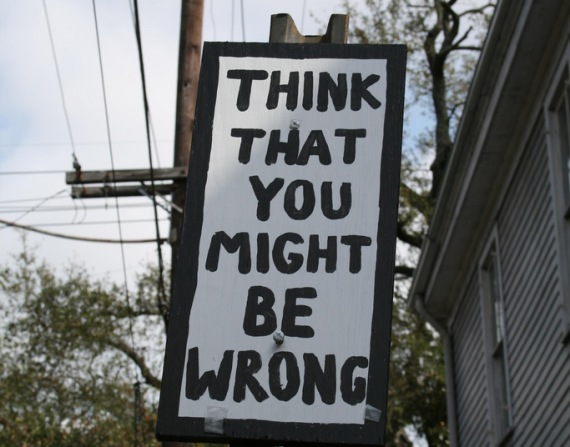
Above all else, think that you might be wrong.
Simply asserting is true because of personal beliefs, simply doesn’t cut it, pure and simple even if large political forces will temporarily back your claims via power instead of knowledge.
Let me conclude with practical advice for students.
- Read the assignment thoroughly and answer the question that is asked! It is amazing how often students will answer some other question that they have conceived in their own minds.
- Make sure to conform to any provided rubric or guideline.
- Don’t simply assert; make an evidence-based argument.
- If you attempt to make a solid argument, you will likely get a good score, even if the conclusion is controversial.
While it is true that there are instructors out there who want students to conform to a very specific point of view, the reality is that how a student answers is often as important, if not more so, than what answer provided is. Granted, that is also often discipline-specific. But even in the experimental/lab sciences (or even math) a partial answer, well-constructed, even if ultimately wrong, is likely to net partial credit.
The best way to a zero score is to assert an argument-free opinion.
One concluding thought: if a given student is certain that they already have all the answers, what are they doing wasting their time in schools? I mean, why waste all that time and money? The notion of pursuing an education only to have all your pre-existing views, positions, and knowledge confirmed is a remarkable one to hold. What’s the point?









