AP (“GOP Sen. Dan Sullivan draws an unusual opponent in Alaska’s primary — and he’s not happy about it“):
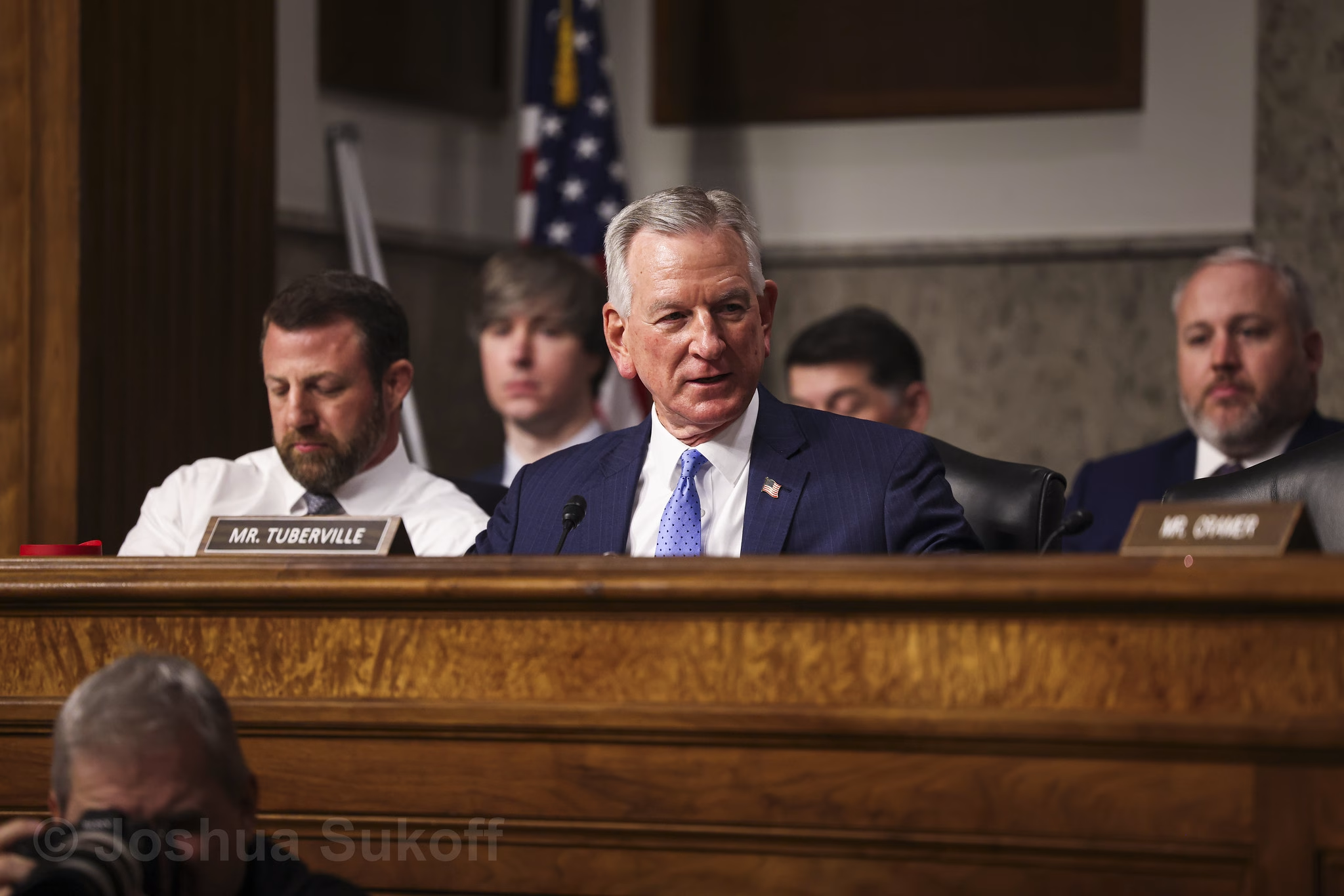
Republican U.S. Sen. Dan Sullivan is running for reelection in Alaska and faces a field of 15 competitors. One of them is Dan Sullivan.
The senator told reporters in Washington, D.C., on Tuesday that he thinks the appearance on the state’s primary ballot of another Republican with the same name is a dirty political trick coordinated by Democrats and the campaign of his chief rival for the seat, former Democratic U.S. Rep. Mary Peltola. He threatened a lawsuit to get to the bottom of it.
“Everybody in Alaska knows I’m Dan Sullivan-R. So he’s trying to do that. Why?” the senator said of the other Dan Sullivan. “He’s not an R. He’s purposely trying to trick my constituents to rig the election for Peltola.”
A spokesman for the Peltola campaign, Harry Child, said it “has no involvement with either Sullivan campaign.” Jenny-Marie Stryker, executive director of the Alaska Democratic Party, said her organization “is in no way affiliated with either Dan Sullivan.”
The kerfuffle over the dueling Dan Sullivans on Alaska’s August primary ballot has drawn the attention of state and national Republicans. They claim that adding a second Dan Sullivan to the ballot will sow confusion among voters who support the incumbent and help Peltola.
In Alaska’s primary, the top four vote-getters, regardless of party affiliation, advance to the ranked-choice general election.
Blake Murphy, an attorney for the National Republican Senatorial Committee, sent a letter dated Monday to Alaska election officials outlining concerns about the potential for voter confusion. Murphy also raised questions about the party affiliation of the challenger, calling the other Dan Sullivan a “sham” candidate.
Murphy wrote the NRSC could consider legal action “to ensure that the Alaska electoral process remains fair.”
Carmela Warfield, the state Republican Party chair, said in a statement accompanying Murphy’s letter that until recently, the challenger was registered as undeclared. In previous years, ballots have not identified which candidates were incumbents.
A spokesperson for the Alaska Division of Elections, Steve Kirch, did not immediately respond to a request for comment on the letter and said a records request would be required to get details of the challenger Sullivan’s voter registration history.
I don’t know enough about Alaskan politics or the non-incumbent Dan Sullivan to have a definitive opinion, but this certainly looks like dirty pool on the part of the Peltola campaign. Sowing confusion in voters is a time-honored tactic of both parties, alas, however despicable it may be. And, certainly, this is an easy way to game a jungle primary.
Of course, it would be much harder to do this if the Alaska Republican Party could control who runs on their ballot line. They would be unlikely to allow anyone other than the incumbent to do so, virtually assuring Senator Sullivan’s re-nomination and re-election. Certainly, they wouldn’t allow a previously unregistered rando with no prior political experience to run for Senator on their line.
This is what we mean by “weak parties” in political science. Because the two major parties choose their nominees through primaries, and anyone can vote in any party’s primary* (or, in this case, the nonpartisan primary), neither the Democratic National Committee nor the Republican National Committee or their state equivalents have the ability to vet candidates or punish those who run under their banner for deviating from the party platform. In the extreme case, as with Donald Trump’s winning the GOP nomination in 2016, the nominee can remake the party in their own image.
*Some states require party registration, but citizens are free to register for whichever party they want before each election. Most are “open,” allowing voters to vote in either party’s primary. Most (if not all) states don’t allow switching parties in the runoff.
In states that are essentially locked into a single party, strategic voters will often vote in that party’s primary even though they intend to vote for the opponent in a general election. This creates perverse incentives, to say the least.