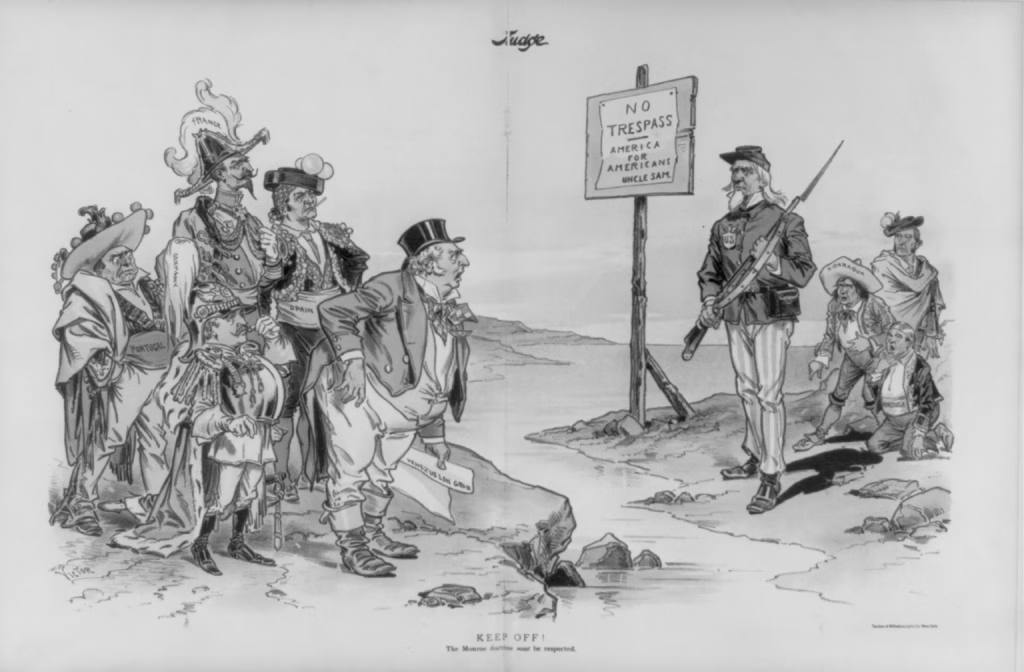
On December 2, 1823, as part of his annual address to Congress, President James Monroe articulated what would become known as the “Monroe Doctrine.” In simple terms, it was a warning to European powers that they should not seek further colonization in the Western Hemisphere and was in support of the Latin American republics that had recently declared/were in the process of declaring their independence from Spain. It is worth noting that in 1823, our young nation, which had recently been invaded by Britain, was in no position to enforce such a policy position.
Here are some relevant bits (emphases herein are mine):
With the existing colonies or dependencies of any European power we have not interfered and shall not interfere. But with the Governments who have declared their independence and maintain it, and whose independence we have, on great consideration and on just principles, acknowledged, we could not view any interposition for the purpose of oppressing them, or controlling in any other manner their destiny, by any European power in any other light than as the manifestation of an unfriendly disposition toward the United States. In the war between those new Governments and Spain we declared our neutrality at the time of their recognition, and to this we have adhered, and shall continue to adhere, provided no change shall occur which, in the judgement of the competent authorities of this Government, shall make a corresponding change on the part of the United States indispensable to their security.
[…]
It is impossible that the allied powers should extend their political system to any portion of either continent without endangering our peace and happiness; nor can anyone believe that our southern brethren, if left to themselves, would adopt it of their own accord. It is equally impossible, therefore, that we should behold such interposition in any form with indifference. If we look to the comparative strength and resources of Spain and those new Governments, and their distance from each other, it must be obvious that she can never subdue them. It is still the true policy of the United States to leave the parties to themselves, in hope that other powers will pursue the same course….
Really, as a “doctrine,” it isn’t especially clear. It has long been understood to be an assertion of some level of US dominion over the western hemisphere, but really only in terms of new European incursions or attempts to reverse the independence of the fomally Spainsh colonies. If you look further at the relevant portions of the speech, there is also some discussion of negotiations with Russia and Great Britain over the use and access to various territories.
What most people think of (if they think anything at all) when they hear “Monroe Doctrine” is more along the line of the “Olney Doctrine” (or the “Olney Corolllary” or the “Olney Interpretation”) as expressed by Grover Cleveland’s Secretary of State Richard Olney in 1895 in a letter to the British government regarding a territorial dispute over British Guyana and Venezuela. In that letter, he wrote:
Today the United States us practically the sovereign on this continent, and its fiat is law upon the subjects to which it confines its interposition. Why? It is not because of the pure friendship of good will felt for it. It is not simply by reason of high character as a civilized state, nor because wisdom and justice and equity are the invariable characteristics of the dealings of the United States. It is because, in addition to all other grounds, its infinite resources combined with its isolated position render it master of the situation and practically invulnerable as against any or all other powers.
That kind of sounds familiar, does it not?
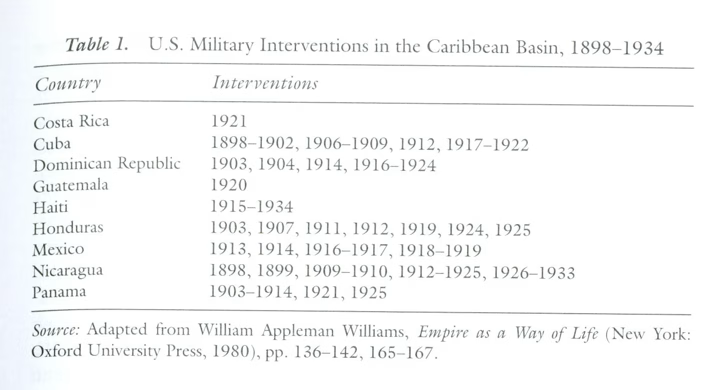
The stated principle that the US’ hegemonic control of the hemisphere also meant the right to intervene internally in Latin American states was articulated by Theodore Roosevelt in what came to be known as the Roosevelt Corollary of the Monroe Doctrine (1904):
Any country whose people conduct themselves well can count upon our hearty friendship. If a nation shows that it knows how to act with reasonable efficiency and decency in social and political matters, if it keeps order and pays its obligations, it need fear no interference from the United States. Chronic wrongdoing, or an impotence which results in a general loosening of the ties of civilized society, may in America, as elsewhere, ultimately require intervention by some civilized nation, and in the Western Hemisphere the adherence of the United States to the Monroe Doctrine may force the United States, however reluctantly, in flagrant cases of such wrongdoing or impotence, to the exercise of an international police power.
What Trump has done fits squarely in this view (an imperialist view, I would underscore) by his actions in Venezuela.
The bottom line is that all of these “doctrines” and “corollaries” are just about raw expressions of power. They are neither moral nor legal justifications for what the US is doing in Venezuela.
This is true for the so-called “Trump Corollary” as proclaimed by the administration last month:
Today, my Administration proudly reaffirms this promise under a new “Trump Corollary” to the Monroe Doctrine: That the American people—not foreign nations nor globalist institutions—will always control their own destiny in our hemisphere.
I am not even sure what that means, especially as it concerns the moral/legal argument for ousting Venezuela’s leader, claiming to now be running the country, and asserting control over its oil.
Don’t get me wrong, Maduro was a bad leader, and the regime that started with Hugo Chavez in the late 90s has been a long-term, slow-moving, man-made disaster. That Maduro is no longer in power is, in a vacuum, a good thing. The problem is that his outer is not in a vacuum, and it is wholly unclear what happens next. History dictates that it will not go smoothly.
Worse, all of this fits into Trump’s National Security Strategy, which views the world as being dominated by great powers that control their spheres of influence. You know, the way Putin looks at Ukraine.
And in that sense, likening back to Monroe, Olney, and Roosevelt is relevant, as that was a world dominated by great powers competing for colonies and influence so as to maintain their empires. Trump is very much acting like we are back in the late 19th/early 20th centuries.
Since I am scraping old PPTs from class, I will end on this as an example of what ideas like the Olney and Roosevelt corollaries wrought.