NPR’s Danielle Kurtzleben (“Trump’s Truth Social lays bare narrow obsessions of an extremely online president“) slogs through 47’s social media feed so you don’t have to. After some prelimary setup, she observes,
During his first presidential campaign, Trump’s constant stream of seemingly unvetted tweets was a sideshow that quickly became inescapable – the boasts, insults, and lies at times hijacked news cycles. Once he was elected, they presented a new frontier in American politics: a real-time view into a president’s mind.
Ten years, one Twitter ejection, one Twitter return, and a move to Truth Social later, Trump’s posts still make news – like when he announces a war or tries to pick a fight with the pope – but for many have become the background noise of American politics.
The president of the United States is now communicating with the public sometimes dozens of times a day on a social media platform that he himself created, and most Americans (and perhaps even journalists) never see most of those posts. Of course, most of those posts are not individually newsworthy. But looking at them together provides a picture of exactly what, in the aggregate, the president of the United States is thinking about and saying to the world at all hours.
Here’s a snapshot, which is somewhat interactive at the link, of what he posted in the first four months of this year:
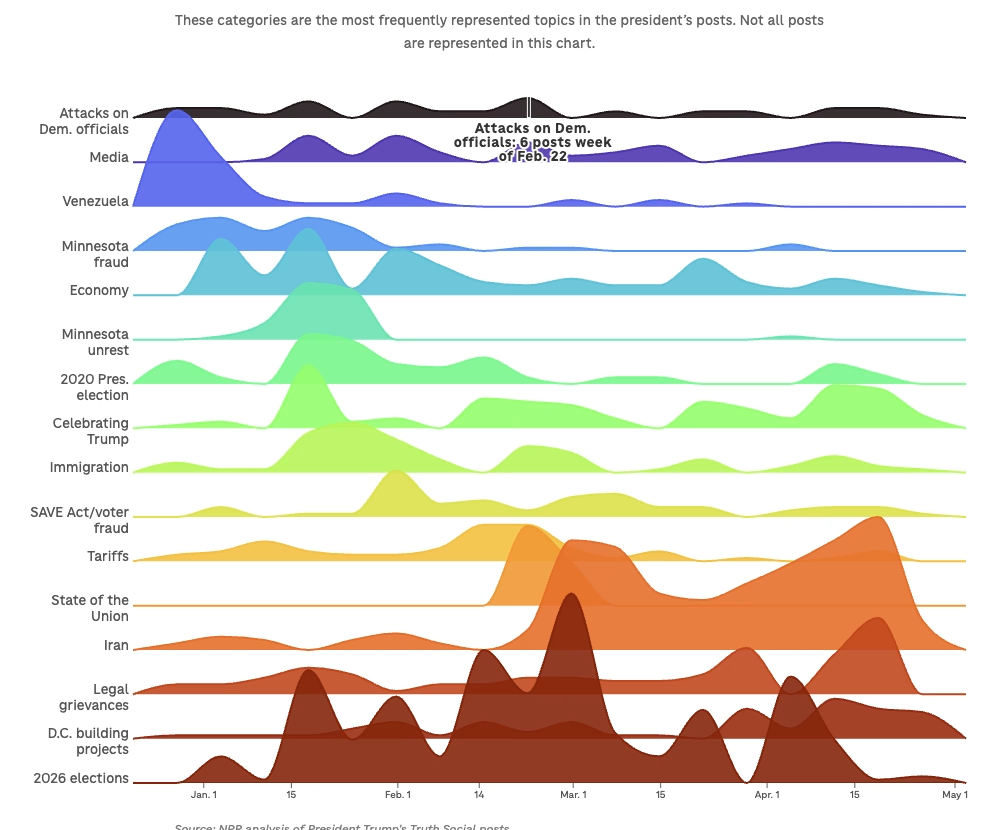
She details it thusly:
Trump posted 2,249 times in the first four months of 2026, an average of just under 19 posts per day.
The most common topic Trump posted about – at about 14% of his posts – was 2026 elections. These posts – more than 300 of them – consist largely of either candidate endorsements or posts touting a Trump-backed candidate’s win.
However, Trump at times did not give a simple endorsement, instead adding attacks on an endorsee’s opponents. For example, in endorsing Republican candidates for the Indiana state Senate, the posts became paragraph-long screeds as Trump attacked sitting senators as “RINOs” (Republicans in name only) if they voted against a Trump-backed redistricting plan.
The next most common topics after elections were Iran (247 posts) and the economy (177). He also posted dozens of times about alleged fraud in Minnesota’s safety net programs, the SAVE Act, and his belief that the justice system was weaponized against him.
To the degree that his posts measure what he’s thinking about, the president’s social media feed suggests he is as preoccupied – or even more so – with his personal projects and vendettas than he is with pressing policy matters.
President Trump posted about the 2020 election 71 times in the first four months of 2026, more than he posted even about tariffs (57 times – all of which we coded as a subset of posts about the economy). Those 2020 election posts all promoted the lie that via massive voter fraud or other malfeasance, Joe Biden stole that election.
Trump posted 68 times about his various Washington, D.C., building projects, including his White House ballroom and a proposed massive arch across the Potomac near Arlington National Cemetery. That’s slightly more than he posted about Venezuela, more than he posted about the SAVE Act he’s promoting, and more than he posted about protesters and federal agents in Minneapolis, including federal agents killing two U.S. citizens.
He posted more than six times as often (105) about his various legal grievances than he did about healthcare policy (17).
Also notable are the topics that get little attention. While tariffs and the war in Iran do affect, for example, the farm economy, Trump posted just four times specifically about American farming during the first four months of the year – less than half as many times as he posted (nine times) about his anger at comedian Bill Maher.
And then there’s this:
As for the top types of posts, the largest category – at just under one-quarter of his posts – are social media reshares. These take several formats – some are screenshots of posts from X, and others are videos reposted from other social media sites, such as TikTok.
This emphasizes the technological differences between now and Trump’s first term.
Near the end of his first term, the videos Trump posted were largely from Fox News or other right-leaning news outlets, or they were videos produced by the White House.
Now, there’s an endless array of TikTok and Instagram videos and memes the president can repost, many of them from amateurs or generated by AI. Some have been outright offensive, as when he posted a racist video that depicted former President Obama and Michelle Obama as apes. The White House initially defended the video, with White House press secretary Karoline Leavitt telling reporters, “Please stop the fake outrage.” Trump later said he hadn’t seen the full video, telling reporters, “I looked at the beginning of it. It was fine.” He did not apologize, and the post was later deleted.
Other posts have promoted conspiracy theories, as with a video that baselessly proposed that Democratic Minnesota Gov. Tim Walz was involved in the 2025 killing of Minnesota Democratic State Rep. Melissa Hortman.
Occasionally, those videos have nothing to do with current events, or even Trump, but are the kind of inane posts littering many people’s Facebook feeds. Around 11 p.m. one night in February, Trump posted a TikTok video of a person’s pet corgi reacting to a can of Reddi-wip. A minute later, he reposted that video along with a screenshot of a supporter’s X post (“Good Night Patriot Friends!”). A minute after that, he posted a 15-second video of Bruce Lee fighting, which he similarly reposted alongside another X screenshot seconds later.
As presidents are wont to do.
She observes,
To some degree, the president’s posting can be seen as an extension of his communications strategy of simply communicating a lot. Trump regularly does lengthy press gaggles in the Oval Office, and he also has the unprecedented habit of fielding calls directly from reporters who have his phone number.
However, with posts, unlike interviews, the president is not having a conversation. Rather than being prompted by a reporter, the president in his posts seemingly reveals what is on his mind at any given time. On April 2, the day he announced that Pam Bondi would be leaving her post as attorney general, President Trump was also thinking about Bruce Springsteen. He insulted the singer in two posts shared at 7:58 a.m. and 9:21 p.m. that day.
Indeed, the president’s insults and tirades have become so commonplace that they at times don’t get much notice. Some of these posts go on at length. On April 9, he wrote a more than 2,700-character post that insulted a series of right-wing commentators but also veered into the topics of Iran, election results, media outlets he dislikes, and his approval rating.
This kind of naked fury from the president of the United States toward his perceived opponents (“NUT JOBS,” “TROUBLEMAKERS,” “low IQs,” “nasty”) might once have made headlines.
In 2026, it’s a Thursday.
Granting that we live in a radically different communications era, this is the polar opposite of the approach taken by the 40th President, Ronald Reagan. In his view, Presidents should speak publicly sparingly, so as to make their every public utterance front-page news. He could dominate the news cycle with a single quote if that’s all journalists had to report.
47 is instead flooding the zone, to the point that things that would have generated hundreds of op-eds and hours of talking-head discussion now generate yawns. It’s nearly impossible to keep up with everything he says; it’s simply exhausting.Now, his posts make news only when he’s threatening to wipe out civilizations.
Thank you for your attention to this matter.