White elites, shockingly, seem to enjoy cities where the culture is dominated by white elites. Aaron Renn breaks the news.
Among the media, academia and within planning circles, there’s a generally standing answer to the question of what cities are the best, the most progressive and best role models for small and mid-sized cities. The standard list includes Portland, Seattle, Austin, Minneapolis, and Denver. In particular, Portland is held up as a paradigm, with its urban growth boundary, extensive transit system, excellent cycling culture, and a pro-density policy. These cities are frequently contrasted with those of the Rust Belt and South, which are found wanting, often even by locals, as “cool” urban places.
But look closely at these exemplars and a curious fact emerges. If you take away the dominant Tier One cities like New York, Chicago and Los Angeles you will find that the “progressive” cities aren’t red or blue, but another color entirely: white.
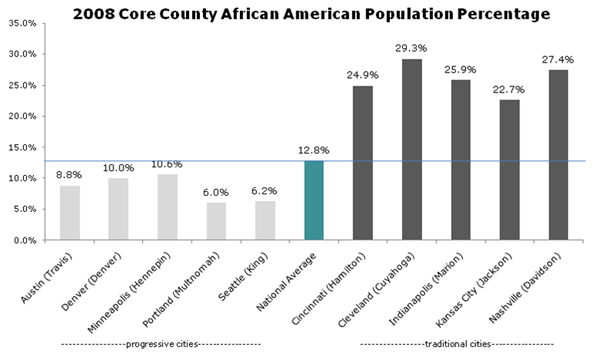
In fact, not one of these “progressive” cities even reaches the national average for African American percentage population in its core county. Perhaps not progressiveness but whiteness is the defining characteristic of the group.
He’s even got a handy dandy chart:

Not noted in the article but worth mentioning in this context: The “African Americans” in Minneapolis are mostly Africans, not Americans. There’s a huge Somali refuge population as a function of rather recent public policy decisions.
This raises troubling questions about these cities. Why is it that progressivism in smaller metros is so often associated with low numbers of African Americans? Can you have a progressive city properly so-called with only a disproportionate handful of African Americans in it? In addition, why has no one called these cities on it?
What is it that these cities are supposed to do? Send out advertisements for more blacks to move there?! Our black population is concentrated in the Deep South, for obvious reasons, and in a handful of urban centers that were built around industrial jobs and therefore encouraged a huge migration.
As the college educated flock to these progressive El Dorados, many factors are cited as reasons: transit systems, density, bike lanes, walkable communities, robust art and cultural scenes. But another way to look at it is simply as White Flight writ large. Why move to the suburbs of your stodgy Midwest city to escape African Americans and get criticized for it when you can move to Portland and actually be praised as progressive, urban and hip? Many of the policies of Portland are not that dissimilar from those of upscale suburbs in their effects. Urban growth boundaries and other mechanisms raise land prices and render housing less affordable exactly the same as large lot zoning and building codes that mandate brick and other expensive materials do. They both contribute to reducing housing affordability for historically disadvantaged communities. Just like the most exclusive suburbs.
Now, I live in the Washington, DC area, which is incredibly diverse in terms of both a large black population and a much higher international immigrant population than the national average. I’ve got no dog in this fight. But it strikes me as silly to attribute predominantly racial motivation for moving to these cities. People go there for good jobs and quality of life.
In comparison to the great cities of the Rust Belt, the Northeast, California and Texas, these cities have relatively homogenous populations. Lack of diversity in culture makes it far easier to implement “progressive” policies that cater to populations with similar values; much the same can be seen in such celebrated urban model cultures in the Netherlands and Scandinavia. Their relative wealth also leads to a natural adoption of the default strategy of the upscale suburb: the nicest stuff for the people with the most money. It is much more difficult when you have more racially and economically diverse populations with different needs, interests, and desires to reconcile.
Right. And who wants more difficult problems to reconcile?
Even Matt Yglesias finds this argument “slightly odd.” For one thing, he correctly notes that number of blacks isn’t the only measure of diversity. Austin, for example, is less white than the country as a whole, with the diversity mostly added by Hispanics. And Renn goes to great lengths to dismiss foreign immigrants, which most of these cities have in great abundance, as a proper measure of diversity since they tend to be more affluent than inner city blacks.
But to take what I think is the ray of truth here, if you take a place that’s under-invested for decades in walkable urbanism and then create a bit of walkable urbanism the tendency is for that bit to become very expensive. And since African-American households have lower incomes and substantially less wealth than white households, the tendency is for the walkable urban places to become white. But to raise this as an objection to building walkable urbanism is like saying that we shouldn’t try to have great public schools, because poor people might not be able to afford to live near them. That’s totally backwards—the inability of poor people to afford to live in good school districts highlights the need for more good educational opportunities not fewer. By the same token, if investments in walkable urbanism cause prices to shoot up and price people out of the area that shows that we need more walkable urbanism.
Right. To go further, it’s simply bizarre to criticize people for trying to build desirable communities for themselves simply because some people living elsewhere don’t have it so good.
Beyond that, it’s worth reading recent posts by Andrew Sullivan and others in reaction to Pat Buchanan‘s latest article lamenting the loss of white American culture. The upshot of all of them is that, as Sully puts it, “white Americans do not realize how black they are.” By which he means how much of our culture is impacted by black culture via what we used to call “the melting pot.” See Sully here, here, here, here, here, and here. Also James Poulos. Ann Althouse disagrees slightly.
“Diversity” is something that’s been advanced as a goal in recent years and which has in turn sparked a counter-diversity push by whites, like Buchanan, who see it as a threat. It’s a very odd thing in that there’s never been a more diverse culture anywhere. Not only are we a giant melting pot drawn from all the world’s cultures — even while our common core is Western European — but we’re incredibly heterogeneous. Life varies from city-to-city, state-to-state, and region-to-region. And “diversity” means more than “percentage of poor blacks.”
So, it’s more than slightly odd for someone to argue for more diversity by arguing we ought all be more alike.