
After reading a Guardian story is headined “A $95,000 question: why are whites five times richer than blacks in the US?” I still don’t know.

A typical white family is now five times richer than its African-American counterpart of the same class, according to a report released today by Brandeis University in Massachusetts.
White families typically have assets worth $100,000 (£69,000), up from $22,000 in the mid-1980s. African-American families’ assets stand at just $5,000, up from around $2,000. A quarter of black families have no assets at all. The study monitored more than 2,000 families since 1984.
“We walk that through essentially a generation and what we see is that the racial wealth gap has galloped, it’s escalated to $95,000,” said Tom Shapiro, one of the authors of the report by the university’s Institute on Assets and Social Policy. “That’s primarily because the whites in the sample were able to accumulate financial assets from their $22,000 all the way to $100,000 and the African-Americans’ wealth essentially flatlined.”
They answer the question with more questions:
Shapiro says the gap remains wide even between blacks and whites of similar classes and with similar jobs and incomes.
“How do we explain the wealth gap among equally-achieving African-American and white families? The same ratio holds up even among low income groups. Finding ways to accumulate financial resources for all low and moderate income families in the United States has been a huge challenge and that challenge keeps getting steeper and steeper. But there are greater opportunities and less challenges for low and moderate income families if they’re white in comparison to if they’re African-American or Hispanic,” he said.
How so?
The report attributes part of the cause to the “powerful role of persistent discrimination in housing, credit and labour markets. African-Americans and Hispanics were at least twice as likely to receive high-cost home mortgages as whites with similar incomes,” the report says.
Although many black families have moved up to better-paying jobs, they begin with fewer assets, such as inheritance, on which to build wealth. They are also more likely to have gone into debt to pay for university loans.
“African-Americans, before the 1960s, first by law and then by custom, were not really allowed to own businesses. They had very little access to credit. There was a very low artificial ceiling on the wealth that could be accumulated. Hence there was very little, if anything, that could be passed along to help their children get to college, to help their children buy their first homes, or as an inheritance when they die,” said Shapiro.
No doubt. The problem with this as the explanation, however, is that the gap has increased as overt discrimination has declined.
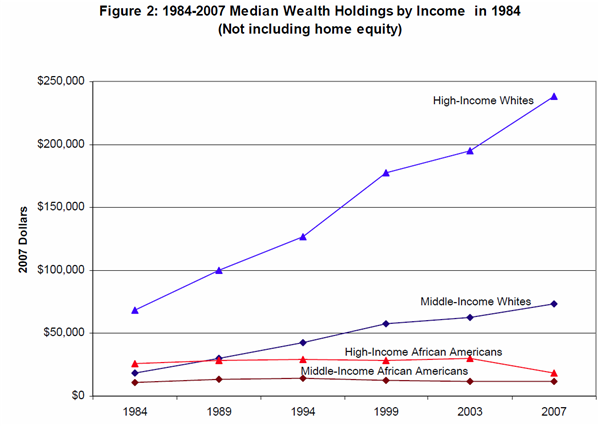
Shapiro says one of the most disturbing aspects of the study is that wealth among the highest-income African-Americans has actually fallen in recent years, dropping from a peak of $25,000 to about $18,000, while among white counterparts of similar class and income it has surged to around $240,000.
In 1984, high-income black Americans had more assets than middle-income whites. That is no longer true.
The public policy change?
Since the 1980s, US administrations have also geared the tax system to the advantage of the better off. Taxes on unearned income, such as shares and inheritance, fell sharply and are much lower than taxes on pay.
But that’s only incidentally related to race. And it doesn’t explain why high status blacks have fewer assets than low status whites, who presumably aren’t inheriting piles of money.
There were also social factors, the study found. “In African-American families there is a much larger extended network of kin as well as other obligations. From other work we’ve done we know that there’s more call on the resources of relatively well-off African-American families; that they lend money that’s not given back; they help cousins go to school. They help brothers and sisters, aunts and uncles, with all kinds of legal and family problems,” said Shapiro.
That’s interesting, of course. We see it with professional athletes who make millions of dollars and are soon flat broke because they can’t say “No” to an extended network of friends and relatives who expect to share in their new-found prosperity. But, surely, it doesn’t explain a five-fold gap?
As best I can tell from the IASP site, they simply begin with the presumption that differences in performance are a function of discrimination and public policy choices. A quick read through the very short policy brief, “The Racial Wealth Gap Increases Fourfold,” [PDF] confirms this. I’m particularly struck by this:
While those who begin the period with roughly similar incomes would be expected to have the same opportunities to build wealth, the differences in accumulation by race remain stark even accounting for income. (p.2)
But “opportunities” don’t translate into “accumulation” unless the proper steps are taken. I recall being a young second lieutenant and investing a significant portion of my income into savings and retirement accounts and still having a decent amount of liquidity while most of my contemporaries (mostly white!) were living hand to mouth. The difference wasn’t in opportunity. And it sure as hell wasn’t because I had a large trust fund. Rather, I planned for my future and lived within my means whilst most of the others bought expensive cars and otherwise engaged in short term thinking rather than deferring gratification.
The study doesn’t explain why blacks and whites of similar incomes pay higher loan rates. It makes allusions to “neighborhoods,” though, which makes some sense. What’s not clear, though, is why middle class blacks aren’t moving to better neighborhoods. And, indeed, the discussion that does exist in the paper conflates the behavior of low income blacks and average whites, which just doesn’t make sense.
UPDATE: Dave Schuler comments at his own digs:
I found the article and, presumably, the study from which it was derived baffling because it ignores a well-known and undispited fact: at every income level in the United States blacks spend more on visible signs of affluence than do their white counter-parts
[…]
When you look a little deeper into this phenomenon it turns out that blacks living in poor communities and whites living in poor communities tend to have similar spending patterns
So, in addition to the no doubt real legacies of past discrimination, we have two phenomena: Variation in cultural norms between blacks and whites generally that more-or-less go away when you control for variables other than income. Which shouldn’t be at all shocking to people who study these things for a living and would therefore be presumed to know more about the subject that Dave and I, who don’t, know off the top of our heads.
Unless, of course, they simply wanted to find what they wanted to find and have an ignoramus press publicize their efforts. In which case: SCORE!









