
Daniel Larison‘s “The Case Against NATO” makes compelling reading. In my New Atlanticist post “The Case Against the Case Against NATO,” I explain why it’s wrong.
Larison argues that the main justification of NATO is to buttress America’s ability to project power into places where it has no business projecting power and that everything else — out of area operations such as Afghanistan, adding new members to form a club of democracies, and so forth — is just cover for that.
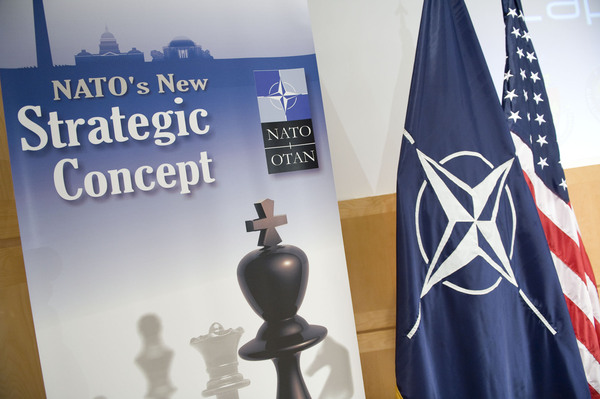
NATO’s premise from the very beginning was that we were all in this thing together. And that remains the idea behind the Alliance. “Out of area” and various mission sets are force planning concepts, not rationales for existence.
“Out-of-area” was not and is not about finding new conflicts to justify NATO’s existence. It was simply a recognition that, given the collapse of the Soviet Union and the absorption of a goodly portion of the Warsaw Pact into NATO, the likeliest security threats were outside Europe. The justification for the continued existence of a decades-old alliance was that it simply made sense for the West to continue working together to achieve our shared interests.
My objection to NATO expansion isn’t so much that doing so annoys Russia but rather that the prospective new members would make it even harder for NATO to do its business. Ukraine and Georgia are not Alliance-ready militaries. More importantly, it’s not at all clear that they share some fundamental Western values. But they might be ready at some point. So might Macedonia, if we can get over the impasse regarding their name. And there’s always our non-Atlantic partners in Australia and New Zealand.
But, again, the rationale for NATO expansion wasn’t the avoidance of obsolescence but rather the fulfillment of a purpose as old as the Alliance: A Europe whole and free. President George H.W. Bush explained this at his historic speech at the Rheingoldhalle in May 1989:
We must recall that the generation coming into its own in America and Western Europe is heir to gifts greater than those bestowed to any generation in history: peace, freedom, and prosperity. This inheritance is possible because 40 years ago the nations of the West joined in that noble, common cause called NATO. And first, there was the vision, the concept of free peoples in North America and Europe working to protect their values. And second, there was the practical sharing of risks and burdens, and a realistic recognition of Soviet expansionism. And finally, there was the determination to look beyond old animosities. The NATO alliance did nothing less than provide a way for Western Europe to heal centuries-old rivalries, to begin an era of reconciliation and restoration. It has been, in fact, a second Renaissance of Europe.
[…]
For 40 years, the seeds of democracy in Eastern Europe lay dormant, buried under the frozen tundra of the Cold War. And for 40 years, the world has waited for the Cold War to end. And decade after decade, time after time, the flowering human spirit withered from the chill of conflict and oppression; and again, the world waited. But the passion for freedom cannot be denied forever. The world has waited long enough. The time is right. Let Europe be whole and free.
To the founders of the alliance, this aspiration was a distant dream, and now it’s the new mission of NATO. If ancient rivals like Britain and France, or France and Germany, can reconcile, then why not the nations of the East and West? In the East, brave men and women are showing us the way. Look at Poland, where Solidarity, Solidarnosc, and the Catholic Church have won legal status. The forces of freedom are putting the Soviet status quo on the defensive. And in the West, we have succeeded because we’ve been faithful to our values and our vision. And on the other side of the rusting Iron Curtain, their vision failed.
The Cold War began with the division of Europe. It can only end when Europe is whole.
We had a group of countries cut off from the West through no fault of their own — indeed, some would say our fault — for decades that we were trying to get back into the fold. The Czech Republic, Hungary, and Poland were admitted to the Alliance ten years after Bush’s speech. Another nine have joined since. Their addition didn’t serve to justify NATO’s existence but rather to allow them to flourish without fear of Russian domination. It’s ability to provide that assurance is what justifies NATO’s existence.
More at the link.