Washington Post, “William Calley, Army officer and face of My Lai Massacre, is dead at 80“
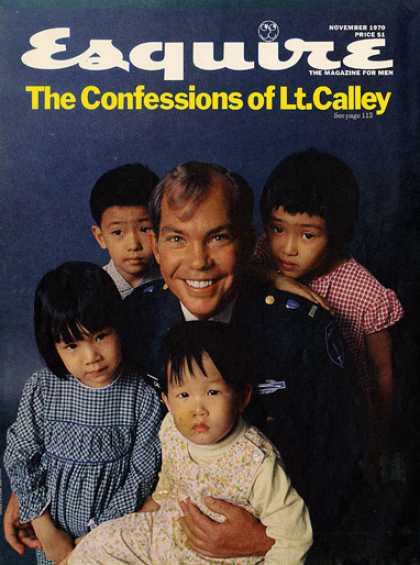
William L. Calley Jr., a junior Army officer who became the only person convicted in connection with the My Lai Massacre of 1968, when U.S. soldiers slaughtered hundreds of unarmed South Vietnamese men, women and children in one of the darkest chapters in American military history, died April 28 at a hospice center in Gainesville, Fla. He was 80.
The Washington Post obtained a copy of his death certificate from the Florida Department of Health in Alachua County. His son, Laws Calley, did not immediately respond to requests for additional information. Other efforts to reach Mr. Calley’s family were unsuccessful.
The Post was alerted to the death, which was not previously reported, by Zachary Woodward, a recent Harvard Law School graduate who said he noticed Mr. Calley’s death while looking through public records.
Although he was once the country’s most notorious Army officer, a symbol of military misconduct in a war that many considered immoral and unwinnable, Mr. Calley had lived in obscurity for decades, declining interviews while working as a jeweler in Columbus, Ga., not far from the military base where he was court-martialed and convicted in 1971.
A junior-college dropout from South Florida, he had bounced around jobs, unsuccessfully trying to enlist in the Army in 1964, before being called up two years later. As the war escalated in Vietnam, he found a home in a military that was desperately trying to replenish its lower ranks.
Mr. Calley was quickly tapped to become a junior officer, with minimal vetting, and was soon promoted to second lieutenant, commanding a platoon in Charlie Company, a unit of the Army’s Americal Division. The company sustained heavy losses in the early months of 1968, losing men to sniper fire, land mines and booby traps as the North Vietnamese and Viet Cong launched coordinated attacks in the Tet Offensive.
On the morning of March 16, 1968, the unit was airlifted by helicopter to Son My, a patchwork village of rice paddies, irrigation ditches and small settlements, including a hamlet known to U.S. soldiers as My Lai 4. Over the next few hours, Mr. Calley and other soldiers in Charlie Company shot and bayoneted women, children and elderly men, destroying the village while searching for Viet Cong guerrillas and sympathizers who were said to have been hiding in the area. Homes were burned, and some women and girls were gang-raped before being killed.
An Army investigation later concluded that 347 men, women and children had been killed, including victims of another American unit, Bravo Company. A Vietnamese estimate placed the death toll at 504.
For more than a year and a half, the details of the atrocity were hidden and covered up from the public. A report to headquarters initially characterized the attack as a significant victory, claiming that 128 “enemy” fighters had been killed. Gen. William C. Westmoreland, the top commander in Vietnam, praised American forces at My Lai for dealing a “heavy blow” to the Viet Cong.
Meanwhile, Ronald Ridenhour, a helicopter gunner who was not at the scene but had heard of the killings weeks later, did his own probing. Back in the United States nearly a year after the massacre, he began writing letters to top political and military leaders about the bloodbath at My Lai — providing information that was credited with sparking official investigations.
Backed with photographs and witness testimony, the Army charged Mr. Calley with premeditated murder days before his scheduled discharge.
Although a four-paragraph Associated Press article appeared in September 1969, providing Mr. Calley’s name and reporting that he was being held for allegedly murdering an unspecified number of civilians, a more complete picture of the massacre was not revealed until that November, through articles by investigative reporter Seymour M. Hersh.
Acting on a tip by an antiwar activist, Hersh worked exhaustively to track down Mr. Calley. He finally located him in the unlikeliest of places for a man facing court-martial for what at the time was believed to be 109 murders: at the senior officers’ quarters of Fort Benning, now called Fort Moore, in Georgia.
Hersh’s articles, distributed to newspapers around the country by the independent Dispatch News Service, received the Pulitzer Prize for international reporting, shocked a nation that was already divided over the Vietnam War and thrust Mr. Calley into the national spotlight.
Almost from the very beginning, Mr. Calley polarized Americans who variously deemed him a war criminal or a scapegoat, a mass murderer or an inexperienced officer made to take the fall for the actions of his superiors. Defenders argued that he had been forced into a brutal conflict with an often invisible enemy, then blamed for the horrors of the war.
To some, he seemed like a convenient target for military prosecutors, the lowest link in a chain of command that included Capt. Ernest Medina, who was accused of bearing overall responsibility for the attacks, and Maj. Gen. Samuel W. Koster, the highest-ranking officer charged with trying to cover up the massacre.
Mr. Calley was convicted of murdering at least 22 noncombatants and sentenced to life at hard labor, after a military jury rejected his defense that he was just following orders. Amid appeals, he ultimately served about three years, much of it under house arrest.
“My Lai was the absolute low point in the history of the modern U.S. military,” said Pulitzer Prize-winning military correspondent Thomas E. Ricks, whose book “The Generals” traces the evolution of the post-World War II Army.
Beyond the atrocities committed by Mr. Calley, Ricks said it was important to remember that “there were 1,000 causes here, bad people doing bad things up and down the chain of command,” including the “second grave sin” of the coverup.
“My Lai forced a reexamination of the U.S. Army,” Ricks noted, referring to its central role in later studies about revamping military professionalism. “It was not just that hundreds of civilians had been murdered, and a score raped, but that the acts of the day were covered up by the Army chain of command.
“The incident was just not the work of a deranged lieutenant,” he continued. “Other officers were aware of what was going on. And the extensive coverup, including the destruction of documents, went all the way up to the rank of general, with two generals and three colonels implicated.”
l did a report on Calley and the massacre as an undergraduate cadet. Aside from the sheer monstrosity of what he and his men did that day, the thing that most struck me was that he never should have been commissioned in the first place. But the Army of the late 1960s was desperate for manpower and a sad sack like Calley, who would never have even gotten into an ROTC program or Officer Candidate School in the 1980s was somehow put into a position he never should have been.
And, of course, the officers above him in the chain of command, including career professionals who should have known better, engaged in a despicable cover-up. In hindsight, it very much reminds me of the actions of the leadership of the Roman Catholic Church in the wake of child molestation charges. Loyalty to the institution’s reputation triumphed over loyalty to the institution’s ostensible values.
Robert McFadden’s New York Times obit, “William Calley, Convicted of Mass Murder in My Lai Massacre, Dies at 80,” explores the issue that has fascinated me about the incident in more recent years: the political reaction to the conviction.
The White House and Congress were flooded with protests over the sentence, if not the verdict. Gov. Jimmy Carter of Georgia called it “a blow to troop morale.” Governors in Utah, Indiana and Mississippi denounced the verdict. Legislatures in Arkansas, Kansas, Texas, New Jersey and South Carolina asked for clemency. Gov. George C. Wallace of Alabama demanded a presidential pardon.
Days after the sentencing, President Richard M. Nixon spared the lieutenant from prison, allowing him to remain in his bachelor apartment at Fort Benning, pending appeals. In an ensuing roller-coaster of legal maneuvers, the fort’s commanding general reduced the life term to 20 years, and Secretary of the Army Howard Callaway cut it to 10 years and said Mr. Calley would be paroled after only one-third of that term.
In 1974, a federal judge in Georgia, J. Robert Elliott, overturned the conviction, saying Mr. Calley had been denied a fair trial because of prejudicial publicity. The Army appealed, and Mr. Calley was confined to barracks at Fort Leavenworth, Kans., for three months. He was then released on bail and never returned to custody.
In 1975, a federal appeals court in New Orleans reversed Judge Elliott and reinstated the conviction. And in 1976, the United States Supreme Court refused to review the case, letting the conviction stand and closing a bitter chapter of national history. By then, Mr. Calley had qualified for parole. His life term had been whittled down to slightly more than three years of house arrest and barracks confinement that had ended in 1974.
That even Jimmy Carter was defending him was something I only learned this morning. Aside from being widely regarded as a beacon of righteousness, he’s an Annapolis-educated man with an exemplary career in the Navy that was cut short by his father’s death. But the zeitgeist was that Calley was a victim of a horrible war and being scapegoated. It didn’t help matters that Calley was punished while the officers above him got off Scot free.