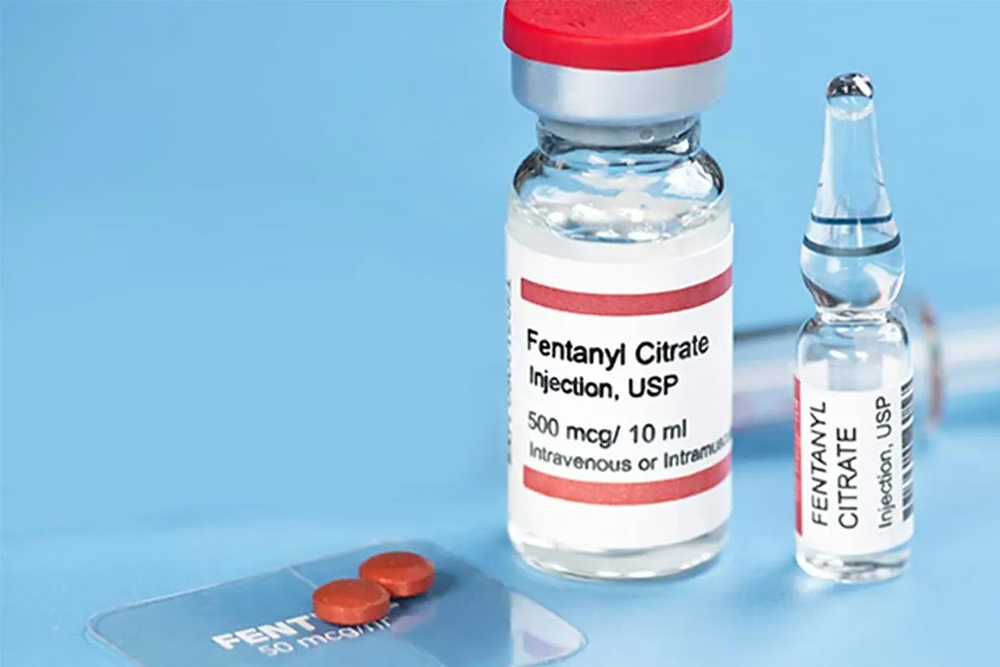
Yesterday’s episode of the NYT The Daily podcast, “How Tariffs Are Shaking Up the War on Fentanyl,” was quite surprising. Michael Barbaro hosts Mexico City Bureau Chief Natalie Kitroeff, who went through extraordinary lengths to interview people who worked in fentanyl labs in Sinaloa.
Her initial impression was how futile efforts to crack down would be:
I think the main takeaway that I had leaving the lab was this is a drug that is extraordinarily easy to produce in almost any conditions. And once you get the product, the amount that you need to make a lot of money if you’re the cartel or if you’re a user to potentially kill you is tiny. I mean, the US government says that people who have not been exposed to fentanyl could be killed by the amount that fits on the tip of a pencil.
[…]
And in this kitchen, in this makeshift lab, I had just seen that tip of the pencil thousands of times over.
Furthermore,
The Sinaloa cartel, the cartel that is, according to the US government, responsible for bringing much of the fentanyl on American streets across the border, they have years worth of experience in industrialized drug production. They’ve done this with a ton of different products, including meth, which is another synthetic drug. So they have experience in making drugs out of chemicals.
They also have a lot of experience corrupting the Mexican government. The last time there was a major crackdown on drug cartels, the security chief that led that crackdown ended up being convicted in an American court for taking bribes from the Sinaloa cartel. So this is an incredibly powerful, experienced organization that has the wherewithal and the resources to do this. And the Mexican government has not been effective at stamping that out.
After a long discussion about various threats that President Trump made shortly after office—including an implied threat to send in the military to deal with the problem—we get this:
I was deeply skeptical. I had been going to Sinaloa for months. Based on everything I’d seen, this organization, this criminal group, was just so entrenched in so many aspects of daily life.
And it’s really hard to imagine making a serious impact on a production operation that requires so little, that can just be restarted from one moment to the next, in a place that is dominated by one of the most powerful criminal organizations on the planet. But even though I was really skeptical, I wanted to go back into a lab to see whether all of these threats, whether all of the pressure that Trump had put on Mexico had led to real changes, whether any of this actually made a difference.
[…]
It was really remarkable. The dynamics, it seemed, had completely changed from the last time we were there. I mean, this was still a very dangerous place. There was a lot of violence. But when we started talking to RX cartel contacts, they told us there was basically no production of fentanyl happening in the city. It had totally plummeted.
[…]
Fallen off a cliff. I mean, they acknowledge that production was happening elsewhere in the country. It’s not like fentanyl stopped being made in Mexico, writ large. But here, things had slowed to a near halt.
We met the two cooks who had invited us into their labs. They said, no, we shut everything down. There is such an intense crackdown by the government right now, and we’re under so much scrutiny and pressure, that we’re not cooking anything.
We didn’t meet them inside a lab. They met us at our hotel room. And they said, we’re not doing anything right now.
We’re actually firing employees. We’re saving money. We’re trying to sell our cars and other property to try to make up for lost income, because nothing is going on here. There is no lab for you to visit this time around. And we saw firsthand the crackdown that they were so afraid of.
[…]
While we were there, the Mexican government arrested two major players within the cartel. So there was a lot of activity. At one point, we go to meet with a higher level cartel member who, when we get to him, he said he had heard about the raid that we ran up on. And he is genuinely shaking, his hands.
[…]
His hands are trembling in front of us. And he said, the only option for me right now is survival. No, we’re not cooking. No, we’re not making fentanyl.
That is shut down right now. It may be temporary. We are moving labs. We’re doing this elsewhere.
But right now, I am on lockdown here. I am not leaving my house. I have lookouts everywhere. And I can’t even be here.
He cut the meeting short. He basically ran out. He was so scared.
Well, these guys that we’re talking to are saying, look, the main thing that has changed from when you were here last is that Trump is in office and he’s making all of these threats, and the Mexican government is cracking down like never before. Obviously, the Mexican authorities were on the streets before this. It’s not like they weren’t doing anything. But the cartel members say they’re feeling the heat at a much higher level.
Bullying strikes me as a poor strategy for dealing with friendly governments. Still, the degree to which it is working in the short term is stunning. The fact that they were able to enact this crackdown with such devastating impact essentially on a dime would certainly seem like a pretty strong indication that this was a low-priority effort until Trump turned up the heat.
Given how long our own government, through administration after administration, has been fighting the so-called War on Drugs, I’m deeply skeptical that this level of crackdown is sustainable. There’s just too much money to be made and too much demand for the product.