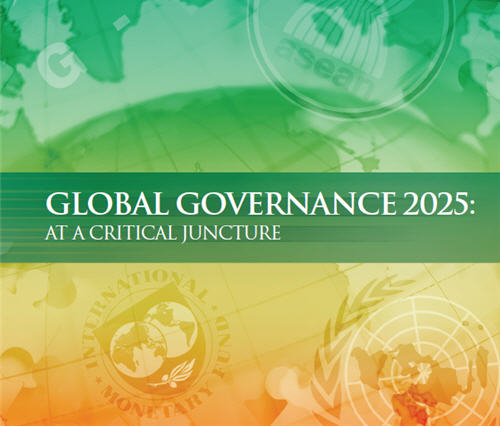

Global Governance 2025, a joint effort of the Atlantic Council and its global partners, sees a wide range of trajectories for the international system depending on whether we adequately address known threats.
In my New Atlanticist post “Muddling Through to 2025,” I evaluate each of the four scenarios proffered by the report authors: Barely Keeping Afloat, Fragmentation, Concert of Europe Redux, and Conflict Trumps Cooperation.
In essence, I argue that the first is the most likely but they’re not mutually exclusive.
This scenario, which I like to call “muddling through,” is no doubt the most likely. It is, after all, essentially the course we’ve been on since shortly after World War II.
The failures of the League of Nations that allowed that conflict to happen sparked the development of a more realistic set of institutions. The United Nations was much more flexible than its predecessor, in that its creators allowed for the very real possibility that the Soviets and other major players would not see eye-to-eye with the West. The Security Council provided a powerful collective security regime in the event of a shared vision on the part of its Permanent Members but, through the veto power, allowed a default to collective defense and state security in the event that any one of them objected.
Similarly, the economic regimes created at Bretton Woods proved very flexible and severable, with such institutions as the IMF and World Bank now performing very different functions than envisioned in 1944 and surviving the collapse of the fixed exchange rate mechanism in the early 1970s.
Much, much more at the link.