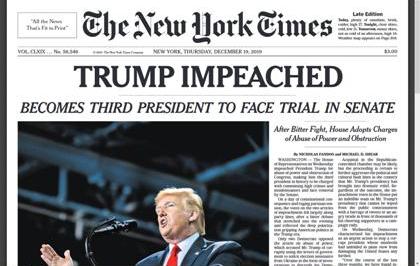

Early yesterday evening, after nearly twelve hours of debate and procedural moves, the House of Representatives formally impeached President Trump on charges of abuse of power and obstruction of Congress, making him the third President in American history to be impeached:
WASHINGTON — The House of Representatives on Wednesday impeached President Trump for abuse of power and obstruction of Congress, making him the third president in history to be charged with committing high crimes and misdemeanors and face removal by the Senate.
On a day of constitutional consequence and raging partisan tension, the votes on the two articles of impeachment fell largely along party lines, after a bitter debate that stretched into the evening and reflected the deep polarization gripping American politics in the Trump era.
Only two Democrats opposed the article on abuse of power, which accused Mr. Trump of corruptly using the levers of government to solicit election assistance from Ukraine in the form of investigations to discredit his Democratic political rivals. Republicans were united in opposition. It passed 230 to 197, with Speaker Nancy Pelosi gaveling the vote to a close from the House rostrum.
On the second charge, obstruction of Congress, a third Democrat joined Republicans in opposition. The vote was 229 to 198.
The impeachment votes set the stage for a historic trial beginning early next year in the Senate, which will have final say — 10 months before Mr. Trump faces re-election — on whether to acquit the 45th president or convict and remove him from office. The timing was uncertain, after Ms. Pelosi suggested late Wednesday that she might wait to send the articles to the Senate, holding them out as leverage in a negotiation on the terms of a trial.
(…)
United in their opposition, Republicans accused the Democrats, who fought their way back from political oblivion in 2016 to win the House in 2018, of misusing the power voters had invested in them to harangue a president they never viewed as legitimate by manufacturing a case against him. Though they conceded few of them, they insisted the facts against Mr. Trump nonetheless fell woefully short of impeachment.
“When all is said and done, when the history of this impeachment is written, it will be said that my Washington Democrat friends couldn’t bring themselves to work with Donald Trump, so they consoled themselves instead by silencing the will of those who did, the American people,” said Representative Mark Meadows, Republican of North CarolinaThroughout the inquiry, even as Republicans raged against the process and sought to offer benign explanations for Mr. Trump’s conduct, none disputed the central facts that served as its basis: that he asked Ukraine’s president to “do us a favor” and investigate Mr. Biden, a prospective rival in the 2020 campaign, and other Democrats.
Mr. Trump’s impeachment had the potential to change the trajectory of his presidency and redefine an already volatile political landscape. Democrats, including the most vulnerable moderates, embraced the articles of impeachment with the full knowledge that doing so could damage them politically, potentially even costing them control of the House.
More from The Washington Post:
The House of Representatives voted late Wednesday to impeach President Trump on charges that he abused his office and obstructed Congress, with Democrats declaring him a threat to the nation and branding an indelible mark on the most turbulent presidency of modern times.
After 11 hours of fierce argument on the House floor between Democrats and Republicans over Trump’s conduct with Ukraine, lawmakers voted almost entirely along party lines to impeach him. Trump becomes the third president in U.S. history to face trial in the Senate — a proceeding that will determine whether he is removed from office less than one year before he stands for reelection.
On Trump’s 1,062nd day in office, Congress brought a momentous reckoning to an unorthodox president who has tested America’s institutions with an array of unrestrained actions, including some that a collection of his own appointees and other government witnesses testified were reckless and endangered national security.
The Democratic-controlled House passed two articles of impeachment against Trump — abuse of power and obstruction of Congress — related to the president’s attempts to withhold military aid to Ukraine and pressure its government to investigate former vice president Joe Biden, a potential 2020 Democratic opponent.
The House voted 230 to 197 to approve the article charging abuse of power, with the gavel falling about 8:30 p.m. On the obstruction of Congress vote, which followed soon after, the tally was 229 to 198.
All Republicans voted against both articles. Among Democrats, two voted no on the first article and three on the second, with one — Rep. Tulsi Gabbard (D-Hawaii) — voting “present” both times.
House Speaker Nancy Pelosi (D-Calif.) framed the day’s proceedings through the long lens of history, reciting the Pledge of Allegiance and singling out the line “the republic for which it stands.”
“Very sadly, now our founders’ vision of a republic is under threat from actions from the White House,” Pelosi said. She added, “If we do not act now, we would be derelict in our duty.”
(…)
The House voted 230 to 197 to approve the article charging abuse of power, with the gavel falling about 8:30 p.m. On the obstruction of Congress vote, which followed soon after, the tally was 229 to 198.
All Republicans voted against both articles. Among Democrats, two voted no on the first article and three on the second, with one — Rep. Tulsi Gabbard (D-Hawaii) — voting “present” both times.
The House voted 230 to 197 to approve the article charging abuse of power, with the gavel falling about 8:30 p.m. On the obstruction of Congress vote, which followed soon after, the tally was 229 to 198.
All Republicans voted against both articles. Among Democrats, two voted no on the first article and three on the second, with one — Rep. Tulsi Gabbard (D-Hawaii) — voting “present” both times.House Speaker Nancy Pelosi (D-Calif.) framed the day’s proceedings through the long lens of history, reciting the Pledge of Allegiance and singling out the line “the republic for which it stands.”
“Very sadly, now our founders’ vision of a republic is under threat from actions from the White House,” Pelosi said. She added, “If we do not act now, we would be derelict in our duty.”
(…)
Wednesday’s action punctuated a quarter-century of increasingly poisonous partisanship in Washington, one that arguably began during Bill Clinton’s presidency, was extended with rebellions against presidents George W. Bush and Barack Obama, and is culminating in the Trump era.
The intensity and polarization of the debate on the House floor vividly illustrated the extent to which leaders of the two parties now believe entirely different accounts of what occurred and are motivated by different concerns. At times they sounded almost as if they were representing different countries.
Democrats characterized Trump as an immediate threat to the nation he was elected to lead, casting his actions as an unprecedented affront to American values. Republicans denounced those charges as unsubstantiated and the process as illegitimate, repeatedly accusing the Democrats of seeking to illegally overturn the results of the last election.
(…)
Democrats and Republicans took turns at the rostrum delivering short, impassioned speeches — a furious debate that in many ways showcased how much Trump has remade the two parties.
The Republicans, mostly white men, stood staunchly behind the president and repeated many of his statements vilifying the opposition. The Democrats, notably more diverse in race and gender, uniformly attacked the president’s conduct as an affront to American values.
“When we say we uphold the Constitution, we are not talking about a piece of parchment,” said Rep. Adam B. Schiff (D-Calif.), chairman of the House Intelligence Committee. “We’re talking about a beautiful architecture in which ambition is set against ambition, in which no branch of government can dominate another.”
(…)
He added, “That is what it means to uphold the Constitution. If you ignore it, if you say the president may refuse to comply, may refuse lawful process, may coerce an ally, may cheat in an election because he’s the president of our party, you do not uphold our Constitution.”
Republicans responded that Democratic leaders had concocted a scheme to oust the president because they were afraid they could not beat him in next November’s election.
House Minority Leader Kevin McCarthy (R-Calif.) said, “Democrats have wanted to impeach President Trump since the day he was elected — and nothing was going to get in their way, certainly not the truth.”
Though some Republican lawmakers defended Trump on the substance of the allegations, many spent most of their time airing grievances about the process. They often echoed the rambling, six-page letter Trump issued to Pelosi on Tuesday, and they repeated the president’s claims of personal persecution in sometimes overheated terms.
“When Jesus was falsely accused of treason, Pontius Pilate gave Jesus the opportunity to face his accusers,” said Rep. Barry Loudermilk (R-Ga.).
“During that sham trial, Pontius Pilate afforded more rights to Jesus than the Democrats have afforded this president in this process.”
Other GOP House members described impeachment as the outgrowth of insidious forces.
“I have descended into the belly of the beast. I have witnessed a terror within,” said Rep. Clay Higgins (R-La.)
Rep. Mike Kelly (R-Pa.), meanwhile, drew a parallel to the Japanese attack on Pearl Harbor in 1941. After quoting President Franklin D. Roosevelt calling Dec. 7 “a date that will live in infamy,” Kelly said, “Today, December the 18th, 2019, is another date that will live in infamy.”
As noted, yesterday’s debate went about as you would have expected, with Democrats earnestly setting forth the case in favor of the President’s impeachment based on the facts uncovered during the course of the investigation that began in September when we first became aware of the whistleblower’s complaint about a July 25th phone call between President Trump and Ukrainian President Zelensky. As we later learned when the written summary became public shortly thereafter, the President used that phone call to attempt to extract promises from the new Ukrainian leader to investigate former Vice-President Joe Biden and his son Hunter as well as a the largely discredited claim that it was the Ukrainians who interfered in the 2016 election in an effort to harm the President’s campaign.
What followed was a relatively quick process that began with closed-door depositions of top former and current members of the Trump Administration, most of them from either the National Security Council or the State Department. Several of those people were present for that July 25th phone call as well as other conversations with the President and other top officials about the Ukraine matter. Those conversations made clear that the Administration intended to withhold more than $300 million in military aid that Congress had authorized earlier in the year unless President Zelensky took the actions that President Trump wanted. It was also clear that the Ukrainians were aware that the pressure for investigations was linked both to the release of military aid and to improvements in the relationship between Washington and Kyiv such as a much-coveted invitation to visit Washington.
Later, as the investigation unfolded, the Trump White House would do everything it could to block Congress from undertaking its Constitutional obligation and duty to investigate and oversee the Executive Branch. In a manner that even the Nixon Administration didn’t attempt, the Trump Administration has attempted to block Congress from current and former Administration officials as well as perfectly legitimate document requests. Each time these requests have been challenged in Court, they have been blocked at the District Court and Court of Appeals level. While those matters are now pending before the Supreme Court, the resolution of those matters likely won’t come before June, right before the party conventions and the beginning of the Presidential General Election season.
From here, of course, attention will turn to the Senate, which will sit in trial of a sitting President for the third time in American history. This time, though, it’s clear that the entire process is a sham, with Republicans such as Senate Majority Leader Mitch McConnell, as well as Senators Lindsey Graham and Rand Paul, making clear that they have no intention of being impartial. In any case, though, even with an acquittal Donald Trump will go down in history as an impeached President. He may try to wear that as a badge of honor of some kind, but it is not. Impeachment will be the first thing mentioned in his obituary when he dies, and the first thing written about him in history books when the time comes. As much as Trump likes to pretend otherwise, it’s clear that this irks him and it will follow him for the rest of his life.
Update: Speaker of the House Nancy Pelosi is reportedly considering a delay in sending the Articles of Impeachment to the Senate in an effort to influence the procedures governing the Senate trial.