A Divided Country
Nine ideologies. Two parties.
WaPo (“Study splits Americans into nine political groups. Where do you belong?“):
As voters approach the 2026 midterm and 2028 presidential election, it’s no secret that the country is highly polarized. But a new exhaustive survey of more than 10,000 Americans shows the daunting challenges Republicans and Democrats face in uniting disparate factions within their own parties.
Deep internal fissures are dividing Republicans over matters of style, like how eager people are to humiliate a political opponent, and substance, like whether abortion should be legal or carrying a gun in public should be commonplace.
Democrats are divided just as deeply over how to address transgender issues, crime and whether they like the “democratic socialist” label, according to the Pew Research Center’s 2026 “Political Typology” study.
Here is the breakdown:
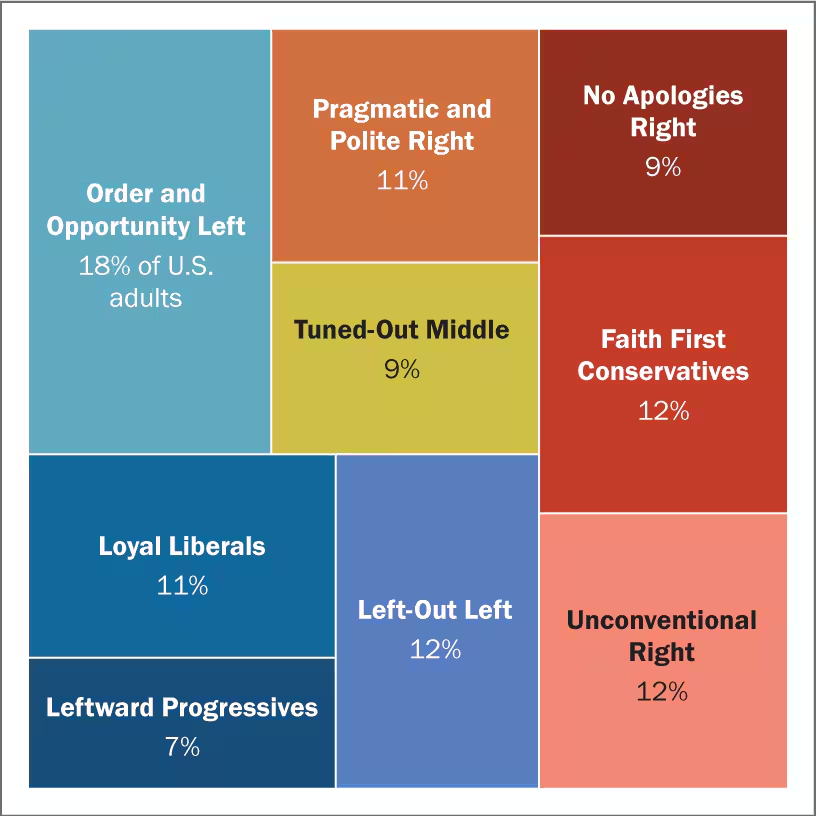
According to the WaPo report, here’s how they break down the four right-leaning groups:
Pew’s analysis found four groups on the political right of roughly equal size: Faith First Conservatives at 12 percent of U.S. adults, the No Apologies Right at 9 percent, the Unconventional Right at 12 percent and the Pragmatic and Polite Right at 11 percent.
Guns, abortion and religion marked some of the biggest cleavages on the right. Majorities of Faith First Conservative and the No Apologies Right groups were very comfortable with people openly carrying guns in public, opposed legal abortion and said it’s important for U.S. culture to be based on Christian beliefs. Fewer than half of people in the Unconventional Right and Pragmatic and Polite Right hold any of these views.
A second big division is the tone of political rhetoric. The No Apologies Right is the only group in which a majority (53 percent) said they like it “when politicians you agree with humiliate political opponents,” compared with just 5 percent of the Pragmatic and Political Right and fewer than half of any other group in Pew’s analysis.
The Pragmatic and Polite Right held conservative views on economics and the role of government but more liberal views on race and international issues. For example, most said the legacy of slavery continues to affect the condition of Black people, and more than 6 in 10 had a favorable view of NATO. A slight majority opposed the Iran war, while majorities in the other three right-leaning groups supported it.
The Unconventional Right — a younger and less politically engaged group — held a hodgepodge of conservative and moderate views: They generally favored smaller government, but about half said government has a responsibility to provide health insurance. They were split on the legality of abortion and whether undocumented immigrants should be deported.
While hard to pin down ideologically, the Unconventional Right is significant because the group has swung sharply against President Donald Trump since he returned to office. While 78 percent approved of him in February 2025, a narrow 53 majority said this in April. Of all the Republican-leaning groups, they’re the least likely to say it “really matters” which party wins control of Congress in the 2026 midterm elections.
Trump is also unpopular among the Pragmatic and Polite Right at 36 percent approval, although he started at a lower 50 percent among this group. By contrast, 81 percent of Faith First Conservatives and 90 percent of the No Apologies Right approve of Trump’s job performance.
They also see four clusters on the left:
Pew identified four Democratic-leaning groups, ranging widely in size: The Order and Opportunity Left was the largest at 18 percent of the adult population, followed by the Left-Out Left at 12 percent, Loyal Liberals at 11 percent and Leftward Progressives representing the smallest group at 7 percent. All four of these groups lean toward the Democratic Party, but the poll reveals stark splits in how they view the party as well as their social and economic values.
In one of the biggest divisions, 92 percent of Leftward Progressives and 69 percent of Loyal Liberals are extremely or very comfortable with people using “they/them” pronouns, compared with fewer than half of other Democratic-leaning groups and about one-quarter of Americans overall. Leftward Progressives and Loyal Liberals also stand out in their lower concern with crime, for liking political leaders that identify as “democratic socialists” and saying it’s bad for the country that some people are billionaires.
Leftward Progressives stand out for their youth, frequent internet use and frustrations with the Democratic Party. While nearly all of those who voted supported Kamala Harris in 2024, barely 6 in 10 have a favorable view of the Democratic Party, and they’re more likely than any group to wish there were more political parties.
Loyal Liberals are the counterweight to progressives, holding progressive political values on many topics but also a strong allegiance to the Democratic Party.
The Order and Opportunity Left may be one of the most politically significant groups, leaning clearly toward Democrats but standing out as socially moderate. While those who voted in 2024 favored Harris over Trump by a more than 3 to 1 margin, they are more trusting of military and police than other left-leaning groups, and 6 in 10 favor a military presence at the U.S.-Mexico border.
The Order and Opportunity left is racially diverse and has lower incomes than most other groups, but their views on the economy are nuanced. While most think large corporations make too much profit, they have more confidence in business leaders than other left-leaning groups. They also believe in economic mobility generally, saying Americans have at least “a fair amount” of control over their financial success.
Intrigued, I clicked through and took the survey myself. Here’s what it returned:
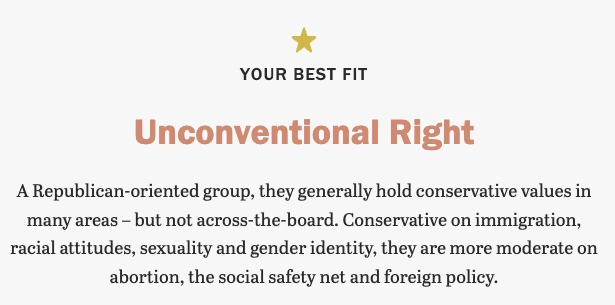
While “Unconventional Right” is potentially a reasonable label for my political views, I certainly don’t meet the description. At 60, few would call me “young.” And I’m a PhD political scientist who has run a political blog for 23 years; I’m hardly unengaged. Beyond that, I’m not sure whether I’m meaningfully “conservative,” at least if the current Republican Party orthodoxy defines that term, on immigration, race, or gender issues.
Then again, as I was taking the survey, as is often the case, I found many of the questions, or at least the choices of answers, rather frustrating. In many cases, there were false binaries. In others, my answer would have been “it depends,” but that was not among the options.
Regardless of the validity of the survey or the particular set of typologies, the larger point is inarguable: there’s considerably more viewpoint diversity in the country than can be represented by two political parties. Let alone a party of the progressive left and populist right, with essentially no issue overlap.
I scored leftward progressive (yay?)
The description says, among other things, “overwhelmingly back legal abortion.” I do, but there was no question about abortion on the quiz.
Loyal Liberal for me.
ETA: well, that should teach me to comment before finishing the article. I wanted to make those points before the rest of OP prompted more thoughts. James coded as unconventional right tells me a little more about the real meaning.
I will leave it up, because I think my questions and observations are reasonable.
—
The question I have when these sorts of studies get released: how do they differentiate between answers motivated by the game and those motivated by genuine beliefs, moral or otherwise?
The rhetoric question on the Right and the pronouns question on the Left are examples here.
Are the polite conservatives different from the pragmatic conservatives in this way?
How many of the Left of all groups like MR—above all, concerned about how issues like pronouns or Latinx affect Democratic electoral prospects?
—
The unconventional right strike me as the drunk, disruptive frat fuckbois yelling at the reporter about Spencer Pratt last week.
For them, the keyfabe is the point. Politics-as-trash TV.
Allowing for the fact that these sorts of surveys are difficult to formulate—I found my choices of answers missing key context for my views.
unsurprisingly, loyal liberal here. though I as well was frustrated by the options.
@James, yeah, unconventional right seems a good fit for you. I suspect that if the R’s went back to being the party of Reagan, you’d be a regular R voter. Of course the R’s won’t be the party of Reagan for a long time.
Like others who have commented I found the quiz structurally questionable in terms of question selection (no abortion question?), question wording with ambiguous terms (what does it mean to have a “secure” border), answer structure (2/3/5 possible answers; unipolar and bipolar scales), and even answer ordering (one question with three answers in a pro/con/unsure ordering when all others are pro/unsure/con). Graphical decisions about displaying the output is also questionable as boxes-in-a-box which evokes the idea of areas in a cartesian coordinate system, which implies only two (orthogonal) axes in the plot, but the axes are not labeled/defined.
I agree that there are likely multiple clustering of people in the political landscape, but this “study” seems more likely to confuse than enlighten the understanding of what that landscape looks like
Order and Opportunity Left.
That tracks, I seem to be what one might consider a classic Democratic leaning citizen.
I have no problem with that as I am not unhappy with myself that I do not stand out from the pack.
I lean pretty hard left, not sure if anyone has noticed. But I’m not excited about not extending the FISA law. What’s that make me? Confused?
I’m still not voting for Fatso, or anyone Fatso adjacent.
“Unconventional Right” is probably where I would have landed when I worked in politics. I tend to think of this as “cultural Republicans,” who basically had an upbringing that coded them into Rs, but they have enough education and life experiences that they understand the practical application of some Republican policies is that they counter national objectives (and in many cases counter common sense). My hunch is that’s why they tend to skew younger–these are likely a lot of young people who grew up in Republican households so there’s some carryover there, but at an age when they are bumping up against the idiocy of some Republican policies (like healthcare costs and coverage) that directly affects them.
I am now Loyal Liberal, frustrated by the options.
Where is pure Centrist? Even this boxing of politically ideology is only left or right or just nothing. I always preferred the Political Compass quiz, more questions and graphs you on a scale. I consider myself moderate left but this has me as loyal liberal. That label make me unelectable lol.
Leftward Progressive – although I think of myself as very centrist. I worked in small business and corporate jobs for nearly 40 years, retired young, I live off stock market investments, I support full freedoms for every person to live out their lives in the most fulfilling way possible and in a way that they alone define as fulfilling, and I believe that your civil rights end when they start to curtail mine.
I suppose the Overton window for the United States is pretty hard right, so I’ll stick with my “Centrist” self-label.
My spontaneous initial response to most questions was, “Huh?” How do I answer – how important is it for the U. S. to be the sole superpower? How do I rank the importance of something that ain’t gonna happen?
However, I came out as a Loyal Liberal. Probably fair, given I’ve voted straight Dem (with one edge case exception) since 1968 their description fits:
The whole idea of categorizing box-of-rocks voters on policy is, IMHO, a pundit/pollster/consultant affectation. But I would guess Pew tested these questions and some of them go to core beliefs and attitudes that reflect tribal identity and voting history. Has anyone published a summary of various political taxonomies pollsters have created?* And yes, we’d be better served with multiple parties.
______
* I’ve been amused that the WIKI page on liberalism is mostly history and a list of writers while the Conservatism page is largely a taxonomy of flavors of conservative.
ETA: When I posted I got a message that the site was unavailable. When I came back to the page my comment showed as posted. iPad DuckDuckGo. (I’d forgotten I had that selected)
Loyal Liberal here as well. In light of the description, I am not surprised there are so many of us.
@Sleeping Dog:
“@James, yeah, unconventional right seems a good fit for you. I suspect that if the R’s went back to being the party of Reagan, you’d be a regular R voter. Of course the R’s won’t be the party of Reagan for a long time.”
Agreed. At least a couple of times per month, James says something which makes me mutter, “You can take the man out of the party, but you can’t take the party out of the man”.
@Jen: Before I took the quiz also thought I would end up Unconventional Right. It scored me as Loyal Liberal. I think I’m probably what used to be called a Rockefeller Republican. That person would today score as Loyal Liberal.
I really don’t like labels or pigeonholes. I mean, they are fun to play with and all, but they seem to me to do more harm than good. They are a form of stereotype that can delude someone into thinking “I know you” without ever listening or observing someone.
Loyal liberal here, but as I took the test, I was often looking for more choices of answers.
Leftward progressive.
I’m actually pretty middle of the road for the tiny neighborhood in Seattle that I basically never leave, so I have no idea why they think I’m so far left.
ETA: site unavailable on posting, iOS/Brave.
ETA2: The question about they/them — I am uncomfortable with people using “they/them” to describe themselves because that’s not how pronouns work — they should be using “I”.
@Jc:
@Tony W:
I’ve come to the conclusion that those who call themselves “centrist” or “moderate” (and I used to consider myself both) are delusional. I’ve learned that everyone leans one way or another overall. But on specific issues one can be right or left, and the overall philosophy, when truly examined, leans left or right, not the middle.
There is no middle position on gay marriage. You either think it’s good for society or not. Same with abortion. Same with most culture war issues.
If you dobut where you stand, take each issue to it’s logical outrageous conclusion, create a binary yes/no, and honestly see where you stand.
Should abortions be allowed, even if done late in a pregnancy?
Should we have immigration into the country, even if that means alot of illegal immigrants?
Should gay marriage be legal?
If you bring every issue down to a binary, yes/no, question, it’s pretty easy to see where you actually land.
I’d answer all three questions yes.
There are very few real centrists. What there are are people who are conservative or liberal, depending on the issue.
The answers from most commenters here, so far, are proving my point.
Most have said they consider themselves differently than the data – on this quiz – shows.
@EddieInCA: I think your binary test is exactly what surfaces “centrists/moderates.” The yes/no will show where the L/R stand. Then there are those for whom context matters.
Example:
Should abortions be allowed, even if done late in a pregnancy?
Assuming that Right–>never allow, and left–>always allow, you will have people who say, “I am uncomfortable with a near-full-term pregnancy being aborted simply because someone has changed their mind. However, if it is threatening the life or health of the mother, then I think x, y, and z efforts are appropriate to take.”
I do think that many people are uncomfortable with absolutes. That’s where we get “centrists.” It’s not so much that they hold views that cannot be categorized as right or left, it’s that they don’t feel at home at the edge–and forcing them to accept that edge (e.g., if you don’t support termination for any reason right up to the point of viability) is what causes people to respond negatively to the PARTY, rather than the issue.
@EddieInCA:
That, to me, is centrist.
Moderate is “understands that change needs to happen, but let’s not get radical about it”.
I consider myself centrist. Socially liberal, fiscally conservative, we need the EPA but I also think they’ve overreached their authority at times. I fully support vaccine mandates, but oppose laws telling me how big of a soda I can buy.
I’m sure that this test would put me somewhere on the left–but that’s because there’s no “center” category available. From the chart up top, you’re either left, right, or “tuned out”. I disagree with that premise.
@EddieInCA:
The interesting option is where do you put people that don’t conform across a range of issues to the left-right binary. For instance, I’ve know people that are far to the left on economic issues, strong social welfare state and little or no restrictions on immigration, yet condemn abortion and believe gay marriage is wrong. These folks are either currently or formerly part of the Catholic Workers Movement and I suspect similar beliefs can be found within other religious communities.
In fact, I think I’ll re-take the questionnaire and see what it says.
put me in the
Left-Out Left
A Democratic-oriented group with relatively low expectations of the political system, they generally feel not well-represented. While they like the Democratic Party considerably more than the Republican Party, their evaluations of Democrats are lukewarm at best.
@EddieInCA:
Not caring. You might not claim that it isn’t a position at all, but as Rush has proclaimed “if you decide not to decide, you still have made a choice.”
I would toss “weak support” into the same category. The entire “I’d rather they can get married, but the price of eggs is too high.” The position itself is meaningless without kind of push behind it. (In mathy terms, a vector of length 0 is the same as any other vector of length 0, regardless of direction)
Or civil unions — the separate but unequal institution.
Very often the definition of moderation is a willingness to sacrifice others’ rights so everyone (else) can get along.
@Sleeping Dog:
Reeducation camps?
I jest, mostly, but the alt-right pipeline exists because they are so good at taking a few issues that they can get easy agreement on and then socializing people into accepting the whole agenda. A person might start with just a moderate discomfort with trans folks, or ethics in game journalism, but soon enough they’re attending rallies with neonazis (see Britain, et al.)
It’s an open-air, free-range reeducation camp.
@EddieInCA: I’m a centrist in the European sense. Some things like basic human rights for all people are non-negotiables.
It’s more about *how much* aid we give the poor, and what form that aid takes. Discussing the government’s role in assuring people who cannot work (age, disability, family conditions) have the right levels of support, and also setting a limit on how much a single person (e.g. Billionaires shouldn’t exist) can have for themselves.
I think that’s quite centrist.
@inhumans99: You and I have the same label. I’ve always called myself a “lunch bucket Democrat” meaning working to make a good living. I was in the military for four years, a firefighter/paramedic for 21 years and a middle school teacher for 19 more years. I was a union trustee for my locals and always worked for fair wages and benefits and believed in and worked for DEI before it had a label. I don’t know if my pension funds are invested in firms some would demand be divested and I wouldn’t demand that at my expense, I’m not that altruistic. I believe in fair treatment fair voting and safety nets and if I need to pay more taxes for that then that’s fine. I think I’m pretty much like Gregory Lawrence Brown was.
@Mu Yixiao:
And while moderates wait for a more convenient season, tomorrow never comes.
It’s not clear a political party should be an echo chamber. Especially when to form a government, you’d still end up in a coalition with similar parties anyway. The constant instability in Israeli and British politics does not cover that model in glory. Six prime ministers in 10 years? Yikes! Do the Brits and Israelis feel any better represented by this? Are they getting better governance or better socioeconomic outcomes? Does not appear so.
I’d never try to label my political team by quiz. As silly as the relationship quizzes in the old teen magazines if yore. Is WaPo trying to take the Tiger Beat On The Potomac title away from Politico?
I dislike such surveys so much that I don’t look at them any more, let alone answer them. They have all the problems most of the commenters have mentioned.
One of my go-to questions is almost a quote from early Hayek: “In a rich, developed country, there should be a floor under everyone’s outcomes. Government needs to have a role in that. Yes or no?” At the time, Hayek was a yes on that. For a long time, almost all conservative economists were a yes on that. If nothing else, economists have been exposed to enough history to understand that if too many people are denied the benefits of society, Bad Things eventually happen.
Hopefully there will be future historians to point out that the billionaires who pushed that the answer should be no all seemed to believe — wrongly — that their wealth would insulate them from the Bad Things.
Loyal liberal. But the test is crap. It is shot through with questionable assumptions and subjective judgment trying to masquerade as objectivity. I’d caveat every question, and question context, but nuance is forbidden and no, that does not clarify, it invalidates. Our very first paid writing gig was personality quizzes for YM magazine: Question, then Answer 1, Answer two, and three is a badumpah. This quiz while presented in more serious tone is about as useful as, ‘Are you a true romantic?’ or, ‘Do you take things too seriously?’ and our unpublished quiz, ‘Are you dumb as fuck?’
At least it was short.
Moderate in this case simply means that you are annoyed at the existence of the problem and desire silence from people who point the problem out. For example, I am moderate about open relationships, but I don’t feel myself polarized by them. I get why couples feel like they are in ruts, and why these ruts exist. I’m just skeptical about the solution.
But if some leftist candidate were tied to non-monogamy and then the great very monogamous mass of Americans were fed a bunch of propaganda about how polarizing this extreme position is and every Democrat was suddenly forced to ask what they think about ethical non-monogamy, the ‘moderate’ position would be a head-shaking way of saying never ever mention the idea that one’s relationship might be in a rut…or else the voters who love monogamy so much will end up voting for Trump.
@Gustopher:
This.
As I’ve gotten older, I’ve gotten more liberal, against most social commentary and what history has shown to be the paradigm. Not just a little more liberal, but I’m damn close to socialist right now, mostly because of the income inequality that has taken hold in more developed nations. And by all rights, I should be more conservative, asking for lower taxes and less regulation, given my income level. But, nope. I’m good paying more CA taxes, and hoping someone does something about the upcoming trillionaire class.
One of the things that has given me much joy (I’m an asshole) is watching so many MAGA lives ruined by the policies of the man they voted for because they believed only brown, black and Asian people would be the recipients of cruel policies. Those tears always bring a smile to my face.
F-you. You were okay with all of it until it affected you, and now, boo-hoo, we’re supposed to feel bad because you lost your company, job, spouse, income, because of the policies you voted for in hopes others would suffer. GTFOH.
@Tony W:
Nope. Based on that paragraph, you’re a lefty, despite how much you may hate it.
@Kurtz:
Absolutely wrong. If you look at history, I think you’ll find that “moving slowly” is the primary method of change.
Yes, there are some splashy moments that stand out in history, but… they didn’t actually make cultural change.
Brown v Board of Education didn’t magically make everyone okay with integration. Hell… some people still aren’t okay with it.
Actual integration happened though a slow, complicated, painstaking process that, to be honest, we still haven’t finished. We’re still working on it.
If you tell someone “you must change!” you’ll get nothing but enemies.
If you make changes in moderation, they don’t notice. It’s the cliche “frog on a pot”. I used to teach a class in business persuasion. One of the projects was to point at something white and tell them to convince me it wasn’t white.
You’d be surprised at just how easy that is–and, if you’re doing it right, you never say “you’re wrong”.
Moderates don’t “wait for a more convenient season”, they look for paths that can lead to actual advancement rather than those that look good in a headline (and go nowhere).
Most of the US electorate are probably moderates. It’s just that our system gives a larger microphone to the radicals.
And if you dismiss the moderates, you’re alienating an important part of the electorate that you could be pulling to your side.
One of the biggest flaws Democrats have is the idea that “if you’re not 100% with me, you’re the enemy”. That makes moderates stay home on election day–when they could be voting for Democrats who understand that there are people who are mostly on their side, but have some concerns.
You want more people to vote D? Stop telling them that their concerns aren’t important, that they’re not “pure enough”, that they’re not welcome.
For fuck’s sake! Pursue and embrace every fucking vote you can get if it means we can banish the MAGA clown show from government and get back to *real* governance.
@Mu Yixiao:
I wrote one sentence that contains 12 words and it prompted that defensive response?
Do you know the origin of the phrase I used that you enclosed in scare quotes? Do you know who used it in this context?
Because I’m pretty sure the radical who used the phrase in letter he wrote while he sat in a jail knew a little something the way moderates behaved in his era.
In fact, many moderates and conservatives (and some right wingers) repeated another quote from that person over and over again just six years ago. Not to mention how many people who belong to all three of those groups claim to believe in the original source of the phrase.
Of course, when presented with other passages and quotes from the both the original work and the author who drew inspiration from it, well, they didn’t have much else constructive to say.
MLK, Jr. quoted the Book of Acts.
Irony 1: MLK was considered too radical in his time. Now, moderates and those all over the Right select quotes that they think defend their moderation or resistance to change.
Irony 2: They started to quote him in response to widespread protests against police killings of unarmed Black citizens 57 years after he quoted the Bible as he sat in a jail.
Irony 3: many of the people doing the quoting claim adherence to Biblical principles.
Irony 4: many of those doing the quoting use the Bible to justify their political preferences. Just as their historical forebears used the same texts to justify all sorts of violent acts, e.g. imperialism, colonialism, and codified bigotry.
After all, many of the
peopleradicals of their time who fought against the violence based their opposition on the very book used to justify oppression.So, no, I don’t need a history lesson. But I can tell you this: it takes some gall to hold up an assassinated radical as some example of moderation, all because Malcolm X and the Black Panther Party were so much more menacing than he.
But only in retrospect, of course.
Pretty damn convenient for you that none of them are around to give you a history lesson when you complain about the over-zealous EPA.
“We need a hatchet, then a scalpel.” —John McCain, 2008 Presidential Debate, in response to a question about the federal budget.
Does that sound like a moderate to you? What is McCain’s legacy with the current standard bearers of his party? (It’s not even 20 years later).
In fact, every moment that Stephen Miller sits at the center of power designing policy is an indictment of your conception of social change. After all, moderates said MLK was an agitator and a radical who threatened social cohesion and upended the order.
I wonder how many middle class people thought Jesus was a little to disruptive at the Temple during Passover.
But sure, maybe if we kept segregation going a little bit longer. Or if Congress waited to pass the various CRAs or the VRA, Alito and Roberts and Miller just would not have noticed the receding tide of bigotry.
Yeah, that makes sense.
@Mu Yixiao:
I’m sorry, but the people who worked day in day out for civil rights did not have moderate views on civil rights. Their thoughts about equality were not torturous or complicated or nuanced. And their approach was equally extreme: they basically said that most white people were like infants and could not be spoken to as adults capable of moral reasoning.
And everything else you’re saying is pretty ridiculous. Talking to people as if you’re trying to upsell them on a subscription package they don’t need is not how most adults talk to the people they know. You Must Change Your Life is a pretty common sentiment. For example, look at the Bible, poetry, song lyrics. The tech world has invented a person who everyone now hates, and they sound like that, but that’s why they are hated.
@Mu Yixiao:
@Kurtz:
I wrote a long response then deleted it because, frankly, I’m trying very hard to live less online and not get into stupid arguments with people. But since you, Kurtz, wrote something very, very similar to what I was going to write, I’m going to resurrect the cliff notes of that post.
Moderates would have told Rosa Parks to not cause a ruckus.
Moderates kept Roosevelt from entering WWII.
Moderates told John Lewis and Hosea Williams to not cross the Edmund Pettis Bridge.
Moderates in the 1770’s wanted to find common ground with the English Monarchy, rather than create a new country.
Moderates said trust Nixon, that the Hippies were wrong about Vietnam.
Moderates confirmed Brett Kavanaugh.
Moderates told Harvey Milk to tone it down; that he was too “out there.”
Moderates told Susan B Anthony to not push so hard.
From MLK: (Italics mine – Ed)
@EddieInCA:
Yeah, I have been trying to post less as well. Too often it is exhausting for nothing more than frustration. If I’m going to engage in an activity that leaves me exhausted and risk frustration, then I need more to show for it than momentary catharsis.
Hence, the one line reply that invoked something specific.
I let the response get to me, for better or worse.
The concerns of the moderate are almost always amorphous—so broad they have no real meaning. And the defense almost never acknowledges the extant concrete harms and resultant moral costs of inaction.
The paradoxical combo of self-pity and self-regard infused throughout the text grates on my nerves.
ETA: the full MLK passage was a good move, btw.