
WaPo fronts a new poll they’ve commissioned in partnership with ABC News under the headline “3 in 10 Americans Admit to Race Bias Survey Shows Age, Too, May Affect Election Views.”
While it’s somewhat surprising that nearly a third of Americans admit to “at least some feelings of racial prejudice” (30 percent of whites, 34 percent of blacks, and 27 percent of “Others”), the offsets are more interesting. Let’s look inside the poll itself.
- Nearly double the number of people (40 percent) said that age was important as compared to race (23 percent), although those saying it was very important were about the same (12 percent and 13 percent, respectively).
- Obama has better favorables (63 percent) than McCain (56 percent) and much higher strongly favorables (35 to 18 percent). And virtually no one has “no opinion” of either candidate.
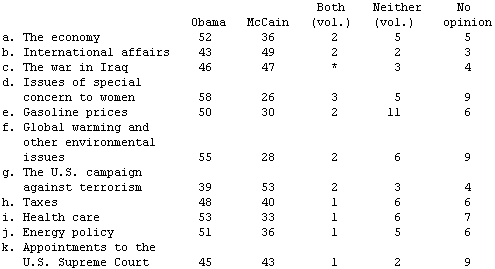
Only two issues rate double digits as “the single most important issue in your choice for president:” Economy/Jobs (33 percent) and Iraq/War in Iraq (19 percent). The only other answers with significant response were Health care (8 percent), Gas/Oil prices/Energy (6 percent), and Terrorism/National security (4 percent). Obama gets higher “trust more” ratings than McCain on virtually every issue:

Obama also beats or ties McCain on the important values questions:

Ideologically, 52 percent think Obama is “just right” as compared to only 40 percent for McCain. The internals, though, are more interesting:
- 36 percent think Obama is “too liberal” compared to only 5 percent who say he’s “too conservative”
- 34 percent think McCain is “too conservative” but 19 percent say he’s “too liberal”!
So, despite whatever damage the prolonged primary battle may have done to Obama’s support among Democrats, McCain has much more mending to do with his natural base. Interestingly, McCain’s “too liberal” numbers are comparable to what they were in 2000. His “too conservative” numbers have doubled.
Otherwise:
- On the national security front, the results split as to which candidates they favored. 65 percent support withdrawal from Iraq and 61 percent disagreed with the idea that “non-citizens suspected of terrorism . . . should be allowed to challenge their detentions in the U.S. civilian court system.” [UPDATE: Commenter Houston points out that I’m omitting the non-standalone questions in my analysis here. Indeed, if we look at those surveyed under “issues,” national security is stronger for McCain. McCain leads 49-43 on “international affairs,” 47-46 on “War in Iraq,” and 53 to 39 on terrorism. The second of those is particularly odd given that 65 percent want us out of Iraq, which is much closer to Obama’s position than McCain’s.]
- And people value “New direct and new ideas” more highly than “Strength and experience” by a 50 to 43 margin.
- The only hopeful sign for McCain, seemingly contradicting some of the above findings, is that more people (56 to 52 percent) think he is a “safe choice for president” and slightly more people (46 to 42 percent) think Obama is a “risky choice for president. At roughly the same time in 2000, 59 percent thought George W. Bush was safe and 38 percent thought he was risky compared to 57 percent and 40 percent for Al Gore.
Also of interest:
- Slightly more (72 percent) of Obama’s voters say they will definitely vote for him as compared to 69 percent of McCain’s.
- Only 50 percent think Obama has “the kind of experience it takes to serve effectively as president.” (The question was apparently not asked about McCain.) Yet, 43 percent lean toward Obama compared to only 42 percent for McCain.
- 57 percent though McCain would “mainly continue in George W. Bush’s direction” vice 38 percent who thought he’d “mainly lead the country in a new direction.”
- 77 percent think a president “SHOULD be willing to meet with leaders of foreign countries that are hostile toward the United States because talking can improve relations and avoid confrontation.”
- 39 percent of Democrat leaners want to see Hillary Clinton get the nomination. Yet 75 percent are satisfied or enthusiastic about the outcome.
- 46 percent would like to see Hillary Clinton as Obama’s running mate. John Edwards, with 8 percent, is the only other candidate getting meaningful support.
- 50 percent favor “smaller government with fewer services” compared to 45 percent who favor “larger government with more services”
- Only 19 percent consider themselves to be “a feminist,” compared to 77 percent who did not
- 43 percent rate themselves as Moderates, 33 percent as Conservative, and only 21 percent as Liberal
The sample group seems to be somewhat skewed:
- 27 percent were aged 50-64 and another 16 percent 65+
- 54 percent had at least some college, with 11 percent having post-graduate degrees
- 18 percent made less than $20,000 a year
I’m skeptical of some of the other numbers, as well. For example, 75 percent claim to be following the election closely, with 34 percent saying they’re following “closely.” This roughly mirrors the numbers from this point in 2004 (78 percent) and is up a quarter from this point in 2000 (49 percent). 71 percent say they’re certain to vote and 81 percent claim they’re registered to vote at their present address. These answers simply don’t reflect reality. In 2004, which had the highest turnout in a generation, only 60.7 percent of eligible voters showed up. And this is a survey of “adults,” not registered, let alone likely, voters.
These answers — and perhaps those to the race questions, as well — are quite probably skewed by people telling pollsters what they think they’re expected to say rather than the truth. Indeed, the fact that nearly a third of respondents were willing to admit some racial prejudice (admittedly, after a strong of questions where they could demonstrate that they had friends of other colors and so forth) is surprising.









