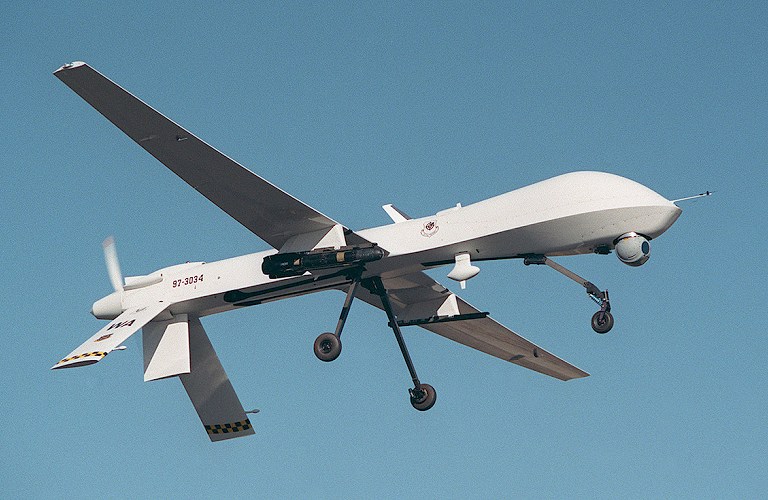

A report to the U.N. by special rapporteur New York University law professor Philip Alston suggests that the Obama Administration’s program to have CIA agents remote pilot drone strikes in Pakistan should be disbanded in favor of putting the operation in the hands of the military.
A soon-to-be-released United Nations report will call into question the use of unmanned aircraft for targeted killings in Afghanistan and Pakistan by U.S. intelligence agencies.
The report, to be released next week by the U.N. special rapporteur on extrajudicial executions, will call on the United States to stop allowing the Central Intelligence Agency to carry out drone attacks on suspected militants.
The special rapporteur, New York University law professor Philip Alston, told The New York Times that the CIA does not have the public accountability that’s required of the U.S. military. Alston says the use of the drones and their firepower should be restricted to the armed forces.
I definitely concur with this, on the principle of reciprocity, if nothing else. I don’t think too many of us would be comfortable with Chinese or Russian intelligence services using unmanned drones to embark on assassinations. Moreover, as the article points out, since the CIA operatives are ununiformed and not part of a military apparatus, they may be liable for criminal prosecution.
David Glazier, a professor at Loyola Law School in Los Angeles, says he agrees that the drone strikes are not war crimes. But he says that the CIA pilots who fly the drones could be regarded as common criminals. “They have no legal authority to be killing anyone,” Glazier says. “They have committed the crime of murder under Pakistan’s law.”
Glazier says that the issue comes down to who is considered a “privileged belligerent” in a conflict. Soldiers in organized armies are considered privileged belligerents who can’t be prosecuted for war crimes if they kill enemy soldiers in battle.
But someone who doesn’t wear a uniform, or belong to an army — such as a member of a terrorist group, or a civilian CIA pilot — might be prosecuted for murder, Glazier says.
I don’t know enough about the laws at issue to judge the legal liability of the CIA pilots. But it’s definitely a concern, and intelligence agencies are typically exempt from the usual rules of war, so Pakistan might well be within its rights to prosecute were it so inclined.
And, I might add, none of the above even touches the issue of whether the Obama or Bush Administrations had the legal authority to authorize these strikes in the first place.