
George Gene Gustines writes for the NYT (“Batman Is Turning 80. Fighting Crime Must Pay.“):
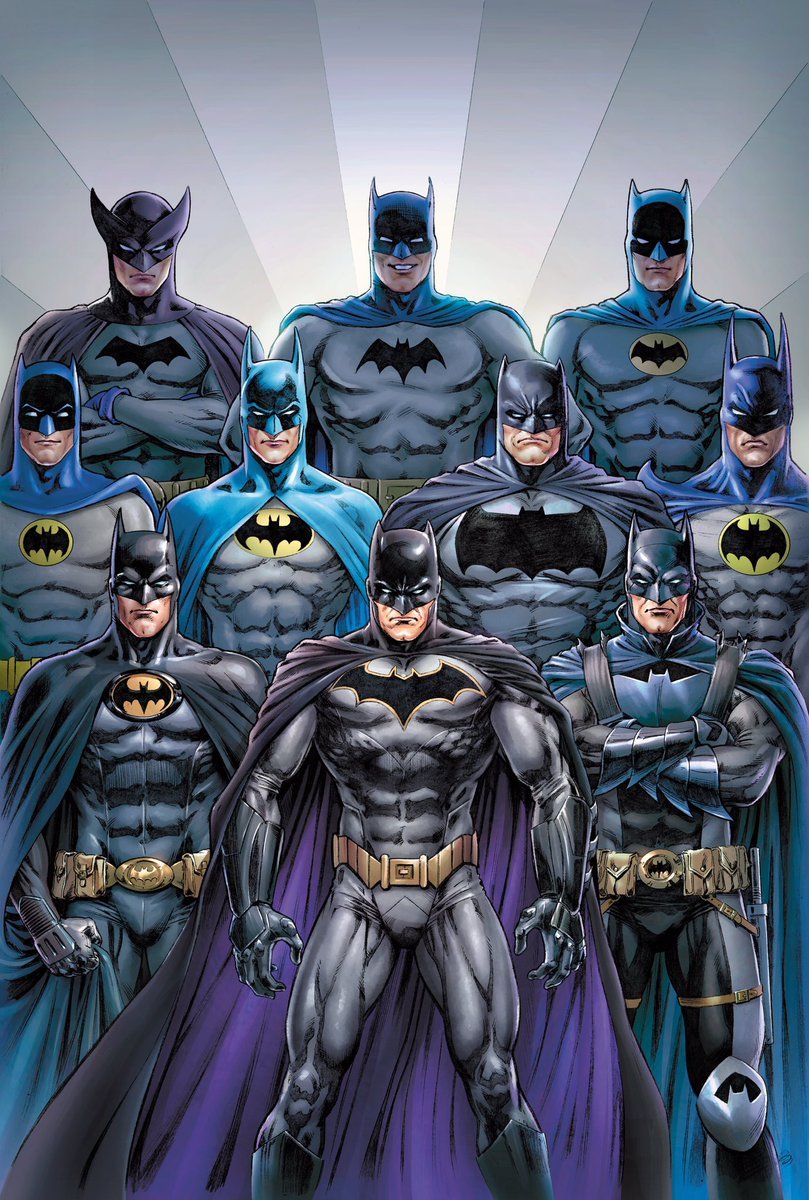
Holy milestones, Batman! Detective Comics, where the caped crusader debuted on March 30, 1939, will reach issue No. 1000 on Wednesday, just days before the hero’s 80th birthday. “It is evidence of the greatness and power of the Batman concept that the character has appeared continuously over eight decades,” Peter Sanderson, a comic book historian, said.
Growing up, I saw versions of Batman in comics and on TV, but one of the great leaps forward was Frank Miller’s The Dark Knight Returns, a four-part story which presented an older version of the hero coming out of retirement to protect Gotham City once more. Miller’s vision of Batman helped pave the way for Tim Burton’s “Batman,” starring Michael Keaton, perhaps the first time my love of comics was less childish and more socially acceptable.
Since then, we’ve had many film Batmen — his onscreen incarnations have oscillated between campy (Joel Schumacher) and dignified (Christopher Nolan) — but his guiding principle has remained the same. “Batman never gives up on his mission to protect the innocent from evil,” Sanderson said.
He takes us through several milestones of the Caped Crusader’s journey starting with the beginning:
Detective Comics was an anthology series that began in 1937 that eventually gave DC Comics its name. The Bat-Man, as he was then called inside the book, premiered in this issue’s six-page “The Case of the Chemical Syndicate.” (The later cover date — of May, in this instance — was a practice publishers used to keep comics on newsstands longer.) The story introduces Commissioner Gordon, the wealthy Bruce Wayne and his caped alter-ego, who thinks nothing of heaving a criminal off a roof. Batman was created by the artist Bob Kane and the writer Bill Finger, though it took many years for Finger to receive credit for his significant contributions to the canon. Another bat-fact: A copy of Detective No. 27 sold at auction for $1.075 million in 2010.
And ending with what is surely not the end:
This 96-page issue has several stories by a boldface slate of creators. The first, “Batman’s Longest Case,” by Scott Snyder and Greg Capullo, recalls his first adventure. It also introduces the Detective Guild, some of whose members had extensive solo stories in Detective, including Slam Bradley (12 years), Martian Manhunter (nine years) and Elongated Man (five years). “The richness, variety and popularity of these backups contributed to Detective’s success and longevity,” said Richard Roney, a member of the geek squad I run with, who researched and extolled these supporting characters.

I read the books off and on over the years, beginning in the late 1970s. I very much enjoyed the reboot that followed Crisis on Infinite Earths, including the Frank Miller-written “Batman: Year One” series in 1987. I fell away from reading late the next year, as I shipped off to Fort Sill to begin my Army career and have only read a relative handful since.