The first polls after last month’s fourth Democratic debate showed former Vice-President Joe Biden seemingly reasserting the lead that he’s had ever since he first entered the race notwithstanding the rise of Senator Elizabeth Warren, suggesting that Democrats still view him as the best hope to beat Trump in 2020. The same seems to be happening in a new round of polls that came out over the weekend that continue to show Biden in the lead, with Senators Warren and Sanders battling it out for second place while Mayor Pete Buttigieg continues gathering strength:
The top three candidates are far ahead of the rest of the pack in the 2020 Democratic presidential field, according to three national polls released Sunday.
A Washington Post-ABC News poll showed former Vice President Joe Biden at 28 percent among Democrats and Democratic-leaning registered voters, Massachusetts Sen. Elizabeth Warren at 23 percent and Vermont Sen. Bernie Sanders at 17 percent. Those three are the only candidates with double-digit support. (Among all voters, the numbers are Biden at 27 percent, Warren at 21, and Sanders at 19.)
An NBC News-Wall Street Journal poll offered similar results, with Biden at 27 percent, Warren at 23 and Sanders at 19. A Fox News poll had the best news for Biden, showing him at 31 percent, Warren at 21 and Sanders at 19.
The three polls were released exactly one year before Election Day 2020.
Mayor Pete Buttigieg of South Bend, Ind., sits in fourth place in all three polls, with his current support ranging from 6 to 9 percent. Buttigieg, however, has recently shown greater strength in individual states, polling at 20 percent, for instance, in an Iowa poll released Thursday by Iowa State University.
California Sen. Kamala Harris, who was polling in double digits during the summer, was in fifth place in two polls and sixth (behind Minnesota Sen. Amy Klobuchar) in one of them. One bit of good news for her: Harris’ 4 percent showing in the NBC/WSJ poll was sufficient to qualify her for the Democrats’ December debate being sponsored by POLITICO and PBS.
These numbers are roughly comparable to other polling put out since the last time we looked at the national polling:
- The most recent Harvard/Harris poll put former Vice-President Biden at 33%, followed by Senator Sanders at 18%, Senator Warren at 15%, Senator Harris at 5%, Mayor Buttigieg at 4%, Senators Klobuchar and Booker at 3%, Andrew Yang at 2%, and all other candidates under 2%
- The most recent USA Today/Suffolk poll has Biden at 26%, Warren at 17%, Sanders at 13%, Buttigieg at 10%, Congresswoman Gabbard at 4%, Harris and Yang at 3%, and Klobuchar and Booker at 2%, and all other candidates at or under 1%;
- The most recent Economist/YouGov poll has Biden at 27%, Warren 23%, Sanders at 14%, Buttigieg at 7%, Harris at 4%, Yang at 3%, and Klobuchar and Gabbard at 2%, with all other candidates at or under 1%.
- The most recent Politico/Morning Consult poll has Biden at 32%, Warren and Sanders tied at 20%, Buttigieg at 7%, Harris at 6%, Yang at 3%, Klobuchar, Yang, and Booker at 2%, and all other candidates at or below 1%.
In several of these polls, Beto O’Rourke, who dropped out of the race on Friday, was polling at either 3 or 2%, so it will be interesting to see where his support might go, although it’s not likely to have a major impact on the race.
In any case, this puts the RealClearPolitics average as follows:
- Joe Biden —- 29.1%
- Elizabeth Warren — 20.3%
- Bernie Sanders — 17.1%
- Pete Buttigieg — 7.1%
- Kamala Harris — 3.9%
- Andrew Yang — 2.7%
- Amy Klobuchar — 2.6%
- Tulsi Gabbard — 2.0%
- Cory Booker — 2.0%
- All other candidates under 2%
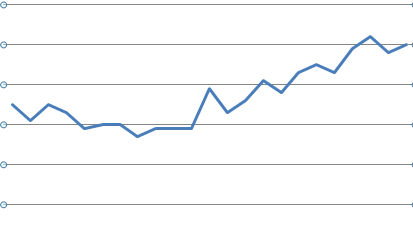
The poll average chart, meanwhile, appears to show Biden moving back up while Warren backs away from her peak:

Of course, as is the case with the General Election, it’s the states that matter more than the national polling, and there we get a bit of a different picture.
]n Iowa, for example, the RealClearPolitics average looks like this:
- Elizabeth Warren — 22.7%
- Pete Buttigieg — 17.0%
- Joe Biden — 15.7%
- Bernie Sanders — 15.3%
- Amy Klobuchar — 3.7%
- Kamala Harris — 3,0%
- Tom Steyer — 2.7%
- Tulsi Gabbard — 2.3%
- Andrew Yang — 2.0%
- Cory Booker — 1.3%
- All other candidates under 1%
In New Hampshire, the average looks like this:
- Elizabeth Warren — 25.0%
- Joe Biden — 21.0%
- Bernie Sanders — 20.0%
- Pete Buttigieg — 8.7%
- Kamala Harris — 4.0%
- Andrew Yang — 3.7%
- Amy Klobuchar — 3.0%
- Tulsi Gabbard — 2.7%
- Tom Steyer —- 2.7%
- Cory Booker — 1.7%
- All other candidates under 1%
In Nevada, which has seen only limited polling, the average looks like this:
- Joe Biden — 25.0%
- Elizabeth Warren — 19.7%
- Bernie Sanders — 18.3%
- Kamala Harris — 4.7%
- Pete Buttigieg — 4.0%
- Andrew Yang — 3.7%
- Tom Stever — 3.3%
- Cory Booker — 1.7%
- Tulsi Gabbard — 1.0%
- All other candidates under 1%
Rounding out the February contests with South Carolina we see this:
- Joe Biden — 35.0%
- Elizabeth Warren — 15.5%
- Bernie Sanders — 12.8%
- Kamala Harris — 7.8%
- Tom Steyer — 4.5%
- Pete Buttigieg — 4.0%
- Cory Booker — 3.5%
- Andrew Yang — 2.3%
- Amy Klobuchar — 2.0%
- Tulsi Gabbard — 1.3%
- All other candidates at or below 1%.
Finally, looking ahead to the biggest primary of the year in California, we find this:
- Elizabeth Warren — 24.5%
- Joe Biden — 23.5%
- Bernie Sanders — 20.3%
- Kamala Harris — 8.0%
- Pete Buttigieg —- 6.3%
- Andrew Yang — 3.0%
- Cory Booker — 1.5$
- Amy Klobuchar — 1.5%
- Tulsi Gabbard — 1.3%
- Julian Castro — 1.0%
- All other candidates under 1%.
What all of these poll results tell us is that the race for the Democratic nomination, at least for the moment, is down to a four-person race whether you look at it from the state or national level. At the top, generally speaking, we have former Vice-President Biden and Senator Elizabeth Warren, a matchup that suggests that the race is slowly but surely shaping up to be the showdown between the progressive wing of the Democratic Party, most likely represented by Senator Warren and the mainstream center-left of the party represented by the former Vice-President. Biden, Behind them, there’s Bernie Sanders and Pete Buttigieg, who has managed to gain momentum over the past several weeks.
At the state level, things are getting interesting. Warren and Buttigieg, both of whom have spent a lot of time on the ground, seem to be pulling ahead in Iowa with Biden in third place. In this respect, it’s important to remember that historically Iowa has been a place where the candidates who finish in the top three slots end up being those who get the most momentum after the caucuses. In New Hampshire, which holds its primary just over a week after Iowa, we have the trio of Warren Biden, and Sanders leading the pack while Buttigieg is in a close fourth place. If Warren manages to win one or both of these first two contests, then she’ll be well on the way toward making Sanders and Harris, the other competitors for the progressive vote, far less relevant going forward. The final two February contests, in Nevada and South Carolina, appear to be in the Vice-President’s column but that could easily change as momentum shifts once actually voting begins. Finally, in the biggest prize of the first five weeks of voting, Harris appears to be in danger of being rejected by the same voters that put her in the Senate. If she doesn’t improve her numbers in the Golden State then that could be the end of her campaign.
All of this comes just under one year before Election Day and 92 days before the Iowa Caucuses. There’s still time for things to change, but the patterns are beginning to seem obvious.