WaPo’s Jon Cohen thinks the “bipartisanship” tack that President Obama is taking to fight back against recent Republican gains could work.

Nearly six in 10 in the new poll say the Republicans aren’t doing enough to forge compromise with President Obama on important issues; more than four in 10 see Obama as doing too little to get GOP support. Among independents, 56 percent see the Republicans in Congress as too unbending and 50 percent say so of the president; 28 percent of independents say both sides are doing too little to find agreement.
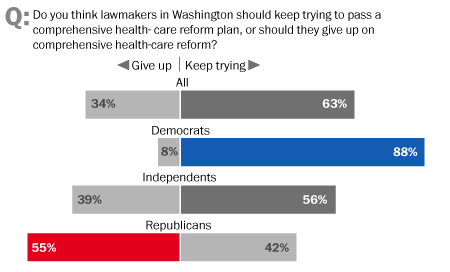
As party leaders tussle over the proposed bipartisan health care summit, nearly two-thirds of Americans say they want Congress to keep working to pass comprehensive health-care reform. Democrats overwhelmingly support continued action on this front, as do 56 percent of independents and 42 percent of Republicans.
The problem with this is two-fold, however. First, people generally seem to think that, if politicians would just work together, they’d not only get things done but they’d miraculously be just the policies that they themselves prefer. That’s not the reality. Second, while a striking number of Republicans also share that sentiment, a majority correctly understands that any bill they could pass with a Democratic majority and a Democratic president would be one they’d very much dislike. So giving up — which translates into obstructionism — is the better course.
Personally, I’d like to see some reforms passed on things like portability and interstate competition. These measures could win overwhelming support from both parties. But, for a variety of reasons, they’re unlikely to happen absent a comprehensive bill. And a comprehensive bill is unlikely.
Regardless, Mark Knoller‘s right here:
He’s appealing for a spirit of bipartisanship – urging Democrats and Republicans alike “to put aside matters of party for the good of the country.”
It’s a familiar refrain from U.S. presidents who can’t get their way in Congress.
“We must put aside our political differences if we’re ever to set our economy to rights,” said President Reagan in 1982.
“It is time to put aside partisan rivalries and work together for our nation’s future,” said President Reagan in 1987 in trying to get Congress to enact deficit reduction
“We must put aside partisanship for the sake of our nation,” said the first President Bush in 1990 in appealing for congressional cooperation on the budget.
“We must now put aside bitterness and rancor, move beyond partisanship,” urged President Clinton in 1993 in trying to get Congress to pass his economic plan.
What these presidential appeals for bipartisanship always mean is: do it my way.
Because, of course, if the other party were only reasonable, that’s what they’d do!
UPDATE: John Cole isn’t buying Knoller’s analysis.
Missing from this “analysis” from Knoller is the fact that but for bizarre Senate rules, a vast MAJORITY of the House and Senate want what the President wants. Missing from this analysis is the fact that the GOP is not acting as an honest partner and is voting as a block, providing not one vote. Missing from this analysis is the fact that the WH has made so many concessions to the Republicans and included so many of their demands into legislation that the left wing is pissed, and the GOP turned around and voted against it anyway.
He doesn’t want them to surrender. Hell, if they would just vote for bills that they co-signed, he’d be happy.
Nothing is going to change until our pudgy, well-paid, lazy stenographer class is as desperate as the rest of the American people. If Mark Knoller and Michael Gerson had no health care, made 17k a year, and had a pre-existing condition, I bet they’d think differently about things. But then again, that is suggesting he even thought before barfing up this piece.
But none of that contradicts what Knoller is saying. Obviously, if the Senate worked on a purely majoritarian basis, presidents wouldn’t need bipartisan cooperation when their party controlled Congress. But, since it doesn’t, they do. And, while all the presidents above — including Obama — naturally offered to make compromises, Knoller’s right: Calls for “cooperation” are almost invariably pleas for the other side to cave.