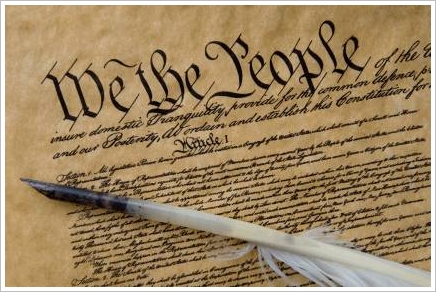
 For a whole variety of reasons, I’m a strong believer in the adherence to the plain meaning of the U.S. Constitution and believe that it should be amended rather than circumvented when the realities of today conflict with those of 1789. Still, there are those who make a fetish of the wisdom of the Framers when, as Eugene Volokh notes, “blatant unconstitutionality started early.”
He cites a specific, fairly innocuous passage:
1789: The states ratify the U.S. Constitution, which says, in relevant part, that “No Person shall be a Representative who shall not have attained to the Age of twenty five Years.”
1797: William C.C. Claiborne is seated as a Representative from Tennessee, at age 22.
I’d love to know more about whether any constitutional objections were raised to this; Joseph T. Hatfield, William Claiborne: Jeffersonian Centurion in the American Southwest (1976), doesn’t discuss any controversy about this, and a research assistant whom I asked to look through the Knoxville Gazette for 1796 to 1798 didn’t find any articles mentioning any controversy about this.
Henry Clay was sworn in as U.S. Senator on Dec. 29, 1806, when he was three and a half months short of the constitutionally required age of thirty. I couldn’t find any evidence that there was any controversy about that, either. On the other hand, Albert Gallatin was denied a Senate seat in 1793 on the grounds that he hadn’t satisfied the constitutional requirement of having “been nine Years a Citizen of the United States.”
Particularly amusing in light of the continued frothing at the mouth over Barack Obama’s birth certificate.
Of course, the age requirement is among the least significant examples — although one of which I was unaware — of the Constitution being treated as a mere political inconvenience while the men who wrote it were not only alive but still active in politics. Remember, James Madison, widely considered the Father of the Constitution, was president from 1809 to 1817 — well after these incidents. Either George Washington or John Adams, both prominent Framers, were president when Claiborne was seated and Thomas Jefferson was in office when Clay was seated.
Regardless, Washington vastly expanded on the enumerated powers of the presidency — creating the doctrine of Implied Powers — and Jefferson, the leader of the minimalist camp during the Constitutional debates and long thereafter, boldly ignored the document when making the Louisiana Purchase.