
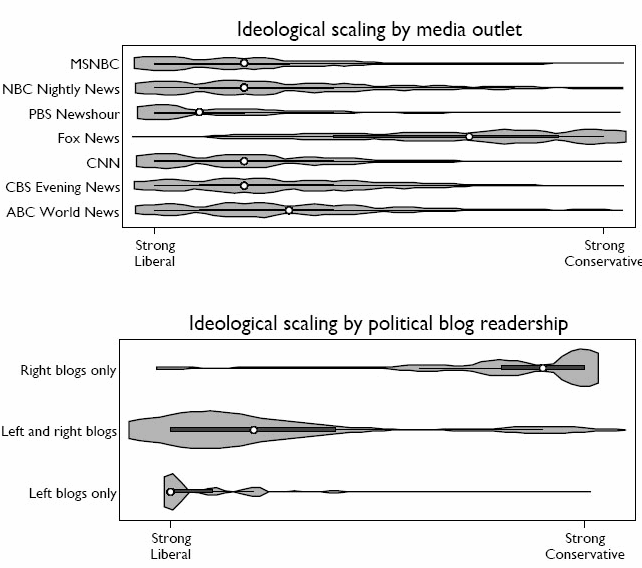
Henry Farrell, Eric Lawrence, and John Sides have collaborated on a paper, still in late draft stages, entitled “Self-Segregation or Deliberation? Blog Readership, Participation, and Polarization in American Politics.” A PDF of the working copy is available here.
Henry reports that,
[B]log readers seem to exhibit strong homophily. That is to say, they overwhelmingly choose blogs that are written by people who are roughly in accordance with their political views. Left wingers read left wing blogs, right wingers read right wing blogs, and very few people read both left wing and right wing blogs. Those few people who read both left wing and right wing blogs are considerably more likely to be left wing themselves; interpret this as you like. Furthermore, blog readers are politically very polarized. They tend to clump around either the ‘strong liberal’ or the ‘strong conservative’ pole; there aren’t many blog readers in the center. This contrasts with consumers of various TV news channels, as the figure [thumbnailed at right] illustrates. All of this suggests that blog readership is unlikely to be associated with the kinds of deliberative exchange between different points of view that some political theorists would like to see.
Sides adds,
Only 6% of political blog readers named both left and right blogs. Thus, most blog readers are “carnivores” rather than “omnivores”: they like partisan red meat, as it were. This is the self-segregation that the paper discusses.
I’m clearly an outlier, a right-of-center blogger who not only reads from both sides of the aisle but reads predominantly the other side. I suspect this stems from my tendency to read blogs written by academics and journalists, which skews the choices of quality blogs available to me. Further, I’ve got numerous commenters from the left, right, and center.
That aside, the results don’t much surprise me. After all, we’re a polarized polity right now, so it stands to reason that we’d see the same in the blogosphere. Given that the mass media outlets to which blogs are compared in the chart above are ostensibly “neutral” whereas the blogs are openly biased, it’s remarkable how polarized the audiences of the former are.
Further, as I’ve discussed perhaps ad nasuem in posts over the past five plus years, most blogs are frankly unreadable by those not sympathetic to the point of view of the author. This holds true even when one excludes the 90-plus percent of political blogs that are unreadable, period. Few people have an appetite for being rudely insulted on a regular basis, having their intelligence, decency and patriotism questioned.









