
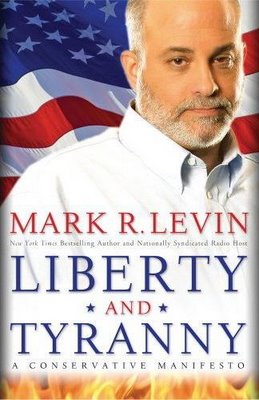

Chapter Five – On Federalism, pp. 49-60
Before I start this chapter, I have a feeling that I’m going to be bored. This is probably going to be a short entry, because I find it hard to get exercised one way or the other about federalism. Then again, maybe Levin will make me go on a long digression, we’ll see.
We open with a description of the Constitutional Convention that is fairly accurate. A good start so far.
After a first paragraph in which describes the intent of the Framers’ in terms of a national government, he underscores the importance of the delineation of state and federal power by referencing the Tenth Amendment. (Which, of course, was not adopted in 1787, but rather ratified by the states after the adoption of the Constitution, but both Madison and Hamilton considered the Tenth Amendment to be superfluous so I’ll let this point slide.)
Next, Levin notes that “States are governmental entities that reflect the personalities, characteristics, histories, and priorities of the individuals who inhabit them.” This is true, as far as it goes. But states are also arbitrary lines on a map, reflecting two centuries of compromise over slavery and the western territories, some of which make more sense than others. There’s nothing really special about them. Consider this: HALF of the population of the state of New York, 8.4 million, lives in New York City. That’s a larger population than 38 of the 50 states. The ten least populated states, COMBINED, have a smaller population than New York City. So why is New York City “just” a City, while much smaller political entities are considered states? Just the circumstances of history. There’s no rhyme or reason to it.
Indeed, it’s this strange and arbitrary makeup of the states that led Alexander Hamilton to walk into the Constitutional Convention with a plan that virtually eliminated state sovereignty entirely.
Next, Levin makes the usual paeans to Federalism, which we’ve all heard before, but let’s let him talk:
States are more likely to better reflect the interests of their citizens than the federal government. Localities are even more likely to better reflect these interests because the decision makers come from the communities they govern–they are directly affected by their own decisions.
A couple things worth noting here.
1. These are empirical arguments. If they’re true, we ought to be able to somehow make a determination that this is so. But Levin doesn’t do that–he just asserts it.
2. This begs the question — why have a federal government at all? Levin’s only support, so far, seems to be that the Founding Fathers wanted it that way. I’m interested to see if he defends the federal government at all later on.
3. I actually don’t think that state and local government reflect their local constituents better. The fact of the matter is, people don’t really care much about local governments except when they’re screwing something up. I guarantee if you stopped 30 random people on the street in a normal sized suburb, they wouldn’t be able to name their mayor, City Councilmen for their district, or their State Representative. I’ll bet they CAN name the mayor of the nearest big city; the name of their governor, and the name of the President.
4. One of the reasons why people don’t care much about local government is because people move around much more than they used to. For my own part, I have lived in two states, worked in four, and lived in five different cities, and worked in seven different cities. And I doubt I’m that unusual. I have much stronger bonds of affection for my country than I do my city.
5. In many important issues involving civil liberties, it is the federal government that prevents the states from infringing on liberty, not the other way around. The federal government integrated before the states did. The federal government passed anti-lynching laws. The FBI has pretty much removed the grip that a lot of organized crime syndicates had over local governments. Etc. Etc. Etc.
Let me add to these notes that I’m not opposed to local jurisdictions having jurisdiction in some areas but not in others, nor do I think that local communities shouldn’t have any say in how they govern themselves. I just feel obligated to point out that the real world is a lot fuzzier and grayer than Levin implies.
Next Levin talks about one of the benefits of Federalism – the concept that the states can experiments with different policies, and thus inform each other and the federal government about better ways to do things. I agree that that’s a cool feature of the system.
After that, Levin discusses another benefit of federalism – mobility, which I alluded to earlier. The idea here is that “[i]ndividuals with widely divergent beliefs are able to coexist in the same country” because of diversity among states. I think that’s a pretty cool feature, too.
At this point, I’m starting to wonder whether I’m going to agree with Levin about the rest of the chapter! But wait… oh. Never mind.
However, one of the most dramatic events undermining state constitutional authority came with the ratification of the Seventeenth Amendment on April 8, 1913. The Seventeenth Amendment changed the method by which Senators were chosen, from being selected by the state legislatures–ensuring that the state governments would have a direct and meaningful voice in the operation of the federal government–to direct popular election by the citizens of each state.
My colleagues Doug and Steven have done the legwork on the ridiculousness of this argument, so I’ll refer you here, here, and here.
I’ll only add one note of my own. Anybody who has ever bothered to read the notes on the debates over the Constitution knows that this idea that Senators being selected by State Legislatures wasn’t carefully crafted to preserve federalism. It was a last minute compromise. None of the major plans for the Constitution included this provision in it. Madison’s Virginia Plan called for Senators to be selected by the House! Hamilton’s plan called for Senators to serve for life, but they were to be selected by electors who were voted for by the people–not state legislators. The New Jersey Plan called for the Congress to remain as it was under the Articles of Confederation. The Pinckney Plan also had Senators selected by the House. The idea of State Legislatures selecting Senators came late in the game – in July of 1787 – under the “Connecticut Compromise.”
Next Levin goes on to criticize the Wickard v. Filburn decision, which in his words “swept away 150 years of constitutional jurisprudence.”
Nonsense.
Although much maligned in conservative/libertarian circles (in fact, I recall arguing against Wickard in my Constitutional law class!) the plain fact of the matter is that Wickard wasn’t a unanimous opinion for nothing. It was firmly in the bounds of the plain text of Constitution. The plain text of the Constitution grants the Congress the power to “regulate Commerce … among the several States” and the plain text of the Constitution grants the Congress the power to “make all Laws which shall be necessary and proper for carrying into Execution the foregoing Powers.”
In the case of Wickard, it was within Congress’s authority to regulate commerce by controlling the price of wheat. Congress determined that in order to so regulate the price, the amount of wheat grown had to be regulated. Thus, its prohibition against growing excess wheat for private use was perfectly Constitutional. (Whether it was a good policy is an altogether different question — it wasn’t. But that’s not the point here.)
Did this line of reasoning overturn “150 years” of jurisprudence? Hardly. Wickard relies on John Marshall’s 1824 decision in Gibbons v. Ogden, in which John Marshall describes the Commerce Power thusly:
If, as has always been understood, the sovereignty of Congress, though limited to specified objects, is plenary as to those objects, the power over commerce with foreign nations, and among the several States, is vested in Congress as absolutely as it would be in a single government, having in its Constitution the same restrictions on the exercise of the power as are found in the Constitution of the United States.
Moreover, there is an even stronger basis for this line of reasoning in McCulloch v. Maryland, where Marshall noted:
Let the end be legitimate, let it be within the scope of the constitution, and all means which are appropriate, which are plainly adapted to that end, which are not prohibited, but consist with the letter and spirit of the constitution, are constitutional.
This formulation is virtually identical to Alexander Hamilton’s defense of the Constitutionality of the Bank of the United States way back in 1791, where Hamilton wrote:
If the end be clearly comprehended within any of the specified powers, and if the measure have an obvious relation to that end, and is not forbidden by any particular provision of the Constitution, it may safely be deemed to come within the compass of the national authority.
Thus there is a clear throughline of jurisprudence, starting with Alexander Hamilton’s defense of the Constitutionality of the Bank of the United States, through the earliest decisions involving the Commerce Clause, right on down through Wickard.
After this, Levin then complains that the states have become “administrative appendages” of the federal government, and further complains that the “Statists” have constructed a “Fourth Branch of government” vis a vis adminstrative agencies. Both of these arguments have little merit. The Constitution is quite clear that the federal government has supreme authority within its powers. It has every right to ensure that the states abide by federal law. As to the Administrative State, while there’s no doubt that it’s become a large part of the federal government, a bureaucracy to manage the duties of the executive office was not only contemplated in the Constitution, but also part of the very first government. George Washington himself helped create the first executive offices from which the modern bureaucracy emanates.
Levin then spends a paragraph complaining about federal regulations, but its unclear as to what his solution is. The modern economy is large and complex. Regulating that economy requires complexity. I have no issues with streamlining federal regulations and have no doubt that some pruning could be done. That said, some regulations are necessary for a number of reasons, and to simply dismiss them all without addressing the problems for which the regulations are purported to solve is absurd.
Levin then goes on to make a decent point about federalism — namely, that it was to their credit that the northern states resisted federal authority vis a vis the Fugitive Slave Laws before the Civil War. I think that’s a good point and, as I mentioned above, I think there’s definitely some value to a certain degree of give and take between federal and state governments.
But in my mind, this give and take doesn’t have any moral merit. It’s purely one of utility. Whether the federal government or state or local government should be the leading authority in certain areas should be a matter of what works best — not some arbitrary distinctions. Frankly, it makes a lot more sense to me for the Federal government to be the dominant economic regulation. And I wish it did more. For example, it’s silly that, if you get a license to be say, an electrician in Oregon that you have to be re-licensed if you move to Pennsylvania. That kind of local economic regulation serves no useful function. Better that rules governing electricians be centralized. On the other hand, it doesn’t make much sense to me to have the federal government control natural parks — that seems to me to be something that makes more sense for the states to manage. Now, maybe I’m wrong on these two specific policy issues. But the point is that it doesn’t make sense to ascribe some sort of magical power to federalism. We should focus on what works instead.
Levin then goes on to what I think is an excellent point — it was precisely the adoption of the Constitution that did lead to the eventual end of slavery, that did lead to civil rights, etc etc etc.
I have to say that, overall, I found this chapter to be the most interesting of the book so far, and certainly the one with the most insightful points. It is also, and this is no coincidence, the chapter that so far has had the least references to the Statist boogeyman and its associated logical fallacies.
Levin closes with a quote from Madison, and so I’ll do the same:
“A popular Government without popular information, or the means of acquiring it, is but a Prologue to a Farce or a Tragedy, or perhaps both. Knowledge will forever govern ignorance: And a people who mean to be their own Governors, must arm themselves with the power which knowledge gives.”
Next up is Chapter Six, entitled “On the Free Market”, which is over 30 pages long. I wager I’ll be doing this chapter in several parts. Until next time!









