
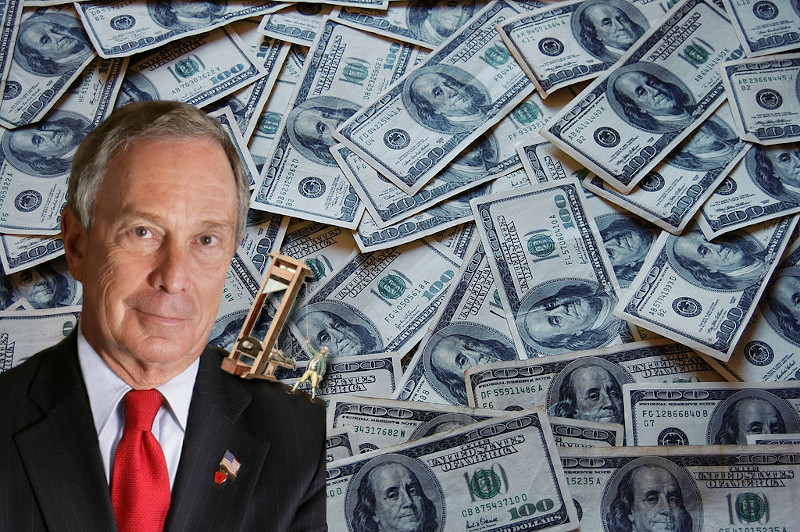

The FiveThirtyEight forecast is, by its very nature, extremely volatile. It depends very much on events that haven’t happened yet. But, ahead of South Carolina, it ran three scenarios: Joe Biden wins big, Joe Biden barely wins, and Bernie Sanders wins. Only the middle of those outcomes offered any opening for Mike Bloomberg to have a great night on Super Tuesday and emerge as the moderate alternative to Sanders.
There wasn’t enough time between Saturday night’s announcement of a big Biden win in the Palmetto State and the opening of the polls Tuesday morning to conduct a lot of polling. But the combination of Biden’s big win and the rush of his former opponents—including recently-departed Pete Buttigieg and Amy Klobuchar—to endorse him radically changed the landscape going in.
Bloomberg and Elizabeth Warren were the big losers from this change of expectations. We’ll get to her later. But Bloomberg couldn’t have had a worse night electorally.
AP (“AP source: Bloomberg to reassess after disappointing results“):
Democratic presidential candidate Mike Bloomberg will reassess on Wednesday whether he should stay in the race after getting disappointing results in Super Tuesday primaries despite spending more than a half billion dollars on his three-month campaign.
A person close to the Bloomberg campaign confirmed the deliberations. The person wasn’t authorized to discuss the matter by name and requested anonymity. Bloomberg flew back to New York after campaigning Tuesday in Florida, a state that votes March 17 and where he’s already spent millions.Bloomberg, a billionaire businessman and former New York mayor, spent sums never before seen in political campaign history since entering the race in November. Millions of dollars went toward states like Virginia, North Carolina and Tennessee — all three of which former Vice President Joe Biden won on Tuesday, riding a wave after his decisive victory in South Carolina. Sen. Bernie Sanders, meanwhile, racked up victories in California, Colorado and other states.
People are rushing to second-guess his decision to run:
Bloomberg’s poor showing was a rejection by voters of the central rationale of his campaign: He was the candidate best poised to take on Republican President Donald Trump. And it was proof that, in politics, money can’t solve every problem. Bloomberg, one of the world’s wealthiest men, has a $61 billion net worth that flows from the financial data and media company he founded in the 1980s, Bloomberg LP.
“When you come in late to the game and you are someone who has a record, you can’t assume you can just wash that away with spending. You’re still gonna have to answer questions and you’re still gonna have to be vetted,” said Karen Finney, a Democratic strategist and former Hillary Clinton aide.
Well, sure.
But if Biden had had an anemic finish in South Carolina Saturday, voters may well have rallied to Bloomberg yesterday. Indeed, Bloomberg was my backup in that event.
Bloomberg had aimed to take advantage of a weak and divided field of moderate candidates and collect enough delegates out of the day to emerge as the moderate alternative to Sanders. But Biden was boosted by Amy Klobuchar’s and Pete Buttigieg’s decisions to exit the race and endorse him.
The AP has allocated some delegates to Bloomberg from the territory of American Samoa, Texas, North Carolina, Tennessee, Colorado, Alabama and Oklahoma.
Kevin Sheekey, Bloomberg’s campaign manager, said the campaign’s “number one priority remains defeating Donald Trump in November.”
If that’s indeed his goal—and I believe it is—then dropping out and throwing his endorsement and money behind Biden would now seem to be the best option. Indeed, that would have been his best option Sunday or Monday—as I wrote several times. But one understands his desire to at least test his waters once with the voters after such a massive investment.
There were signs Bloomberg wants to to stay in the race. He has already announced campaign stops in Michigan, Pennsylvania and Florida on Thursday, Friday and Saturday. He’s spent tens of millions of dollars in states that don’t vote until later in March or April, and bought new advertising time on Tuesday night, according to the ad tracking firm Advertising Analytics.
But Bloomberg has plenty of money. He won’t even notice another few million dollars and he has to hedge his bets until his decision is final. But it seems a rather obvious one at this point.
Bloomberg himself spoke before most of the races had been decided, and preemptively dismissed the outcome.
“No matter how many delegates we win tonight, we have done something no one thought was possible: In just three months, we’ve gone from 1 percent in the polls to being a contender for the Democratic nomination for president,” he said.
Indeed, Bloomberg’s money allowed him to campaign in the Super Tuesday states in ways his opponents could only dream of. He was the only candidate on air in all 14 states, and had staff on the ground in every state, including some teams that campaign leadership said were bigger than any campaign had built for a prior election.
According to TV ad spending data obtained by The Associated Press, Bloomberg dropped nearly $180 million on television advertising in those states as of this past weekend. More than $100 million went into Texas and California, the race’s two largest delegate troves, coming out to roughly $3 per voter.
In San Diego, some Democrats have even turned Bloomberg’s name into a verb to describe one Democratic candidate’s massive spending in the local congressional race, saying she’s “Bloomberged” the race. A TV viewer there could have seen a Bloomberg ad as many as 40 times in the 10 days leading up to the election. Bloomberg hired more than 300 operatives in the state as part of a national staff of 2,400 people.
“It has to be somewhat humbling, not making any showing at all, especially given all he’s spent both on TV buys and on field organizing,” said Jess Durfee, a Democratic National Committee member from San Diego who voted for Elizabeth Warren.
Of course it’s embarrassing to have so little to show for such a big investment. But, while I’m under no illusion that the average voter spends anything like the amount of time I do consuming information, I’m sure most of them understood going in that it was a two-man race. It’s why so many people who weren’t enthusiastic about Biden wound up voting for him.









