
The free high-resolution photo of person, photography, money, child, business, singing, euro, merit, businessman, finance, wealth, profit, performing arts, stock exchange, revenue, investments, speculate, stock broker, speculation, share price, capital market , taken with an NIKON D3200 02/10 2017 The picture taken with 250.0mm, f/7.1s, 10/400s, ISO 400 The image is released free of copyrights under Creative Commons CC0. You may download, modify, distribute, and use them royalty free for anything you like, even in commercial applications. Attribution is not required.
The image is released free of copyrights under Creative Commons CC0.

Britain’s Decline

Richer than Germany 20 years ago, it’s now poorer than Mississippi.

18

Comments

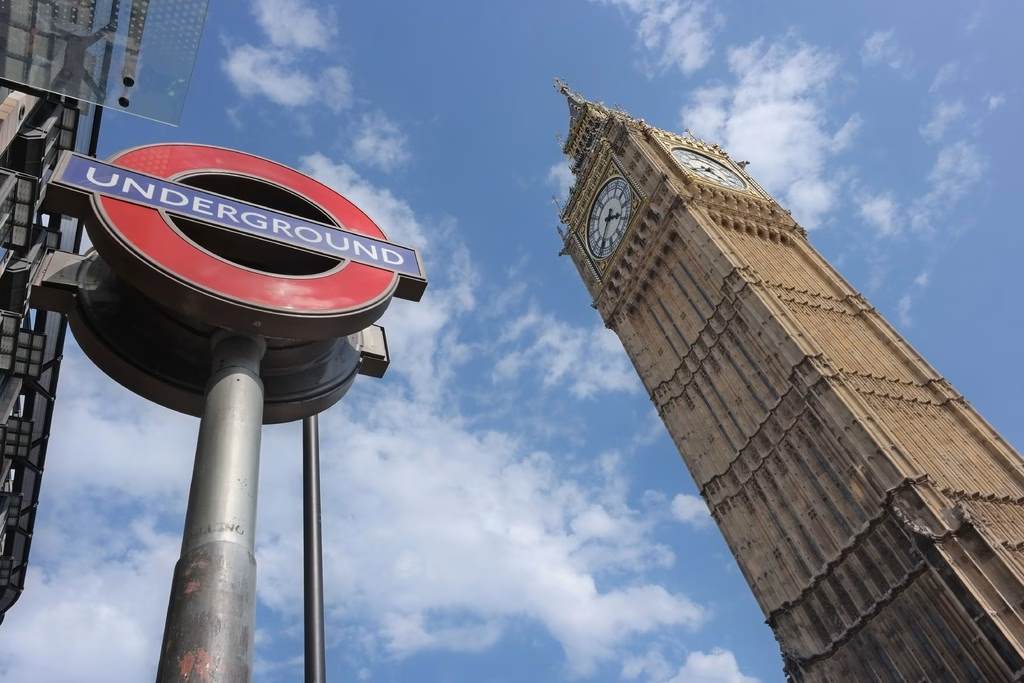
photo of architecture, sky, street, tube, clock, building, city, skyscraper, urban, travel, metro, underground, transportation, sign, europe, tower, mast, station, landmark, blue, big ben, uk, england, capital, london, parliament, steeple, public, british, english, britain, united kingdom
CC0 Public Domain photo via PxHere

The Atlantic’s Idrees Kahloon examines, “How Britain Became as Poor as Mississippi.”

The setup:

The past 18 years, enough time for a whole lost generation to be born and brought up, have yielded nothing but stagnation and mass disillusionment. In 2007, before the global financial crisis, Britain was at its postimperial zenith. Median household income had just surpassed that of Germany. A pound was worth more than $2, and London was arguably displacing New York as the center of international banking.

But since then, Britain has been left behind. The country’s output per person is now only just above that of Mississippi, America’s poorest state—and that slight lead is only achieved thanks to London. Outside the capital, in places where tourists do not visit, living standards fall well below Mississippi’s. Brits visiting the United States find that their currency has depreciated to the point where the pound today buys only about $1.35. British wages have lagged well behind those in the U.S., and also those in Germany, France, the Netherlands, Denmark; once you account for inflation, they’ve barely grown at all. Within the next decade, the typical Pole will have a standard of living equal to the typical Brit, if current trends continue.

One generation ago, Britain was a major global power; today, it is a middling one, gripped by sclerosis. Taxation is at the highest level since World War II, yet public services have deteriorated. The National Health Service, the celebrated pillar of the British cradle-to-grave welfare state, has a backlog of 6 million patients—almost a tenth of the population—waiting for treatment. The health service now has to spend more money settling maternity-malpractice claims than it does on actually providing maternity care. Many Brits can neither obtain an appointment with a publicly funded dentist nor afford a private one; in a 2023 survey, one in 10 reported doing DIY dental work, in extreme cases extracting their own teeth or gluing broken crowns back together.

His explanation for what happened:

Some in Britain blame rotten luck—the 2008 financial crash, the coronavirus pandemic, an energy crisis after Russia invaded Ukraine. But other countries endured these challenges too. What differentiated Britain was its self-sabotaging responses to these and other problems. Brexit is the most famous example, but hardly the only one. Bad choices, beginning just after the financial crisis, begot worse ones. As public disillusionment has grown, politicians have been rotated swiftly in and out of power, abruptly terminating whatever policies they had started. Six different prime ministers have governed since the 2010 general election. They do not seem to be getting more talented over time.

[…]

The country’s downward slide has been consistent in one respect: As Britain has become more and more aware of its diminishment, it has retreated ever more fully into a defensive crouch. Politics have become zero-sum, descending into fights over who has robbed whom. Suspicion has fallen, above all, on immigrants, whom both major parties have turned against. There is still an enduring strain of British exceptionalism, quieter and more understated than the American version, which suggests that by retreating inward, Britain can make itself great again. Astonishingly, or perhaps predictably, it is growing stronger as the country’s problems get worse.

[…]

In the 1990s, both the Tories and Tony Blair’s “New Labour” Party made the same bet: Britain was to be a postindustrial, services-based economy, anchored in finance. Tax receipts from a booming London would be redistributed to lagging regions in the old industrial heartland, helping to renew them. Then came 2008, and London’s financial industry cratered.

But the government’s actions during and after the crisis compounded the damage. Rather than increase spending to revive depressed demand, as modern Keynesians would counsel, the government, then led by Conservative Prime Minister David Cameron, opted to slash budgets as revenue plunged. The theory was that fiscal discipline—cutting spending more sharply than Britain’s peer countries—would inspire confidence and spur growth. At the time, deficits and debt were seen as immoral; unlike profligate Greece, Britain would manage its affairs prudently.

[…]

Austerity was felt most harshly by those who were already suffering after deindustrialization. The welfare state had partially compensated the losers from globalization. When it abruptly shrank—because the masters of the universe had miscalculated—anger erupted upward, at British elites, and also outward, at European migrants, who were competing for jobs and public services. It was because of this political pressure that Cameron made another fateful decision: to hold the Brexit referendum in 2016. This was a gambit; Cameron expected the vote to fail. He did not want to leave the European Union, but he wanted to arrest the rise of figures such as Nigel Farage, the longtime gadfly of British politics, who had been campaigning for withdrawal from the EU for decades. Left-behind Britain, the places especially harmed by austerity cuts, voted overwhelmingly to leave. The morning after he lost the referendum, Cameron resigned, ushering in a period of political instability that has now lasted a decade, and shows no sign of ending.

There’s a whole lot more, but that’s the gist of his argument.

With respect to Brexit, there is a growing realization that it was a mistake. There has been a lot of talk of “Bre-entry.”

Similarly, while austerity was long the elite consensus at places like the IMF and World Bank, its popularity has faded. To be sure, there are risks to the Keynesian approach as well. Despite our political turmoil, the United States weathered the Great Recession and COVID considerably better than most, partially because of massive infusions of cash into the system by the government. The cost of that is a national debt of over $39 trillion, the interest payments on which have now exceeded our spending on national defense. I’m skeptical that this is sustainable.

18 responses to “Britain’s Decline”

  1. I remember back when Brexit was happening the media reported that once you got out it would be nearly impossible to get back in. Do they even have a path for re-entry? This is really sad for the British people.

    3
  2. The theory was that fiscal discipline—cutting spending more sharply than Britain’s peer countries—would inspire confidence and spur growth. At the time, deficits and debt were seen as immoral; unlike profligate Greece, Britain would manage its affairs prudently.

    ”Mister, we could use a man like Herbert Hoover again.” Or like Churchill as Chancellor of the Exchequer post WWI. At least the The Atlantic seems to have noticed it was Tories what done it.

    7
  3. During the early to mid-seventies, the pound went from $2.40 to $2.72.

  4. Jay L. Gischer Avatar
    Jay L. Gischer

    It’s a sad tale. I wonder if it isn’t maybe something that is inevitable once a small group of elites mange to get a strong enough grip on power somewhere. They will see what’s good for them as what’s good for the country, and lead it to ruin. I mean, one can see this pattern in many different places.

    For instance, we *could* have been using the general boom we’ve been having to pay down our own deficit. But instead, Republicans decided to cut taxes on the rich. Not on the rest of us, but just on the rich and corporations. Because we will grow out of the deficit!!!

    Looks like we’re going to inflate the deficit down intead. Which is fine when it means that rich people don’t have to pay taxes. When it would have meant some relief to mortgageholders in 2009 or 2010 though, OH NOES, we can’t have INFLATION!!!11!1!

    9
  5. May be totally tangential (but maybe not) but here is an interesting article from the Guardian:

    It was Britain’s most expensive house. Why is its only resident a homeless man who lives on the porch?

    It is a story about the fabulously wealthy, hidden assets, secretive business structures, international politics and intrigue. I’m increasingly convinced that if we don’t do something about income inequality and secrecy we will not be far behind.

    2-8A Rutland Gate had jewel-encrusted bathroom suites and gold wastepaper bins in its 45 rooms, but has lain empty for years. With many people desperate for secure housing, what does the abandonment of this palace tell us about the UK?

    When it last changed hands, in 2020, 2-8A Rutland Gate was Britain’s most expensive house, selling for £210m. The word “house” hardly does it justice; palace is probably more accurate. It is in Knightsbridge, one of the most glamorous parts of London, and has 45 rooms, four lifts, an indoor pool and 116 windows, 68 of which overlook Hyde Park.

    But no one is enjoying those views. This palace has been empty for years.

    There may not be anyone inside, but there is someone outside – just outside – and I’m afraid I’ve woken him up. On the porch is a makeshift tent, made mostly from umbrellas. A bearded head emerges, a little bleary, but cheerful. The porch is filled with stuff, which spills out along the railings: baskets, books and newspapers, pictures, teddy bears, games, a couple of bicycles, lots of flowers in vases, pots and bins.

    2
  6. @Jay L. Gischer:

    Looks like we’re going to inflate the deficit down intead.

    Not until they’ve used the debt to kill SS and Medicare/Medicaid.

    I wonder if it isn’t maybe something that is inevitable once a small group of elites mange to get a strong enough grip on power somewhere. … I mean, one can see this pattern in many different places.

    I happen to be rereading Peter Turchin’s End Times. He has studied multiple societies over history. He sees this happening in a roughly couple hundred year cycle pretty much everywhere, every time.

    1
  7. It is probably relevant that there has been a net exodus of Poles from the UK the last five years. The stereotypical Polish plumber has been moving back to Poland due to economic factors. Brits leaving the UK is stable at ~250,000 per year, but fewer moving there each year. Australia, the US, and Canada are the main targets of UK emigrants.

    2
  8. Jay L. Gischer Avatar
    Jay L. Gischer

    And now I’m thinking of @Beth. I am worried.

    5
  9. “How Britain Became as Poor as Mississippi.”

    You posit that as though it is a bad thing.
    THE ENTIRE GOAL OF THE REPUBLICAN PROJECT IS TO SPREAD POVERTY!!
    All of the poorest states are Ruby Red.
    If that’s not the goal, then explain why it is?
    Explain why the Speaker of the House is from one of the poorest states? Yet he does anything he can to support Fatso’s debt busting policies and nothing to help his constituents.
    This is nothing new.
    It has been going on since Reagan and his voodoo economics.
    Fuck Republicans. Fuck MAGA.

    11
  10. @Daryl:
    The only way Red States become self-supporting is to re-institute slavery.
    So, let’s enslave every last MAGAt that believes in Republican economic policies.

    2
  11. This is such a negative take. All I’m hearing is that Mississippi is doing great relative to one of our peer nations.

    I think we have to credit the pro-business administrations of decades of successive Republican governors, as well as the prison-labor industry, which has brought back slavery, and which may have even removed a number of undesirable people from the statistics.

    6
  12. Severing the country from a decades-old successful experiment in a globalized economy, the facilitated free exchange of labor and capital in the hopes of isolating oneself from all those overly foreign influences (you know, people who talk funny and whose skin has the wrong hue) while somehow (via magic?) keeping all the good things about the EU ends up having been the massively stupid mistake that a lot of people saw coming.

    Good thing everyone learned their lessons about the massive achievements of the post-war global order and aren’t foolishly dismantling it!

    4
  13. I think I’ve made this joke before:

    Regret: what you may feel after doing something stupid.

    Bregret: What you may feel after doing something massively stupid.

    2
  14. BTW: I take the general point about GDP per capita, but I can’t help but think that the average citizen of the UK, and especially the average lower-class Brit, doesn’t have a better quality of life (and at least in terms of things like access to health care and other services) than is the case for a similarly situated Mississippian.

    1
  15. @Steven L. Taylor:

    Recently Krugman did several pieces in his substack, mostly in the free area, about comparisons between European countries and the US. It was all too technical, or in Krugman’s words wonky, for me to try to explain what he said. The impression is that the comparisons are not very valid in most respects. He does touch on quality of life and overall health.

    It should all be on his substack still.

  16. Austerity has never worked. Keynesian stimulus has always worked. The only thing we don’t know, because the elite won’t let us try, is whether taxing the rich and paying off the stimulus debt works.

    Historically, countries deal with their debts in one of three ways: they pay it off, they default, or they inflate it away. Paying it off is by far the least frequently used.

    5
  17. @Michael Cain: The elites can’t even admit their tax cuts for the rich is the debt.

    1
  18. @Steven L. Taylor: Well, the poor Brit has to wait 6 months for NHS health care. The poor Mississippian has no access at all, except for emergency services required by law, and represent Unfunded Mandates that the Republicans/MAGA/Redstaters continually complain about.

    2




