

On Tuesday, in the comments below my post about how many MAGAnistas want to believe in even the most ridiculous fantasies, Gustopher asked this extremely salient question:
They may want to believe, but why do they want to believe this?
There are a couple of levels to the answer. The tier is why people believe in conspiracy theories in general; the second is about why the MAGA conspiracy theories resonate with that particular audience.
There are lots of reasons why people fall into the conspiracy theory rabbit hole:
- Conspiracy theories create sense in a senseless world. It’s terrifying to imagine that impersonal, uncontrollable forces govern our lives. Weirdly, it can be more comforting to believe that a small, sinister cabal is really the driving force behind history.
- Conspiracy theories explain why people feel dispossessed and disenfranchised. These cabals aren’t just interested in manipulating markets and controlling global conflicts. They’re also out to get you, for whatever you represent to them that they find offensive (for example, because you’re white, male, Christian, and can’t get a date).
- Conspiracy theories are esoteric knowledge. Even if you feel powerless and downtrodden, you can at least claim one advantage: you know something that the sheeple don’t.
- Conspiracy theories give people agency. Even an underdog, when armed with secret knowledge, can strike a blow against their vastly more powerful enemies. Even the act of rejecting the “dominant narrative” can be counted in the ledger of resistance.
There’s lots of interesting social science research into conspiracy theories, posing hypotheses about how there may be a conspiracy theory mindset, how that worldview makes one open to seemingly disconnected conspiracy theories (If clearly there are lizard people running the world, why not Bigfoot?), and even how there might be neurobiological origins of conspiracy thinking. And it’s nothing new for scholars to point out how often conspiracy theories (or, as Umberto Eco called it, “obsession with a plot”) are an integral part of fascist content.
But none of these possible explanations tell us why someone would be willing to believe in specific MAGA fever dreams, such as voting machine companies are rigging elections, Venezuelan gangs have seized power in a Colorado suburb, Haitian immigrants are eating innocent pets, gay teachers are “grooming” students, or Bill Gates wants to inject microchips into your veins. The content of these conspiracy theories has a simpler explanation: these are the people who already make the believers in conspiracy theories uncomfortable, and they are looking for stronger justifications for their discomfort. Or, to put it more succinctly, they want to believe because they want to hate.
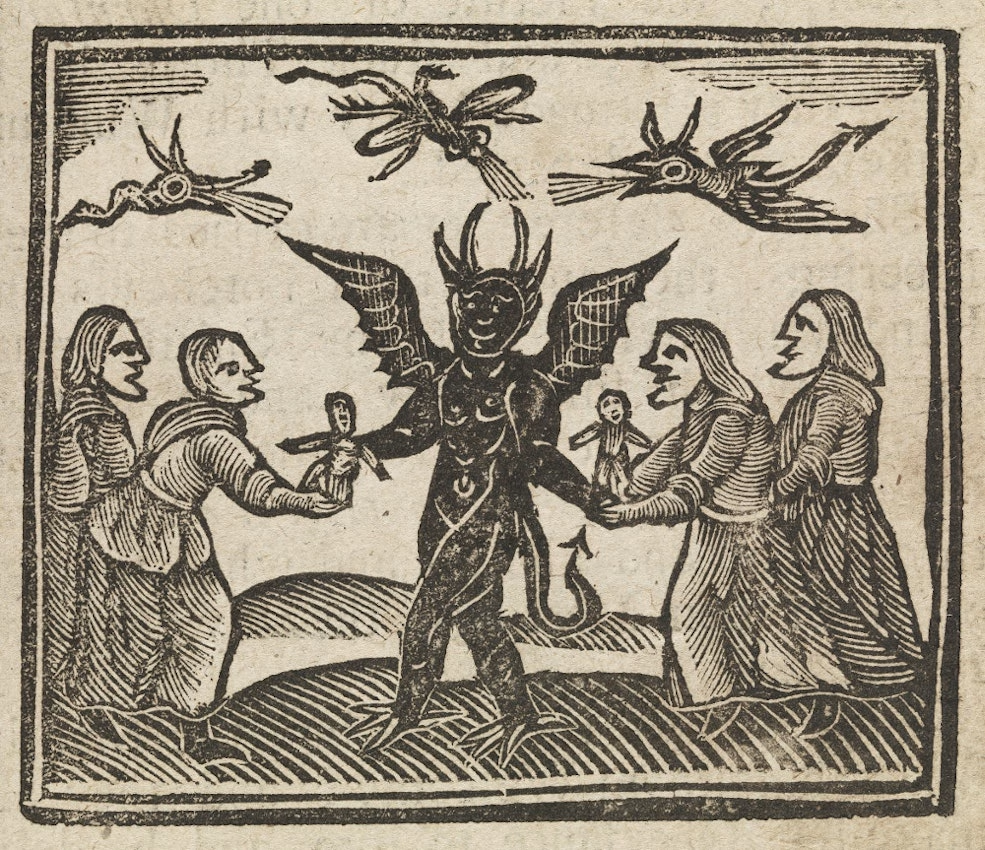
You might simply invoke the word “Othering” and leave it at that. However, I believe it’s more important to understand the mechanism that replaces the humanity of people you don’t like with a demonic caricature.
There are many basic human impulses at work which polite, vague terms like “disenfranchisement” don’t capture. They’re as simple and direct as discomfort (with the day workers hanging around the Home Depot parking lot), disgust (with the concept of gay sex), fear (about one’s own sexual leanings, of changes to the community in which one lives, etc.), envy (of people who are more successful than yourself), and bafflement (at how complex systems, such as government agencies and supply chains, operate).
Conspiracy theories take these very raw human feelings and turn them into a narrative of good and evil, in which the most extreme countermeasures are justified. It’s not just that transvestites makes me feel icky, but drag queen story hours are an active plot to corrupt the nation’s youth. Those day workers aren’t merely people unlike myself, but still recognizably human; they’re rapists and murderers who have infiltrated our country. That talking head on TV isn’t merely someone with whom I don’t agree, but a secret communist trying to undermine the pillars of American society.
MAGA conspiracies are so ridiculous because they are trying to justify things that are inherently hateful. The more innocuous the truth (most immigrants are just people looking for a better life, or escape from a horrible fate; LGBTQ+ people don’t want special privileges, they just want to be treated as humanely and fairly as everyone else; etc.), the more outlandish the narrative has to be.
Of course, no one is immune from taking this dark path, including people of more left-wing political persuasions. One simply has to look at the equally absurd conspiracy theories in the history of Communism that justified horrors like the liquidation of Ukrainian “kulaks,” the killing fields in Cambodia, or the Cultural Revolution. However, we’re talking about this particular movement, in this country, at this time, and the eager embrace of fantasies that are as ridiculous as they are hateful.
There are other mitigating factors, obviously. Fifty or a hundred years ago, the person who rants about how the Earth is hollow and aliens have secret bases within it would have been the neighborhood kook, with few ways to reinforce their beliefs beyond a few fringe publications, newsletters, AM radio shows broadcast in the middle of the night, and the occasional TV “documentary” show. Now, they are plugged into vast networks of fellow believers who provide encouragement and tortured explanations needed to sustain their beliefs in the face of facts. They also, of course, now have a Conspiracist In Chief who fans the flames of their paranoia, and a legion of other full-time conspiracy thought leaders doing podcasts and posting on social media. You can call this a “permission structure,” but again, I fear this language may as denatured as “disenfranchisement.” What we’re talking about is a license to hate.
To re-make my point from Tuesday’s post, none of this goes away if Kamala Harris is elected president, and the inauguration happens without interruption in January. Once you crawl your way to the top of a pile of tortured logic, unbridled hatred, and outright lies, it’s terrifying to climb down again — particularly when there are legions of people cheering you on, telling you that you’re exactly where you should to be, sneering at the people you think should stay below you.









