
Jeffrey Toobin contends “The Constitutional System Is Not Built to Resist Trump’s Defiance of Congress.”
Our constitutional system never contemplated a President like Donald Trump. The Framers anticipated friction among the three branches of government, which has been a constant throughout our history, but the Trump White House has now established a complete blockade against the legislative branch, thwarting any meaningful oversight. The system, it appears, may simply be incapable of responding to this kind of challenge.
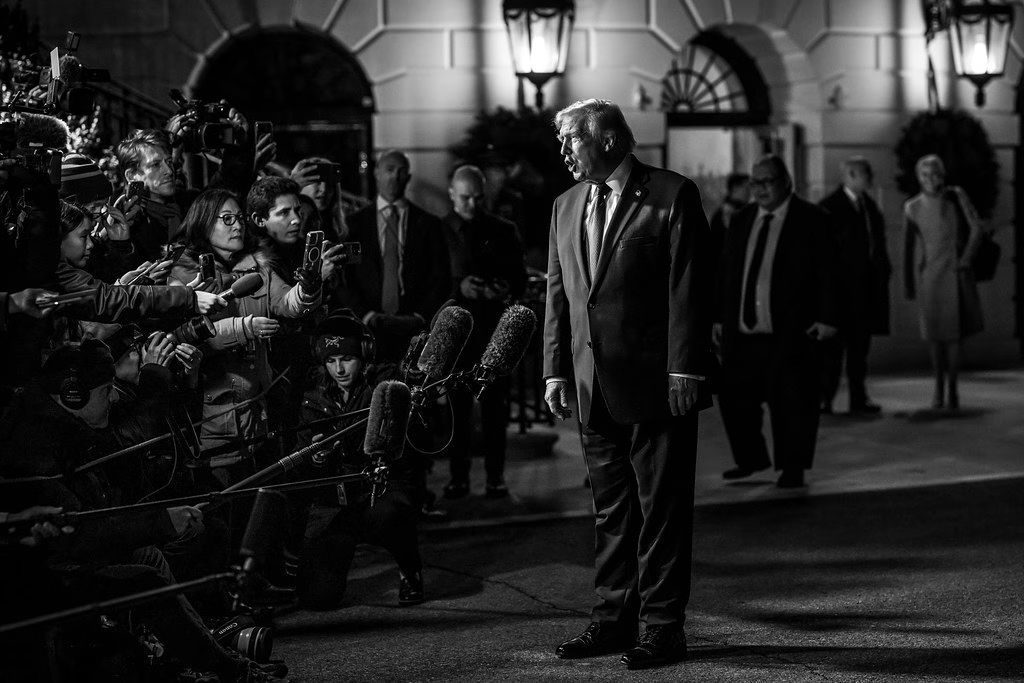
The President has been candid about his plans for responding to investigations from the House of Representatives, which has been controlled by the Democrats since January. “We’re fighting all the subpoenas,” Trump said, last month, and the pace of his defiant actions has since quickened. The President and his Administration have defied congressional inquiries about security clearances, access to the full Mueller report, the President’s bank records, his tax returns, and the continuing investigation of his campaign’s ties to Russia. (This week, it was revealed that the Republican-led Senate Intelligence Committee has subpoenaed the President’s oldest son, Donald Trump, Jr., to testify before it again.) No White House documents have been produced to Congress; after the Attorney General, William Barr, made a contentious appearance before the Senate Judiciary Committee, last week, no other Administration officials have agreed to testify.
I fear Toobin undermines his case by conflating the personal and the public. Access to Trump’s personal financial information—and even his campaign and his son—are of a completely different piece from Congress’ ability to conduct oversight of the Executive agencies. And Trump is on much firmer ground in resisting the former.
Furthermore, while I agree with Doug Mataconis that Trump’s claims of Executive Privilege regarding the Mueller report are weak, Congress isn’t in fact entitled to see it in its entirety. Portions, including grand jury information, are supposed to be shielded. Attorney General Barr has made a less-redacted version available to select leaders, which the Democrats are boycotting on principle. Regardless, our system has a way to solve these sort of disputes: taking the matter to court. Toobin admits as much:
Disputes between the executive and legislative branches about document production and witness testimony invariably wind up before the judiciary, and judges look at these disputes on a case-by-case basis. If the courts proceed this way, the quality of the Trump Administration’s claims vary. For example, the Justice Department has a pretty good argument to withhold portions of the Mueller report from the Judiciary Committee. The law requires federal prosecutors to protect grand-jury secrets and to safeguard the integrity of pending investigations—and courts might well honor the Administration’s position to keep that redacted information from Congress. On the other hand, the argument made by the Treasury Department to withhold the President’s tax returns from the House Ways and Means Committee seems almost frivolous. The law could not be clearer. It states, “Upon written request from the chairman of the Committee on Ways and Means . . . the Secretary shall furnish such committee with any return or return information specified in such request.” Sometimes laws mean what they say: “shall furnish” means “shall furnish.”
Toobin is being disingenuous here. While the law requires Treasury to furnish tax returns on demand, it also requires a legitimate legislative purpose. The administration contends that a fishing expedition into the President’s personal finances does not qualify. I think Congress has the better case here but, again, that’s a matter for the courts to decide.
This kind of case-by-case approach has worked reasonably well in the past, even in contentious political environments. The Republican-controlled House of Representatives battled the Obama Administration over the coöperation of the Attorney General, Eric Holder, with an investigation of Operation Fast and Furious, a gun-trafficking program. The Democratic House struggled with the George W. Bush Administration over access to information about the firing of United States Attorneys. But this approach by the courts—adjudicating one Administration claim of defiance at a time—will miss the point in the current era. There has never been a President who directed an open campaign of total defiance against another branch of government. It is simply misleading to consider these claims in isolation from one another, because the President has acknowledged that they are part of a coördinated campaign. The law has no clear mechanism for adjudicating these claims together—but they belong together. Trump is leading a political campaign, and it calls for a political, not just judicial, response.
I’m not persuaded by this argument. All of the matters here are related in the sense that they amount to the President trying to make it difficult for Congress to investigate him. That’s obviously frustrating. But, so far as I’m aware, Trump is not routinely denying Congress the ability to conduct oversight of matters of public policy unrelated to his personal corruption.
And, of course, lawsuits aren’t the only tool Congress has at its disposal. Toobin anticipates this objection:
The most obvious political response to Trump’s defiance of Congress—and thus of the norms of constitutional history—is impeachment. One article of impeachment against President Richard Nixon accused him of failing “without lawful cause or excuse to produce papers and things as directed by duly authorized subpoenas.” But the Trump Administration is likely to fight all subpoenas in court and wait for resolution there; only then will it be possible to say whether the resistance to all subpoenas is “without lawful cause.” And these cases will drag on. Indeed, Administration lawyers know that bad arguments, as well as good ones, can tie up the courts for months, if not years. (The litigation over Holder and the Fast and Furious documents just ended—after seven years.) Democratic leaders in the House are already skeptical, for political reasons, of pursuing impeachment, and lingering, unresolved disputes in the courts will make a push to remove the President even less likely.
Again, this is unpersuasive. First, the fact that the previous administration successfully ran out the clock on Fast and Furious demonstrates how normal it is for administrations to fight what they perceive as partisan Congressional attempts to investigate them. Second, the notion that Congress can’t impeach the President for refusing to comply with subpoenas until the matters play out in court is absurd; they themselves are the arbiter of whether there’s a lawful cause.
So, after nearly two and a half centuries, Trump will create a new constitutional norm—in which the executive can defy the legislature without consequence. The only likely remedy, therefore, will lie with the voters, next year.
I’m going to go out on a limb here and predict that Trump’s recalcitrance in the face of Congressional attempts to investigate his personal finances won’t be the deciding issue in the 2020 race.
I share Toobin’s belief that the Framers never envisioned a Donald Trump wielding the Presidency. But he’s simply wrong that Congress lacks the Constitutional power to deal with the situation. They could impeach him at any time. They could refuse to fund his programs until he bends to their wishes. That they lack the votes to do either of these things isn’t a failure of the Constitutional system, it’s a political standoff.