 It never fails that, as Election Day draws close, the supporters of the candidate trailing in the polls start telling us that the polls aren’t accurate. Part of this is Pauline Kaelism, with most people associating with likeminded people and therefore floored that more than half the country could possibly prefer the other guy when everyone they know supports their guy. Part of it is selective memory of past polling.
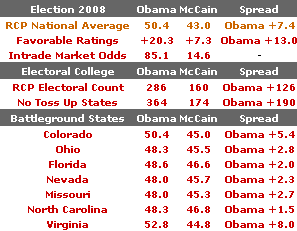
RealClearPolitics, a Republican-leaning site which popularized the aggregation of polls to minimize variation among individual surveys, shows Obama with a wide national lead and leading each and every battleground state. Further, every single national poll shows Obama ahead; the only question is by how much.
The new NBC/Wall Street Journal poll, the public survey I most trust (both because I know Neil Newhouse personally but also because both he and his Democratic cohort, Peter Hart, make their living doing survey research for high level political candidates and therefore have to get it right) has Obama up 10 among registered voters and up in every category that decides elections: “Obama’s current lead is also fueled by his strength among independent voters (topping McCain 49 to 37 percent), suburban voters (53 to 41), Catholics (50 to 44) and white women (49 to 45).” A new Pew poll also has Obama’s lead widening and, more importantly, showing increasing doubt about McCain’s age, judgment, and campaign style.
Ann Coulter recently argued that national polls historically undercout Republicans, an argument I’ve seen echoed in my comments section of late.
Reviewing the polls printed in The New York Times and The Washington Post in the last month of every presidential election since 1976, I found the polls were never wrong in a friendly way to Republicans. When the polls were wrong, which was often, they overestimated support for the Democrat, usually by about 6 to 10 points.
The trouble with that is she then demonstrates her conclusion by cherry picking individual polls that understated the final Republican vote count, choosing a Gallup poll here, an AP poll there, and a NYT poll elsewhere. When, though, was the last time that the aggregated polls were significantly off in a presidential election?
Michael Barone, a Republican-leaning analyst who’s nonetheless much respected for his insights, argues that yes, we can trust the polls but that we have to understand what we’re looking at. He’s right that polling is more art than science in close elections. There are always judgment calls to be made and this contest brings up several known unknowns.
- Are the likely voter screens any good? This is perhaps the hardest job professional pollsters have. It’s very difficult to distinguish attitude from action. Everyone who says they’ll vote for a given candidate won’t. This election, with it’s “enthusiasm gap” makes it especially difficult. Usually, we figure that if people have voted in previous elections, they’ll vote this time and, if they haven’t voted before, they won’t do it this time, either.
- Will Obama’s young supporters actually turn out? They usually don’t but they seem unusually enthusiastic this go-round.
- Will people actually vote for the black guy when it comes down to it? All indications are that they will and serious analysis of the “Bradley effect” seems to undercut the idea that it ever existed.
- Will the polls themselves affect the outcome? Will would-be McCain voters sit out the election, depressed by the conventional wisdom that their guy has lost? Will there be a bandwagon effect with undecidededs swinging toward Obama so they can be on the winning side? Will Obama supporters get overconfident and not show up? Will these factors cancel each other out? We honestly don’t know.
- Will early voting impact the race? I voted last Friday in Virginia, a battleground state. There was a short line. Many states now allow early balloting, either in person or by mail. We really don’t know what this means for the dynamics of the race. The conventional wisdom, though, is that it helps the Democrats. First, Democrat-leaners are less likely to show up on Election Day and wait in line. Anything that makes it more convenient to vote, then, should help the Democrats. Second, Obama has been ahead for a while. People who vote for him now can’t be affected by McCain’s advertising or his next “Hail Mary” play.
These factors and others are hard to calculate. The bottom line, though, is that Obama has a significant lead both nationally and in the state-by-states. For McCain to win, the pollsters are going to have to be wrong in quite a few states — or voter attitudes are going to have to change significantly in less than two weeks.
UPDATE: Rick Moran argues, in a post titled “THE GOP AND THE ‘DEAD PARROT’ SCENARIO,” that the best bet is that the polls understate Obama’s numbers. For those looking for a more upbeat assessment, D.J. Drummond provides it with “Gallup and New Coke.” I share Andrew Sullivan‘s assessment of the latter, unfortunately.