


People often complain that you cannot trust anonymously-sourced news content. However, business leaders are willingly going “on record” to talk about the impact of the trade tariffs Donald Trump has consistently promised to implement if he is elected President. Today’s Washington Post goes into detail about how they are already planning to raise prices if those wide-reaching consumption taxes tariffs are put in place. From the article:
Across the United States, companies that rely on foreign suppliers are preparing to raise prices in response to the massive import tariffs that former president Donald Trump promises if he wins the election Tuesday.
Producers of a range of items, including clothing, footwear, baby products, auto parts and hardware, say they will pass along the cost of the tariffs to their American customers.
The planned price increases next year would come as consumers are beginning to enjoy relief from the highest inflation in four decades and directly contradict Trump’s repeated assurances that foreigners will pay the tariff tab.
“We’re set to raise prices,” Timothy Boyle, chief executive of Columbia Sportswear, said in an interview. “We’re buying stuff today for delivery next fall. So we’re just going to deal with it and we’ll just raise the prices. … It’s going to be very, very difficult to keep products affordable for Americans.”
[…]
“A consistent theoretical and empirical finding in economics is that domestic consumers and domestic firms bear the burden of a tariff, not the foreign country,” according to an analysis by the nonpartisan Budget Lab at Yale University.
Executives at AutoZone, an auto parts retailer, told investors this month they were prepared for products they import to become more expensive. The company’s top suppliers include companies in India, China and Germany, according to a June press release.
“If we get tariffs, we will pass those tariff costs back to the consumer,” Philip Daniele, CEO of AutoZone, said on a recent earnings call. “We’ll generally raise prices ahead of — we know what the tariffs will be — we generally raise prices ahead of that.”
This should surprise no honest person who has been following this issue. Despite Trump’s constant lies, foreign governments do not and never have paid tariffs. Generally speaking, while the people importing the goods could, in theory, absorb those tariffs, that’s a tough pill to swallow in our “maximize shareholder value” era.
And Trump’s supporters are not denying this. The best counter most have is that perhaps he won’t follow through on a core campaign promise. That’s also the hope of some business leaders too. From the same Washington Post article:
By December, some of Acme United’s Westcott brand products, such as rulers and paper trimmers, will be made in Thailand and the Philippines, allowing them to escape tariffs aimed at China, CEO Walter Johnsen said on a recent earnings call.
The Shelton, Connecticut-based company, which operates under multiple brands, also has shifted production of some first aid and medical products to India, Egypt and its U.S. factories in Florida, North Carolina and Washington state.
Johnsen said he was skeptical that Trump would actually follow through with his announced plans to increase tariffs on all U.S. imports. Taxing imported medical products, including medicines, for example, would be too disruptive for the U.S. health-care system, he said.
“The hospitals would come to a halt. So it’s highly unlikely, in my view, that 60 percent tariffs are even remotely going to be real, but it’s a negotiating point,” he told investors.
Likewise, on a recent trip to China, Sebastien Breteau, CEO of QIMA, which conducts worldwide factory inspections and audits for major retailers, found few Chinese suppliers who believed Trump would implement what he has promised.
“He’s a man who can change [his] opinion 10 times in a day. So people don’t believe him. People don’t believe Trump is going to raise tariffs by 60 percent,” said Breteau, whose clients include Costco and Walmart.
Based on his past behavior, believing that Trump will back off of a core policy for being “too disruptive” seems unlikely to me. That’s a position I apparently share that position with Trump supporter and funder Elon Musk. He’s also warning Trump’s followers to be prepared for some immediate economic pain:
With just a week until the presidential election, Donald Trump’s close ally and major economic adviser Elon Musk is warning supporters to expect economic chaos, a crashing stock market and financial “hardship” — albeit only “temporary” — if Trump wins.
It sounds so extreme that Trump fans must either wonder why he had been so foolish as to say the silent part out loud, or maybe hope that the whole story is made up — “fake news.”
But it’s very real.
Billionaire Musk, Trump’s would-be budget-cutting and government-efficiency czar, also says there will be “no special cases” and “no exceptions” when he starts slashing federal spending after Trump takes office.
Speaking on a “telephone town hall” with supporters Tuesday, Musk promised deep federal budget cuts, austerity and economic pain ahead in a new Trump administration.
“We have to reduce spending to live within our means,” Musk said. “That necessarily involves some temporary hardship but it will ensure long-term prosperity.”
Granted in this case, Musk is speaking about cutting 2 trillion dollars in government spending, but it’s part of a large pattern of Trump proposed policy positions that apparently want to save the American Economy by killing it and, with it, many of Trump’s own supporters. See also the plans for mass deportations of farm workers, which would cost both American food producers and American consumers billions in the short term as well.
To that point, Musk doubled down on the “necessary economic hardship” on Twitter, agreeing to this “best case” scenario:
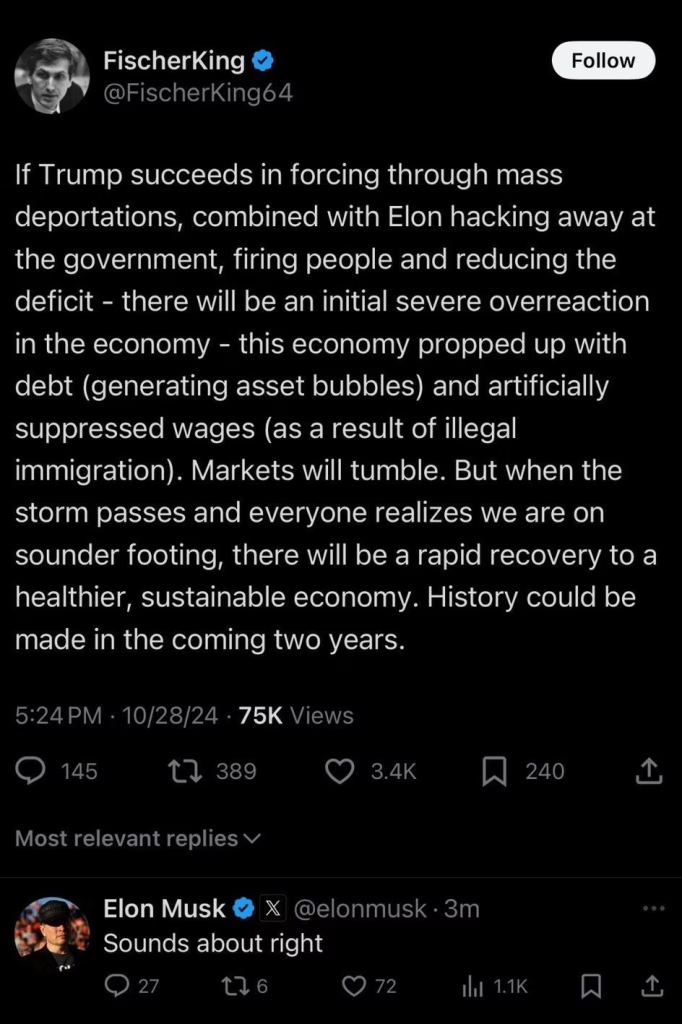
I know some anti-anti-Trump commenters will say “but this is only a short-term pain for a better America going forward.” My only response is to remind them of everything they have written about the inflation we experienced during the first few years of the Biden administration and how unacceptable it was.
Some may also suggest it will be fine because Trump will be tapping brilliant people like Elon Musk to help. And Musk promised things will turn around by the midterms in that discussion.
To that, I’ll gently remind them that Musk bought Twitter a little more than 2 years ago, and its financials haven’t significantly improved (according to some they have gotten worse). Tesla has done a little better; its stock price has still been essentially flat over the past two years (and spent some of that time at least $50/share underwater).
So I’m not exactly feeling comfortable taking his promises to the bank–especially when it’s setting up conditions for Elon to get even richer while a lot of Trump’s supporters (and many of the rest of us) continue to get poorer.
BTW, that’s all before we get to Speaker of the House Mike Johnson’s promise to finally get rid of Obamacare, which I’m sure will help reduce costs for those living at or near the margins.









