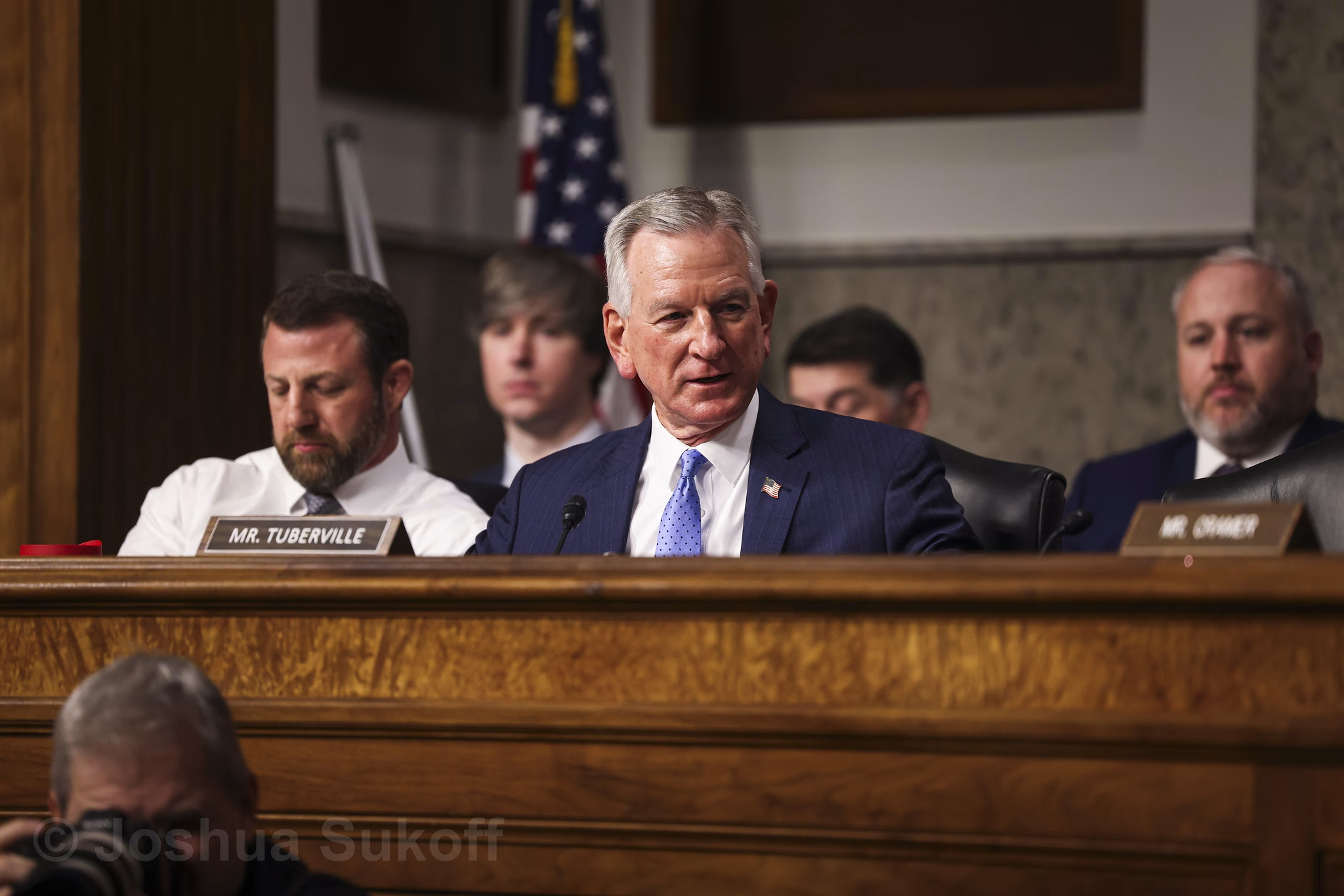
Political talk radio ratings in the Washington, D.C. metro area have plummetted since the November elections.
Local Listeners Tune Out Talk Radio (WaPo, C1)
What a difference an election makes. No, we’re not talking about the fortunes of a rich and powerful democracy. This is about talk radio. And even in the nation’s capital, post-election, people seem to have had their fill of politically oriented talk on the airwaves. The latest quarterly audience ratings spell it out: Local talk stations — both on the right and on the left — saw their audiences dwindle during the January-March period, according to Arbitron Inc.
WMAL-AM (630), home of Rush Limbaugh, Sean Hannity and other mighty righty talkers, was one of the big losers in the latest survey. WMAL lost nearly 30 percent of its core audience (adults ages 25-54) from the preceding three months, when the election was the dominant story. What had been an up-and-coming station a few months ago (WMAL ranked 11th among all stations during the fall) is now a middle-of-the-pack afterthought (it tied for 16th in the latest survey). “For those of us in news and talk, there’s nothing like an election,” says Chris Berry, WMAL’s president and general manager. “It’s like the Super Bowl. For us, the Super Bowl wasn’t in January; it came in November.”
WMAL was at least able to record some ratings. Two of its AM talk competitors, WTNT (570) and WRC (1260), barely registered. WTNT — which features conservatives Laura Ingraham and Joe Scarborough — captured an average of just 0.5 percent of the Washington area’s 2.3 million adult (25-54) listeners; it finished in a tie for 26th. WRC, which turned to a liberal talk format in January by adding Al Franken and some of his “Air America” crew, was nowhere to be found. It captured less than 0.1 percent of the audience, too low to be counted.
One wonders how these ratings compare to comparable periods. It’s not surprising that casual interest in political talk would decline after the election, just as ratings for televised golf dip for non-Majors.
Still, the local talk radio offerings are rather weak. There are three NPR stations and C-SPAN radio available, which is a plus. In terms of commercial stations, though, there’s not much to pick from. During morning drive, the only nationally-syndicated political talk show is Don Imus, which is often entertaining but also often aggravating as the host indulges his sometimes odd non-political interests. I’m not a Howard Stern listener, so the only talk alternative is AM 870’s feed of the Mike & Mike ESPN program.
I’m seldom able to catch much of the midday offerings, but they’re rather slim as well. Laura Ingraham competes with Tony Kornheiser in the 9-noon slot and noon-3 is Rush Limbaugh and Joe Scarborough. G. Gordon Liddy, Ken Hamblin, and other nationally prominent shows are not available. This is particularly odd in the case of Liddy’s show, which originates locally but was only partially carried via tape delay until his replacement with Scarborough.
From 3-6 there’s a tape delay of Glenn Beck’s very uneven show, which is sometimes about politics and sometimes not, and Sean Hannity. I can seldom take Hannity for long and Beck’s show is only interesting on a topical basis. Indeed, I usually wind up listening to retired Georgetown basketball coach John Thompson’s show or something on C-SPAN instead.
The early evening selection is limited to Michael Savage, who is highly intelligent but more highly deranged, and local offerings like Chris Corr. There’s a reason local hosts are local.
Update: Via Michelle Malkin, I see Tom Blumer thinks the rising popularity of blogs may be a partial explanation for this phenomenon, which is not just relegated to D.C. It could well be, although I listen to talk radio almost exclusively while driving or getting ready for work. Come to think of it, though, I used to listen to talk radio when I was on the computer and haven’t done that since I started blogging.
(1400): D.C. area radio talk host Cam Edwards observes,
Blogs are great, don’t get me wrong. But sometimes I think certain quarters of the blogosphere thinks 5 years from now they will have replaced newspapers, talk radio, and the network news. It’s not going to happen. TV didn’t kill radio, cable didn’t kill network television, and the blogs aren’t going to kill off any other form of media. It will be another source, but not a sole source of information.
Quite right. Reading a blog is a different experience than listening to talk radio. Reading blogs while driving would be a bad idea! That doesn’t mean that blog reading (or iPod listening, or whatever) couldn’t be taking a small bite out of talk radio listening. But I suspect this decline is mostly issue-driven. Indeed, blog readership rises and falls rather dramatically with events in the news.