

WaPo (“Pentagon to review Medals of Honor awarded for Wounded Knee massacre“):
Defense Secretary Lloyd Austin has directed the Pentagon to review 20 Medals of Honor awarded for actions during the 1890 Wounded Knee massacre,in which the U.S. Army’s 7th Cavalry opened fire on hundreds of Native Americans, including women and children.
The effort is meant to ensure no troops were recognized for “conduct inconsistent with the nation’s highest military honor,” the Defense Department said in a Wednesday news release. Disqualifying actions include attacking civilians or combatants who already surrendered, murder, rape, and “engaging in any other act demonstrating immorality,” Austin wrote in a July 19 memo directing the review.
The news, first reported by Military.com, follows requests from South Dakota state lawmakers and members of Congress, and over two decades of pressure from Native American groups.
“The fact that the title of the event is ‘massacre’ would not seem to be the kind of thing you award medals for,” said South Dakota state Sen. Lee Schoenbeck (R), who helped oversee a state resolution earlier this year calling for an official inquiry into the awards. “It’s time to get it right.”
On Dec. 29, 1890, U.S. Army soldiers killed an estimated 350 Lakota people in the southwest corner of South Dakota in what is now part of the Pine Ridge Reservation. Historians believe the event was preceded by a single shot stemming from a disagreement between the soldiers and Native American warriors they were attempting to disarm.
“I have never heard of a more brutal, cold-blooded massacre than that at Wounded Knee,” Maj. Gen. Nelson A. Miles, who was an Army commander during the American Indian Wars, wrote in a November 1891 letter. Miles wrote that women, small children and babies were among the dead.
The citations for some troops who were awarded the Medal of Honor, the military’s highest honor, after the massacre are simply for “bravery” or for continuing to fight while wounded, according to the Defense Department memo.
Criteria for awarding Medals of Honor during the Indian Wars was subject to much less scrutiny compared to today, when the process can take years. More than 425 Medals of Honor were awarded for action during that campaign, according to the Department of Veterans Affairs.
During the Civil War, the lack of stringent award oversight contributed to veterans receiving the highest number of Medals of Honor ever — over 1,500 — compared to veterans of later conflicts, according to VA. In some cases, recipients were awarded a medal for recapturing unit flags.
Today, the Medal of Honor is awarded based on criteria drafted in 1963, and is reserved only for troops who are distinguished by the highest level of bravery and who risk their lives while fighting against an enemy of the United States.
As a general rule, the practice of going back into history to decide whether actions decades—in this case more than a century—ago deserved medals is rather bizarre. This is especially true in this case for two reasons: a radically different view of the Indian Wars than existed at the time and the fact that the “Medal of Honor” is simply not the same medal as it was then.
Was the Wounded Knee massacre an awful event that is a stain on our national honor? Of course. Hell, pretty much the entirety of American settlement and westward expansion was characterized by what would now be considered horrendous war crimes. But that certainly wasn’t the prevailing view at the time.
The nation, the Defense Department, and the Army have, quite rightly, recognized the horrors of the Indian Wars and “Wounded Knee” has, rightly, became shorthand for one of the darkest days in our history.
Regardless of the justness of the campaign—and Miles and other contemporaries questioned 7th Cavalry commander James Forsythe’s orders—individual soldiers can still fight valiantly in the defense of their comrades. (Forsythe was exonerated and eventually promoted to major general.) Here’s the Wikipedia summary:
- Sergeant William Austin, cavalry, directed fire at Indians in ravine at Wounded Knee;
- Private Mosheim Feaster, cavalry, for extraordinary gallantry, advancing to an exposed position and holding it;
- Private Mathew Hamilton, cavalry, for conspicuous bravery in action against hostile Sioux Indians, at Wounded Knee Creek, South Dakota, on the 29th, and for coolness and bravery in action near the Catholic Mission, on White Clay Creek, South Dakota, on the 30th.;
- Private Joshua Hartzog, artillery, rescuing commanding officer who was wounded and carried him out of range of hostile guns at Wounded Knee;
- Private Marvin Hillock, cavalry, distinguished bravery in action against hostile Sioux Indians, near the Catholic Mission, on White Clay Creek, South Dakota (often misidentified as Wounded Knee due to a later error in War Department lists), continuing on duty though painfully wounded;[80][81]
- Sergeant Bernhard Jetter, cavalry, distinguished bravery at Wounded Knee for “killing an Indian who was in the act of killing a wounded man of B Troop.”
- Sergeant George Loyd, cavalry, bravery, especially after having been severely wounded through the lung at Wounded Knee;
- Sergeant Albert McMillan, cavalry, while engaged with Indians concealed in a ravine, he assisted the men on the skirmish line, directed their fire, encouraged them by example, and used every effort to dislodge the enemy at Wounded Knee;
- Private Thomas Sullivan, cavalry, conspicuous bravery in action against Indians concealed in a ravine at Wounded Knee;
- First Sergeant Jacob Trautman, cavalry, killed a hostile Indian at close quarters, and, although entitled to retirement from service, remained to close of the campaign at Wounded Knee;
- Sergeant James Ward, cavalry, for distinguished bravery in action against hostile Sioux Indians at Wounded Knee Creek, South Dakota, where, though severely wounded, he continued fighting;
- Private Herman Ziegner, cavalry, for conspicuous bravery in an attack on hostile Sioux Indians, concealed in a ravine at Wounded Knee Creek, South Dakota, on the 29th, and again near the Catholic Mission, on White Clay Creek, South Dakota, on the 30th, in defense of the crest of a hill against a force of hostile Sioux Indians;
- Musician John Clancy, artillery, twice voluntarily rescued wounded comrades under fire of the enemy;
- Lieutenant Ernest Garlington, cavalry, distinguished gallantry;
- First Lieutenant John Chowning Gresham, cavalry, voluntarily led a party into a ravine to dislodge Sioux Indians concealed therein. He was wounded during this action.
- Second Lieutenant Harry Hawthorne, artillery, distinguished conduct in battle with hostile Indians;
- Private George Hobday, cavalry, conspicuous and gallant conduct in battle;
- First Sergeant Frederick Toy, cavalry, for conspicuous bravery and coolness in action against hostile Sioux Indians;
- Corporal Paul Weinert, artillery, taking the place of his commanding officer who had fallen severely wounded, he gallantly served his piece, after each fire advancing it to a better position;
- Private Adam Neder, cavalry, for bravery in action against hostile Sioux Indians, at Wounded Knee Creek, South Dakota, where he was wounded
On cursory examination, almost all of the descriptions strike me as legitimately valorous.
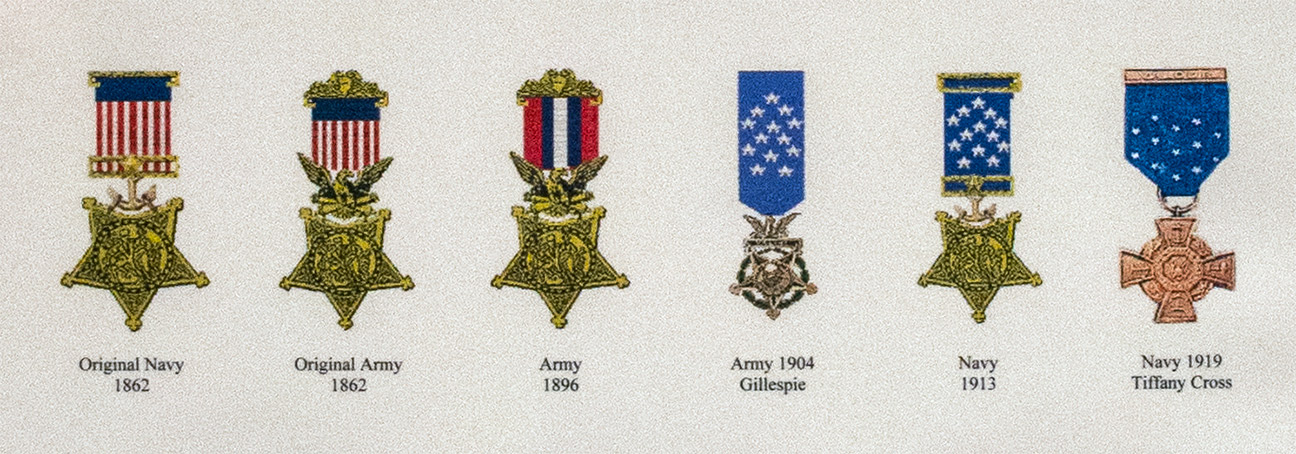
Crucially, while the men were awarded “the Medal of Honor,” it is not remotely the same award as the one that goes by the same name today. The Navy version was created in December 1861 and the Army followed suit in July 1862. It was the only award available for valor and, indeed, through World War I, the only one available to recognize individual achievement of any kind.*
After the Civil War, Congress made the award permanent, and it was awarded quite generously by modern standards. Indeed, it was frequently awarded for heroism outside of combat, such as rescuing comrades during a fire aboard ship. Which makes sense because, again, it was the only personal award available. Nineteen individuals were double recipients, one for actions that took place in the span of less than a week. Richard Byrd was awarded the Medal for reaching the North Pole!
This all changed with World War One when two additional medals for combat gallantry were added: the Distinguished Service Cross (Army)/Navy Cross (Navy-Marine Corps) and the Silver Star. In 1926, the Distinguished Flying Cross was created. Near the end of World War II (1944), the Bronze Star was added.
Oh, and the Army created the Soldier’s Medal in 1926 to recognize “heroism not involving actual conflict with an enemy.” The Navy actually continued awarding Medals of Honor for that purpose, although quite rarely, until following suit with the Navy and Marine Corps Medal in 1942.
In living memory, then, the Medal of Honor is an exalted award reserved for only the highest levels of combat valor. Indeed, even the Distinguished Service/Navy/Air Force Cross is an exceedingly high award, rarely seen. We’ve even gotten rather stingy with the Silver Star. The Medal of Honor has become almost anticlimactic, often requiring years of bureaucratic vetting, resulting in the award being hung on the neck of a member long after he has left the service. (Assuming he’s alive at all.)
We should simply think of pre-WWI Medals of Honor as a different award that happens to have the same name.
UPDATE: A comment from Dr. Dwight Sears has changed my view on this significantly. See “Wounded Knee Medals Redux.”
*The National Archives notes, “The only medal that the War Department officially awarded during the Civil War, Indian Wars, Spanish-American War, and Philippine Insurrection was the Medal of Honor. However, between 1905 and 1919, the War Department authorized several campaign medals for U.S. Army service between 1861 and 1902.”









